


Description
Who it’s for
The Mini 3 is for the first-time pilot who wants a camera that will still look good once the novelty wears off. It sits between DJI’s cheapest models and the Mini 4 Pro, and it gets you the same size of sensor as the Pro models for roughly half the money. If you are buying a drone for travel photos, family video or learning the basics, and you would rather not register anything with the FAA, this is where we would start most people.
It does not suit pilots who fly near trees, buildings or people on a regular basis. With no forward or rear obstacle sensing, the Mini 3 relies entirely on you to avoid what is in front of it.
Design and build
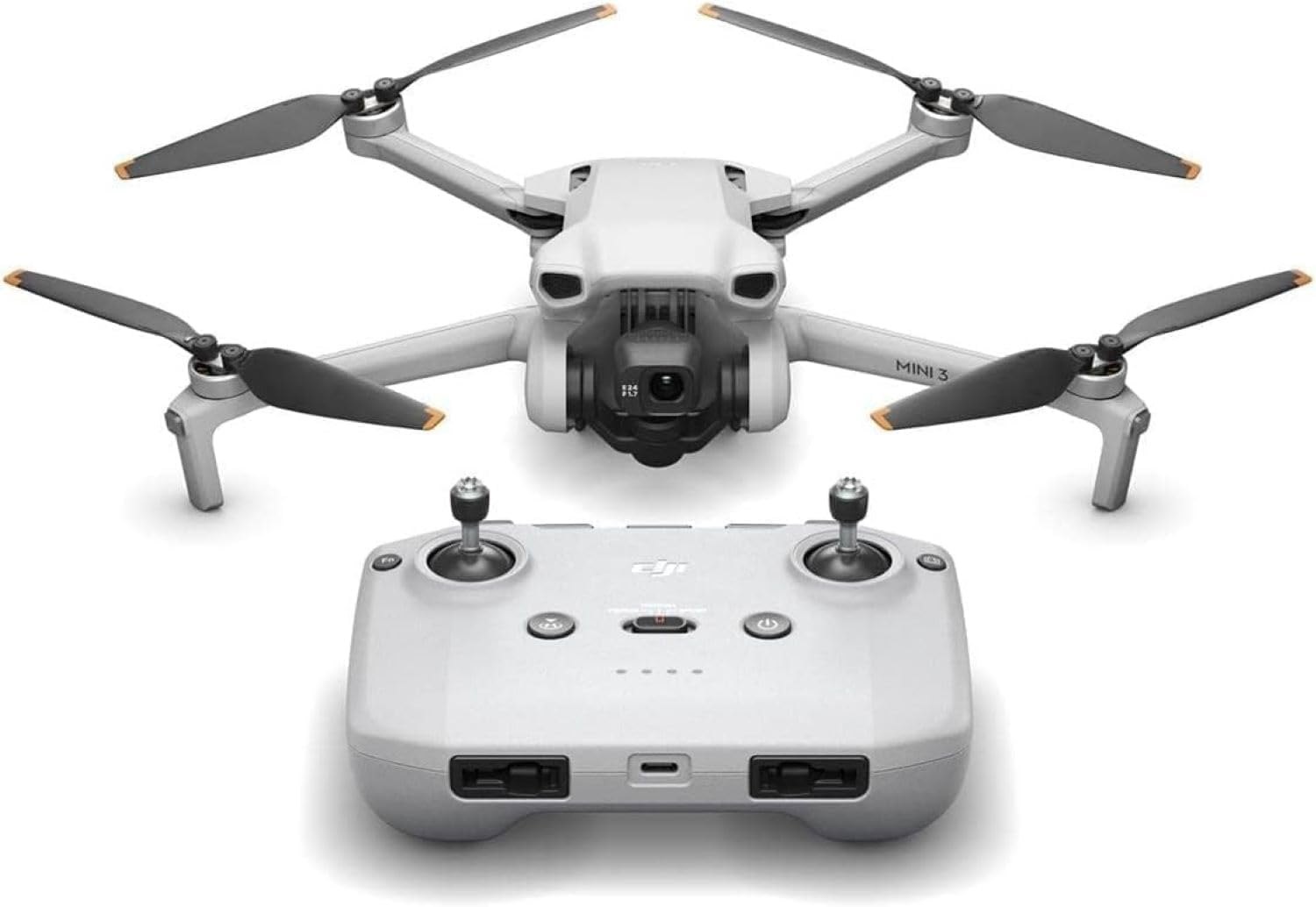
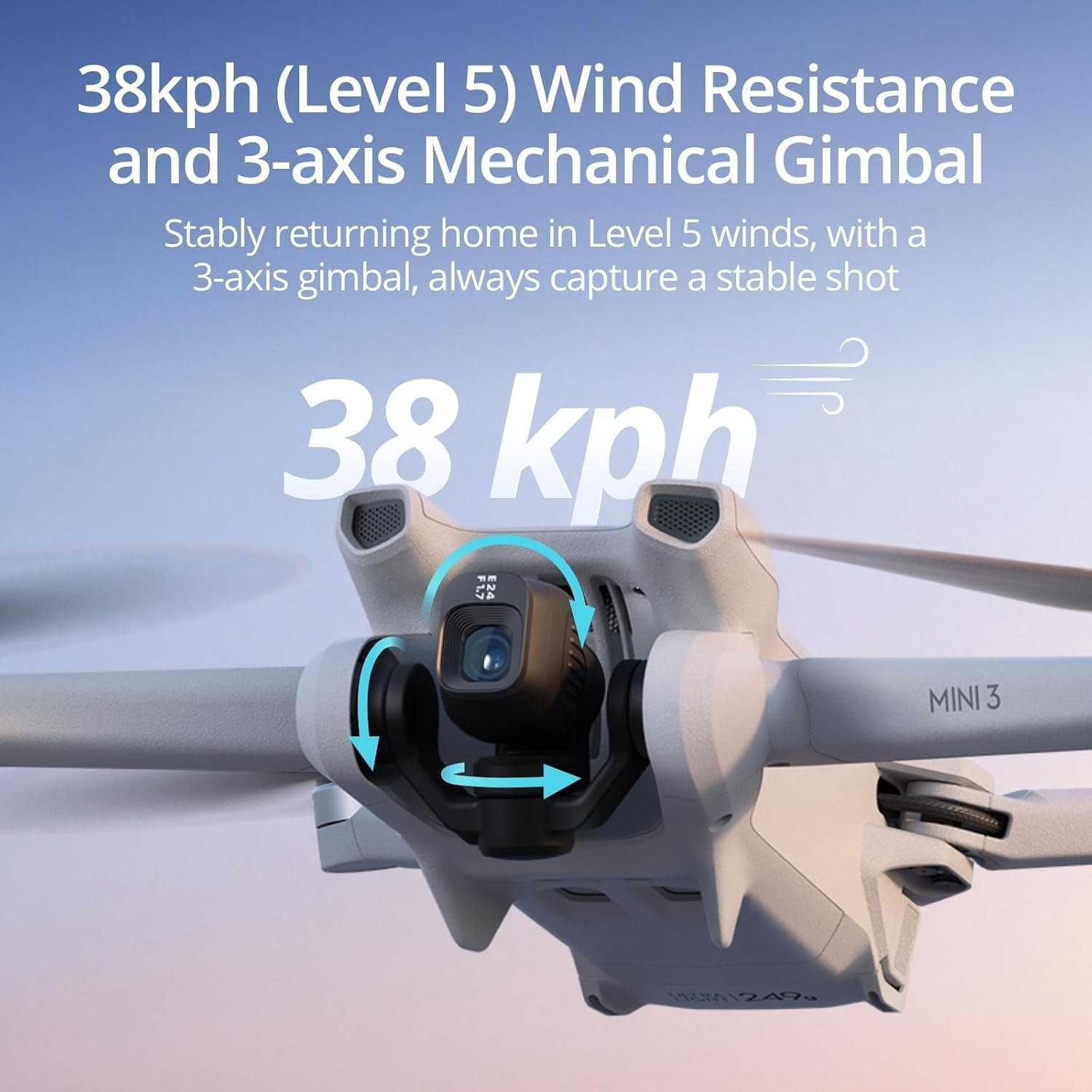
Folded, the Mini 3 measures 148 by 90 by 62 mm and weighs 248 g with the standard battery. It looks almost identical to the Mini 3 Pro, minus the pair of forward-facing sensors on the nose. The gimbal rotates 90 degrees, which means vertical video uses the full sensor rather than a crop, a genuinely useful feature if most of your clips end up on a phone screen.
The base kit comes with the RC-N1 controller, one battery, spare propellers and the cables for your phone. There is no internal storage, so budget for a microSD card. DroneXL notes that the propellers attach with small screws rather than quick-release mounts, which is a minor annoyance when you need to swap a chipped blade in the field.
Camera and flight
The camera is a 1/1.3-inch, 48 MP sensor behind a 24 mm equivalent f/1.7 lens, with dual native ISO. Video tops out at 4K/30 with HDR, and 2.7K and 1080p run to 60 fps at up to 100 Mbps. There is no 10-bit log profile, so footage is meant to look good straight out of the drone rather than be graded heavily.
On paper this is a better imaging package than most drones at this price, and the bigger sensor matters most in the hour around sunrise and sunset, when smaller-sensor budget drones start to smear detail.
Flight time is the other headline. DJI rates the standard battery at 38 minutes, and the Intelligent Flight Battery Plus at 51 minutes, though the Plus battery pushes the drone to about 290 g and into registration territory. Wind resistance is rated at 10.7 m/s, and the top speed is 16 m/s.
Transmission uses DJI’s older O2 system, rated to 10 km under FCC rules. DroneXL describes the 720p/30 live feed as a little fuzzy, which matters if you frame shots carefully on the phone screen. It is good enough to fly with, but you will not judge focus from it.
Living with it
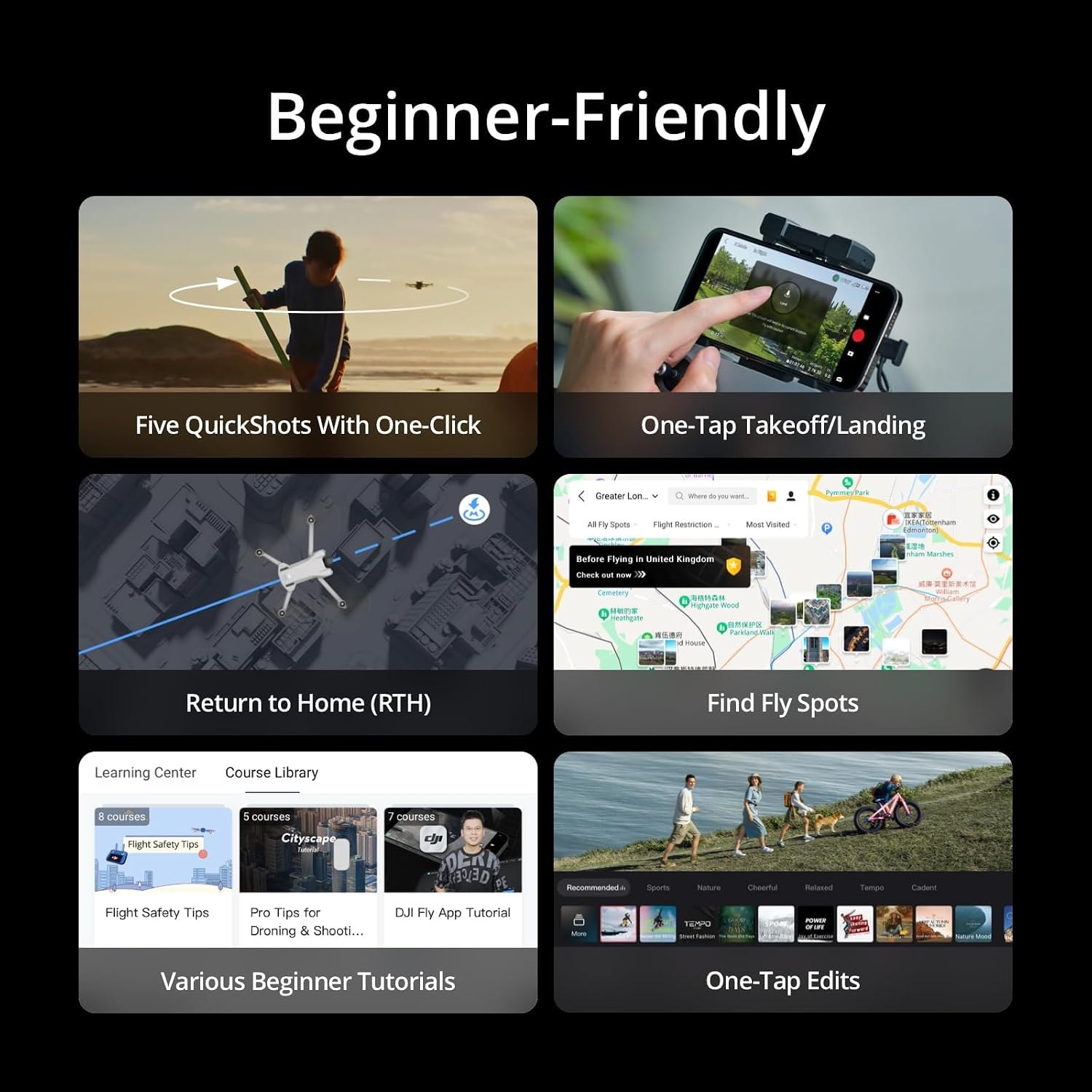
Everything runs through the DJI Fly app. Since the app was pulled from Google Play, Android users install it from DJI’s website, which is a one-time hassle.
The regulatory picture is straightforward for this model. The Mini 3 received FCC authorization in 2022, well before DJI was added to the FCC Covered List in December 2025, so it remains legal to sell, buy and fly. DJI USA lists it as in stock at the time of writing. The FCC has floated further limits on sales of some previously approved drones, but drones you already own are not affected.
Value for money
At the time of writing DJI USA sells the Mini 3 with the RC-N1 for $419, with the DJI RC version at $549 and the Fly More Combo with DJI RC at $719. Amazon has been the better place to buy: DroneXL tracked the base kit at $315 over Labor Day and $269 during Prime Big Deal Days in October 2026.
At under $300 the Mini 3 is very hard to beat. At full price, it is closer to the Mini 4K than its camera deserves, but the gap in obstacle sensing to the Mini 4 Pro is large.
Alternatives
- DJI Mini 4K is the cheaper option if 4K is all you need and you can accept a smaller 1/2.3-inch sensor and shorter flight time.
- DJI Flip costs a little more but adds full propeller guards, forward sensing and 4K/100 video.
- DJI Mini 4 Pro is the step up for omnidirectional obstacle sensing and 10-bit video, if you can find it in stock.
The bottom line
The Mini 3 is still one of the smartest first drones you can buy in the US: a large sensor, long flights and no registration, at a price that regularly dips below $300. Just remember that it will not stop for a tree, so fly in open space until your skills catch up.
.gap-review{margin:2.5rem 0 0}.gap-review h2{font-size:1.5rem;margin:0 0 1.25rem}.gap-verdict{background:#0E1A2B;color:#fff;border-radius:16px;padding:1.5rem 1.75rem}.gap-verdict__head{display:flex;gap:1.25rem;align-items:center}.gap-score{margin:0;width:84px;height:84px;border-radius:50%;background:#FF5A1F;color:#fff;display:flex;flex-direction:column;align-items:center;justify-content:center;font-weight:800;font-size:1.9rem;line-height:1}.gap-score small{font-size:.7rem;font-weight:600;opacity:.85}.gap-eyebrow{margin:0 0 .35rem;text-transform:uppercase;letter-spacing:.08em;font-size:.75rem;font-weight:700;color:#FF5A1F}.gap-verdict__line{margin:0;font-size:1.125rem;line-height:1.45}.gap-proscons{display:grid;grid-template-columns:1fr 1fr;gap:1.25rem 2rem;margin-top:1.5rem;padding-top:1.25rem;border-top:1px solid rgba(255,255,255,.15)}.gap-proscons h3{margin:0 0 .6rem;font-size:.9rem;text-transform:uppercase;letter-spacing:.05em;color:inherit}.gap-proscons ul{list-style:none;margin:0;padding:0}.gap-proscons li{position:relative;padding-left:1.6em;margin:0 0 .45em}.gap-proscons li::before{position:absolute;left:0;top:0;font-weight:800}.gap-pros li::before{content:’+’;color:#4ADE80}.gap-cons li::before{content:’2013′;color:#F87171}.gap-specs,.gap-faq{margin-top:2rem}.gap-specs h3,.gap-faq h3{font-size:1.2rem;margin:0 0 .75rem}.gap-specs table{width:100%;border-collapse:collapse;font-size:.95rem}.gap-specs th,.gap-specs td{text-align:left;padding:.65rem .9rem;border-bottom:1px solid #E2E8F0;vertical-align:top}.gap-specs th{width:38%;background:#F4F6F9}.gap-faq details{border:1px solid #E2E8F0;border-radius:10px;padding:0 1rem;margin:0 0 .6rem}.gap-faq summary{cursor:pointer;padding:.85rem 0;font-weight:600}.gap-cta{margin-top:2rem;padding:1.25rem 1.5rem;background:#F4F6F9;border-radius:16px;display:flex;flex-wrap:wrap;gap:.75rem;align-items:center}.gap-btn{display:inline-block;padding:.85em 1.5em;border-radius:10px;font-weight:600;text-decoration:none!important;background:#FF5A1F;color:#fff!important}.gap-btn–secondary{background:transparent;color:#0E1A2B!important;border:2px solid #E2E8F0}.gap-disclosure,.gap-note{font-size:.875rem;color:#4A5568;margin:.75rem 0 0}@media(max-width:640px){.gap-proscons{grid-template-columns:1fr}}
DJI Mini 3 review
8.2/10
madagear.com verdict
Buy it if you want the best image quality per dollar in a registration-free first drone; skip it if you need obstacle avoidance or subject tracking.
What we like
- 248 g with the standard battery, so no FAA registration for recreational flying
- Large 1/1.3-inch sensor with f/1.7 lens for its price class
- Up to 38 minutes per battery, 51 minutes with the Plus battery
- Gimbal rotates 90 degrees for true vertical video
- Frequent Amazon deals push the base kit well under list price
What we don’t
- Downward sensors only; no forward or rear obstacle avoidance
- No ActiveTrack subject tracking
- Video tops out at 4K/30 and 100 Mbps
- Live view is 720p/30 on the older O2 link
Specs at a glance
| Takeoff weight | 248 g (standard battery); about 290 g with Battery Plus |
|---|---|
| Folded size | 148 x 90 x 62 mm |
| Camera | 1/1.3-inch CMOS, 48 MP, 24 mm equivalent, f/1.7 |
| Video | 4K up to 30 fps; 2.7K and 1080p up to 60 fps; up to 100 Mbps |
| Flight time | Up to 38 min; 51 min with Intelligent Flight Battery Plus |
| Wind resistance | 10.7 m/s (Level 5) |
| Obstacle sensing | Downward vision only |
| Transmission | DJI O2, up to 10 km (FCC) |
| Max speed | 16 m/s |
| Storage | microSD only |
Frequently asked questions
Do I need to register the DJI Mini 3?
Not for recreational flying in the US with the standard battery, since it weighs 248 g. With the Intelligent Flight Battery Plus it goes over 250 g, so you must register it and use Remote ID. Recreational pilots still need the free TRUST certificate.
Is the DJI Mini 3 still legal to buy in the US?
Yes. It received FCC authorization in 2022, before DJI was added to the FCC Covered List in December 2025, so it can still be sold and flown. DJI USA and Amazon both list it at the time of writing.
What is the difference between the Mini 3 and the Mini 3 Pro?
The Mini 3 Pro adds forward and rear obstacle sensing, ActiveTrack, 4K/60 video and a faster O3 video link. The Mini 3 trades those away for a lower price and longer battery life.
Which controller should I choose?
The RC-N1 uses your phone as the screen and keeps the price down. The DJI RC has a built-in display, which is more convenient but adds about $130 to the base kit.
DJI USA list price with the RC-N1 controller. The DJI RC version is $549 and the Fly More Combo with DJI RC is $719. Amazon has dropped the base kit to $269-$315 during 2026 sale events. Price and availability checked on 2026-11-10.
madagear.com is reader-supported. When you buy through links on our site we may earn an affiliate commission, at no extra cost to you. This never affects what we recommend.


Reviews
There are no reviews yet.