



Description
Who it’s for
The Wolfwhoop WT03 is for people building or converting a very small aircraft and who need a first-person view feed without spending real money on it. That covers a few overlapping groups: someone adding a camera to a toy-grade quadcopter, someone assembling a micro brushed build from spare parts, and someone who wants a cheap spare to keep in the toolbox when a crash takes out the camera on their main micro.
It is not for anyone comparing it against modern digital FPV. The gap between a 600TVL analog camera and a digital system is enormous in image quality, and nothing about the WT03 narrows it. What this part offers instead is a low barrier to entry: a single board that produces video and broadcasts it, for less than the cost of a set of propellers on a larger machine.
It also suits the experimental end of the hobby. Because it is an all-in-one unit with simple wiring, it is easy to bolt onto something unusual, a fixed-wing foamie, a small ground vehicle, a camera on a pole, without redesigning the electronics around it. At this price, the consequences of breaking one are small, which matters more than it sounds when you are learning.
Design and build
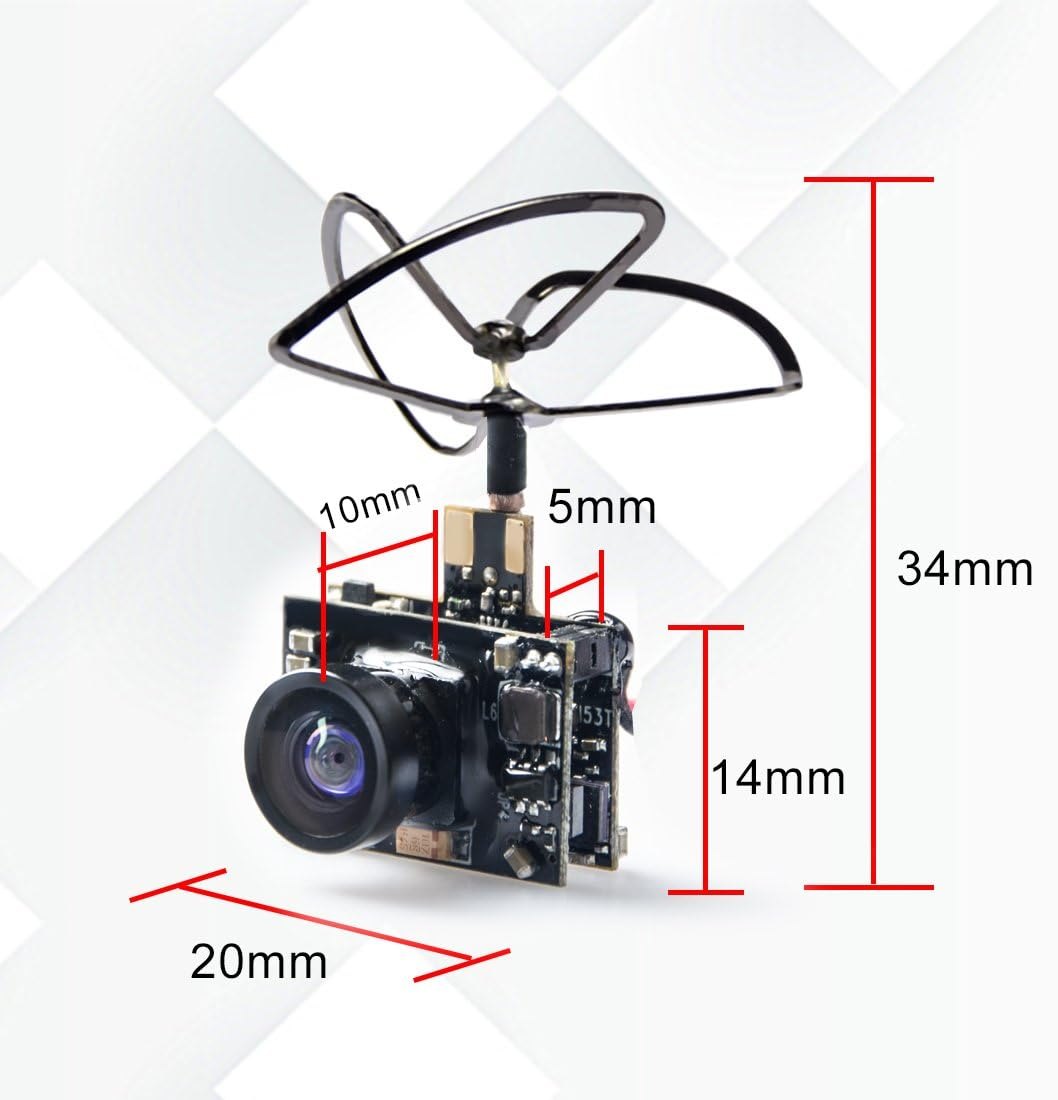
All-in-one FPV boards follow a familiar pattern, and the WT03 fits it: a small camera module on the front, the transmitter circuitry behind it, and an antenna lead coming off the back. Merging the two halves saves weight, saves a connector, and removes one of the more common points of failure in a micro build, the thin coax between a separate camera and VTX.
The listing describes it as black, micro-sized and lightweight, with no stated dimensions or mass. On a micro airframe, where every gram changes the flight time and the handling, the absence of a published weight is a genuine inconvenience. The general class of AIO unit this belongs to usually comes in well under ten grams with the antenna, but that is a category expectation rather than a figure from the maker.
The included cloverleaf antenna is the most interesting part of the package. Cheap FPV kits often ship with a plain dipole, which has an uneven radiation pattern and suffers badly from the polarization mismatch that happens when a drone banks. A circularly polarized cloverleaf handles that better and rejects multipath reflections off walls and the ground, which is exactly the environment a micro drone flies in. For an item at this price, bundling one rather than a dipole is the right call.
What the specs tell us
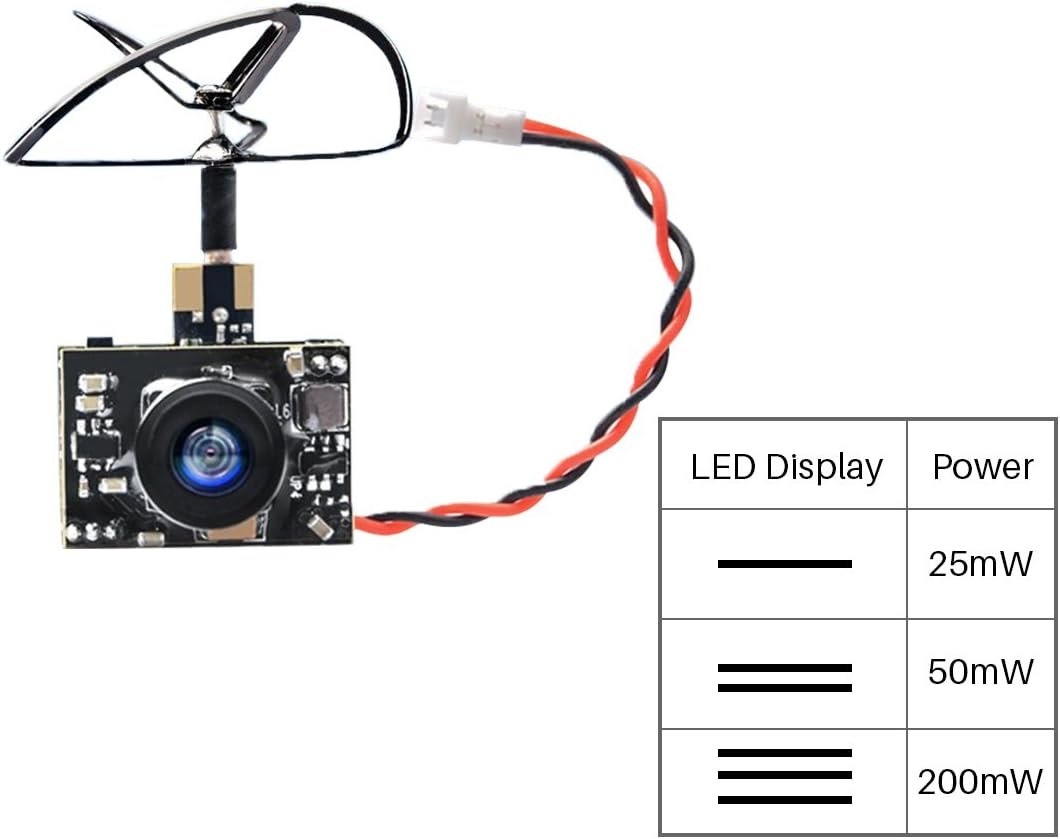
The headline numbers are 600TVL resolution, 5.8GHz transmission, and selectable output at 25mW, 50mW or 200mW. The 600TVL figure is the long-standing baseline for small analog cameras, enough to make out gaps, branches and doorways, and not much more. The adjustable power is useful: 25mW is the level most regions permit without any license consideration and the level you want indoors, where a stronger signal just bounces around and interferes with itself. The 200mW setting is there for open ground.
Two details in the specification table deserve scrutiny. The first is the maximum range of 50 meters. That is a very conservative figure for a 200mW 5.8GHz transmitter with a circularly polarized antenna, and it is likely quoted at the lowest power setting or through obstacles. Still, it is the number the maker publishes, and it frames the product honestly as something for flying nearby rather than pushing out to distance.
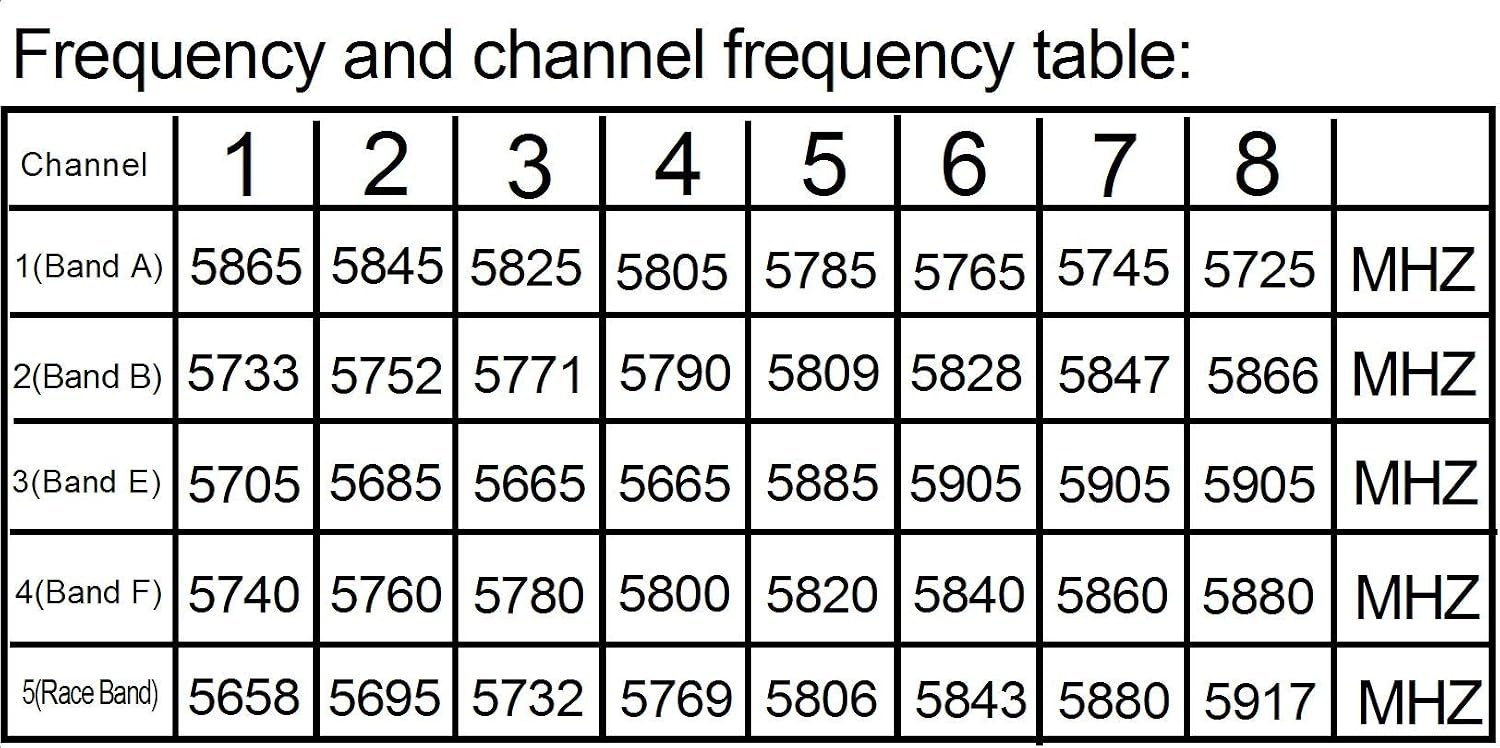
The second is the channel count. Three channels is a long way short of the forty-channel raceband VTXs that have become standard. If you fly alone, it is irrelevant. If you fly with a group, it becomes a real limitation, because there simply are not enough slots to keep everyone clear of each other. The listing also omits an input voltage range and current draw, which is the kind of gap that forces you to read the silkscreen on the board before you connect a battery.
Living with it
The practical experience with a part like this comes down to mounting and power. An AIO unit cuts the wiring down to a power pair and a ground, which is why these are popular for conversions where there is no proper FPV wiring loom to tap into. Finding a spot on a small frame that keeps the lens clear and the antenna away from carbon and motors is usually the longer job.
Buyers rate it 4.3 out of 5 across more than 800 ratings, a respectable score for an inexpensive FPV component, and it also shows up ranked within the RC vehicle category. For a product that has been on the market for years, that suggests it does what it says often enough to keep people reasonably satisfied, though scores at this price point tend to reflect expectations that were modest to begin with.
The realistic daily use is short flights in a garden, a garage or a park, with goggles or a small monitor on a scan-capable receiver. Image quality will be soft and will degrade noticeably in dim light, which is a property of the sensor class rather than a defect. Treat the video as navigation rather than footage, and the unit does its job.
Value for money
At the time of writing it lists at $27.99, which puts it near the floor of what a camera-and-transmitter pair costs. The practical comparison is not against digital systems but against buying a separate micro camera and a separate VTX, which usually lands higher once you add an antenna, and brings an extra connector and more weight along with it.
The part of that price that earns its keep is the cloverleaf antenna and the switchable power. Those two together determine most of what video at close range actually looks like, more than the sensor specification does. What you give up is channel flexibility and any stated tolerance for voltage, and whether that matters depends entirely on whether you fly alone or in a group.
Alternatives
The RunCam Nano series pairs with a small separate VTX and gives a cleaner picture with a more modern sensor, so pick it if image quality matters more than keeping the part count and the price down. The Caddx Ant is similarly a camera-only option worth considering when you already have a transmitter on the build and only need to replace the optics.
For anyone willing to spend considerably more, a digital FPV system such as the Walksnail or DJI micro camera-and-air-unit combinations is a different category entirely, and is the right choice if you want a sharp, low-latency picture and plan to stay in the hobby. At the opposite end, the generic AIO boards sold alongside this one are cheaper still, and are worth it only if you are specifically hunting for the lowest possible outlay and are willing to accept a dipole antenna.
The bottom line
The WT03 is a workable entry point to analog FPV on a very small aircraft, and the bundled cloverleaf plus the three power levels show more thought than the price suggests. Its limits are structural rather than flaws: a three-channel transmitter and a 600TVL sensor place a ceiling on what it can ever be. Buy it as a cheap way to get a micro build flying FPV, not as something you will keep once your standards rise.
.gap-review{margin:2.5rem 0 0}.gap-review h2{font-size:1.5rem;margin:0 0 1.25rem}.gap-verdict{background:#0E1A2B;color:#fff;border-radius:16px;padding:1.5rem 1.75rem}.gap-verdict__head{display:flex;gap:1.25rem;align-items:center}.gap-score{margin:0;width:84px;height:84px;border-radius:50%;background:#FF5A1F;color:#fff;display:flex;flex-direction:column;align-items:center;justify-content:center;font-weight:800;font-size:1.9rem;line-height:1}.gap-score small{font-size:.7rem;font-weight:600;opacity:.85}.gap-eyebrow{margin:0 0 .35rem;text-transform:uppercase;letter-spacing:.08em;font-size:.75rem;font-weight:700;color:#FF5A1F}.gap-verdict__line{margin:0;font-size:1.125rem;line-height:1.45}.gap-proscons{display:grid;grid-template-columns:1fr 1fr;gap:1.25rem 2rem;margin-top:1.5rem;padding-top:1.25rem;border-top:1px solid rgba(255,255,255,.15)}.gap-proscons h3{margin:0 0 .6rem;font-size:.9rem;text-transform:uppercase;letter-spacing:.05em;color:inherit}.gap-proscons ul{list-style:none;margin:0;padding:0}.gap-proscons li{position:relative;padding-left:1.6em;margin:0 0 .45em}.gap-proscons li::before{position:absolute;left:0;top:0;font-weight:800}.gap-pros li::before{content:’+’;color:#4ADE80}.gap-cons li::before{content:’2013′;color:#F87171}.gap-specs,.gap-faq{margin-top:2rem}.gap-specs h3,.gap-faq h3{font-size:1.2rem;margin:0 0 .75rem}.gap-specs table{width:100%;border-collapse:collapse;font-size:.95rem}.gap-specs th,.gap-specs td{text-align:left;padding:.65rem .9rem;border-bottom:1px solid #E2E8F0;vertical-align:top}.gap-specs th{width:38%;background:#F4F6F9}.gap-faq details{border:1px solid #E2E8F0;border-radius:10px;padding:0 1rem;margin:0 0 .6rem}.gap-faq summary{cursor:pointer;padding:.85rem 0;font-weight:600}.gap-cta{margin-top:2rem;padding:1.25rem 1.5rem;background:#F4F6F9;border-radius:16px;display:flex;flex-wrap:wrap;gap:.75rem;align-items:center}.gap-btn{display:inline-block;padding:.85em 1.5em;border-radius:10px;font-weight:600;text-decoration:none!important;background:#FF5A1F;color:#fff!important}.gap-btn–secondary{background:transparent;color:#0E1A2B!important;border:2px solid #E2E8F0}.gap-disclosure,.gap-note{font-size:.875rem;color:#4A5568;margin:.75rem 0 0}@media(max-width:640px){.gap-proscons{grid-template-columns:1fr}}
Wolfwhoop WT03 Micro FPV AIO Camera and VTX review
6.8/10
madagear.com verdict
Buy it if you are putting analog FPV on a toy-grade or micro DIY airframe and want the cheapest workable camera-and-VTX combo; skip it if you need digital video, long range, or modern switchable channel banks.
What we like
- Camera and video transmitter in one board, so no separate VTX to wire
- Switchable 25/50/200mW output lets you match power to the flying area
- Cloverleaf antenna included, which beats the stock dipoles on cheap kits
- Small and light enough for micro airframes where weight decides flight time
- Plug-and-play wiring suits DIY builds and toy-drone conversions
- Buyers rate it 4.3 out of 5, which is respectable for sub-$30 FPV gear
What we don’t
- 600TVL analog resolution looks dated next to digital FPV systems
- Listing quotes only 50 meters maximum range, so this is a yard-and-park unit
- Three channels listed, far fewer than the 40-channel VTXs common now
- No stated voltage range or current draw in the listing details
Specs at a glance
| Model | WT03 |
|---|---|
| Brand | Wolfwhoop |
| Type | All-in-one FPV camera with integrated video transmitter |
| Resolution | 600TVL |
| Transmitter band | 5.8GHz |
| Output power | 25mW / 50mW / 200mW, adjustable |
| Channels | 3 |
| Maximum range | 50 meters (listing figure) |
| Antenna | Cloverleaf |
| Color | Black |
| ASIN | B06XB2ZRBP |
Frequently asked questions
Will this work with my FPV goggles or monitor?
It transmits on 5.8GHz, the same band used by almost every analog FPV goggle and ground-station monitor. The listing notes only three channels, so you may need to scan on the receiver side rather than dialing in a specific band and channel. Any analog receiver with a scan button should find it.
Is 600TVL good enough to fly with?
For a micro drone flown within sight or just around a yard, 600TVL analog is usable and has been the baseline for small FPV builds for years. It will look soft and noisy compared to digital systems, especially in low light. Treat it as a flying aid rather than a camera you would record from.
Does the 50 meter range figure mean it is useless outdoors?
The 50 meter maximum range in the listing is conservative and likely measured at the lowest power setting with obstacles in the way. Owners generally report usable video further out at 200mW with a clear line of sight. Either way, this is not a long-range part, and you should plan flights accordingly.
Can I put this on a toy drone?
That is one of the common uses for an AIO unit like this, since it merges camera and transmitter into a single small board with minimal wiring. You will still need to supply it with the voltage it expects and find somewhere to mount it without upsetting the balance. The listing does not state a voltage range, so check the printing on the board before connecting power.
At the time of writing it lists at $27.99, which covers the AIO camera, the integrated 25/50/200mW transmitter and a cloverleaf antenna, and prices on small FPV parts like this tend to drift a few dollars either way with stock. Price and availability checked on 2026-11-14.
madagear.com is reader-supported. When you buy through links on our site we may earn an affiliate commission, at no extra cost to you. This never affects what we recommend.



Reviews
There are no reviews yet.