



Description
Who it’s for
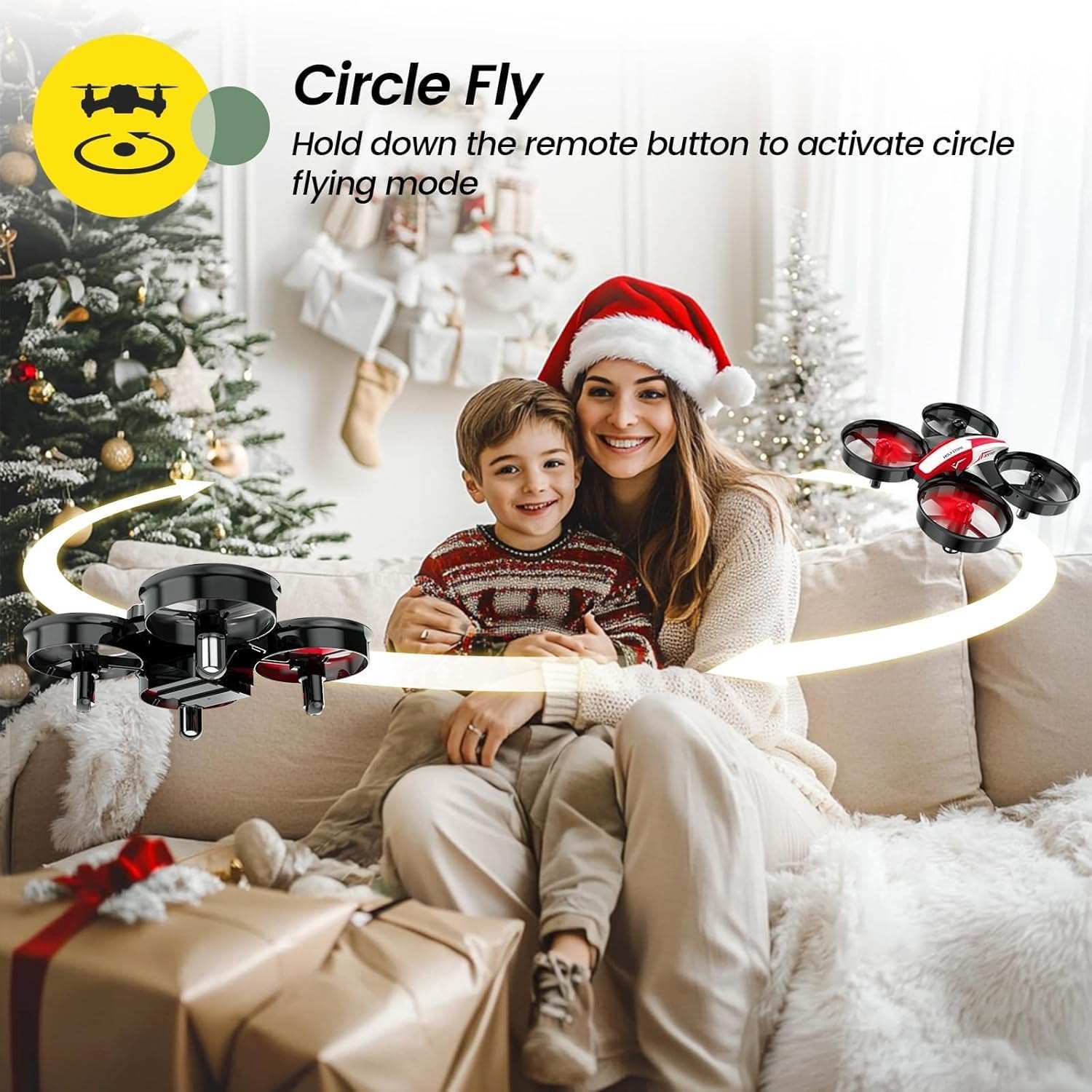
The HS210 is the drone you buy for a child who has never flown anything, or for yourself if you want to find out whether flying a quadcopter by hand is fun before spending real money. It is not a camera drone and does not pretend to be. It is a small, guarded toy that teaches the one skill every later drone builds on: keeping a hovering aircraft where you want it with two sticks. Holy Stone pitches it at kids around 8 to 12, and that is about right. Younger children can manage it with a parent alongside, and adults will find it a cheap, harmless way to practice in a living room.
Design and build
The HS210 measures about 80 mm square and weighs around 24 g, so it sits in the palm of a child’s hand. The propellers are fully enclosed in a plastic ring, which is the single most important design choice here: when it hits a wall, a curtain or a sibling, the props do not touch anything. Owners and reviewers consistently describe it as tough for its size, with the guards taking the impact in most crashes. It comes in red, blue, green and pink, plus seasonal gift boxes. In the box you get the drone, a small game-pad style controller, three removable batteries, a charging cable and spare propellers. There is no app, no phone mount and no pairing beyond switching both on.
Flying it
On the lowest of its three speed modes the HS210 is slow and forgiving, which is exactly what a first-time pilot needs. Current batches have altitude hold, so the drone holds its height while the child concentrates on left, right, forward and back; listings for older batches did not, and the difference is noticeable. Headless mode makes the drone move relative to the pilot rather than its own nose, which helps very young flyers, though we would encourage turning it off as soon as possible, because learning orientation is the point. One-key flips are the feature kids remember. The main flight quirk owners report is drift: the drone tends to slide in one direction after takeoff and needs trimming with the controller buttons. Teach a child to do that early and it becomes part of the routine. Outdoors, the HS210 is at the mercy of any breeze. Its roughly 50 m range is irrelevant, because a light gust will carry it off long before then. Fly it inside or in a dead-calm backyard.
Living with it
Holy Stone quotes about 7 minutes per battery, and owners typically get 5 to 7. With three batteries that is a solid 15 to 20 minutes of flying, which matches a child’s attention span well. Charging takes roughly 40 to 60 minutes per battery over USB, so charge all three before the session rather than during it. The tiny battery connectors are fiddly for small fingers, and the LEDs, which most versions cannot switch off, cost a little flight time. Brushed motors on toy drones wear out with heavy use; if one motor gets weak and the drone starts tipping, that is usually why. Spare batteries and props are inexpensive and easy to find.
Value for money
At the time of writing the HS210 sells for about $30 to $40 on Amazon. For that you get a durable, guarded drone, three batteries and a genuine introduction to manual flying. Spending less usually means one battery and no guards. Spending a little more gets you a camera on the Holy Stone HS420, but camera toys add an app and a phone to the experience, which is not always what a young child needs.
Alternatives
- Holy Stone HS420: pick it if the child wants to see video from the drone on a phone and is old enough to manage an app.
- Potensic A20: pick it as a near-identical no-camera trainer if the HS210 is out of stock in the color you want.
- Holy Stone HS210F: pick it if a younger child would enjoy a drone that also drives along the floor.
The bottom line
The Holy Stone HS210 does one job well: it lets a beginner crash, learn and crash again without breaking anything. Short battery life and drift are the compromises of a $35 nano drone, and three batteries in the box soften them. As a first drone for a child, it is hard to argue with.
.gap-review{margin:2.5rem 0 0}.gap-review h2{font-size:1.5rem;margin:0 0 1.25rem}.gap-verdict{background:#0E1A2B;color:#fff;border-radius:16px;padding:1.5rem 1.75rem}.gap-verdict__head{display:flex;gap:1.25rem;align-items:center}.gap-score{margin:0;width:84px;height:84px;border-radius:50%;background:#FF5A1F;color:#fff;display:flex;flex-direction:column;align-items:center;justify-content:center;font-weight:800;font-size:1.9rem;line-height:1}.gap-score small{font-size:.7rem;font-weight:600;opacity:.85}.gap-eyebrow{margin:0 0 .35rem;text-transform:uppercase;letter-spacing:.08em;font-size:.75rem;font-weight:700;color:#FF5A1F}.gap-verdict__line{margin:0;font-size:1.125rem;line-height:1.45}.gap-proscons{display:grid;grid-template-columns:1fr 1fr;gap:1.25rem 2rem;margin-top:1.5rem;padding-top:1.25rem;border-top:1px solid rgba(255,255,255,.15)}.gap-proscons h3{margin:0 0 .6rem;font-size:.9rem;text-transform:uppercase;letter-spacing:.05em;color:inherit}.gap-proscons ul{list-style:none;margin:0;padding:0}.gap-proscons li{position:relative;padding-left:1.6em;margin:0 0 .45em}.gap-proscons li::before{position:absolute;left:0;top:0;font-weight:800}.gap-pros li::before{content:’+’;color:#4ADE80}.gap-cons li::before{content:’2013′;color:#F87171}.gap-specs,.gap-faq{margin-top:2rem}.gap-specs h3,.gap-faq h3{font-size:1.2rem;margin:0 0 .75rem}.gap-specs table{width:100%;border-collapse:collapse;font-size:.95rem}.gap-specs th,.gap-specs td{text-align:left;padding:.65rem .9rem;border-bottom:1px solid #E2E8F0;vertical-align:top}.gap-specs th{width:38%;background:#F4F6F9}.gap-faq details{border:1px solid #E2E8F0;border-radius:10px;padding:0 1rem;margin:0 0 .6rem}.gap-faq summary{cursor:pointer;padding:.85rem 0;font-weight:600}.gap-cta{margin-top:2rem;padding:1.25rem 1.5rem;background:#F4F6F9;border-radius:16px;display:flex;flex-wrap:wrap;gap:.75rem;align-items:center}.gap-btn{display:inline-block;padding:.85em 1.5em;border-radius:10px;font-weight:600;text-decoration:none!important;background:#FF5A1F;color:#fff!important}.gap-btn–secondary{background:transparent;color:#0E1A2B!important;border:2px solid #E2E8F0}.gap-disclosure,.gap-note{font-size:.875rem;color:#4A5568;margin:.75rem 0 0}@media(max-width:640px){.gap-proscons{grid-template-columns:1fr}}
Holy Stone HS210 review
6.8/10
madagear.com verdict
Buy it as a first drone for a child or as a cheap way to learn manual control indoors; skip it if you want a camera, outdoor flying or more than a few minutes per battery.
What we like
- Fully enclosed prop guards make living-room crashes harmless
- Three batteries in the box, roughly 20 minutes of total flying
- No app, no pairing with a phone: switch on and fly
- Three speed modes let a child step up as skills improve
- At about 24 g it is light enough to bounce off walls without damage
What we don’t
- Around 5 to 7 minutes per battery in practice
- So light that any breeze outdoors pushes it away
- Older units drift and need trimming before every flight
- No camera at all
Specs at a glance
| Weight | About 24 g |
|---|---|
| Size | About 80 × 80 × 30 mm |
| Camera | None |
| Flight time | Up to 7 min per battery (manufacturer figure); 3 batteries included |
| Charging | About 40 to 60 min per battery over USB |
| Control range | About 50 m (2.4 GHz) |
| Speed modes | 3 (low, medium, high) |
| Flight aids | Altitude hold on current batches, headless mode, one-key 3D flips |
| Prop guards | Fully enclosed, built in |
Frequently asked questions
What age is the Holy Stone HS210 suitable for?
Holy Stone markets it to kids roughly 8 to 12 and beginners. Younger children can fly it with an adult nearby, but the small parts and LiPo batteries mean charging should be supervised.
Can the HS210 fly outside?
Only in completely still air. At about 24 g it is pushed around by the lightest breeze, and owners regularly report losing them outdoors. Treat it as an indoor drone.
Does the Holy Stone HS210 have a camera?
No. The HS210 has no camera and no phone app. Holy Stone sells camera models in the same size class, such as the HS420 and HS430.
Do I need to register the HS210?
No. It is far below the 250 g registration threshold in the US. If you fly it outdoors recreationally, the FAA still expects the pilot to have passed the free TRUST test.
Typically sells for about $30 to $40 on Amazon depending on color and seasonal gift boxes; three batteries are included. Price and availability checked on 2026-11-10.
madagear.com is reader-supported. When you buy through links on our site we may earn an affiliate commission, at no extra cost to you. This never affects what we recommend.
Reviews
There are no reviews yet.