
Description
Who it’s for
The DEERC D10 is a budget foldable camera drone for someone ready to fly outdoors for the first time. It suits teenagers and adult beginners who have perhaps crashed a nano drone around the living room and now want something with longer flights, a phone camera view and a case to carry it in. It is not a toy for young children, and it is not a GPS drone. Think of it as an inexpensive way to learn outdoor flying in calm weather before deciding whether a $200 to $400 drone is worth it.
Design and build
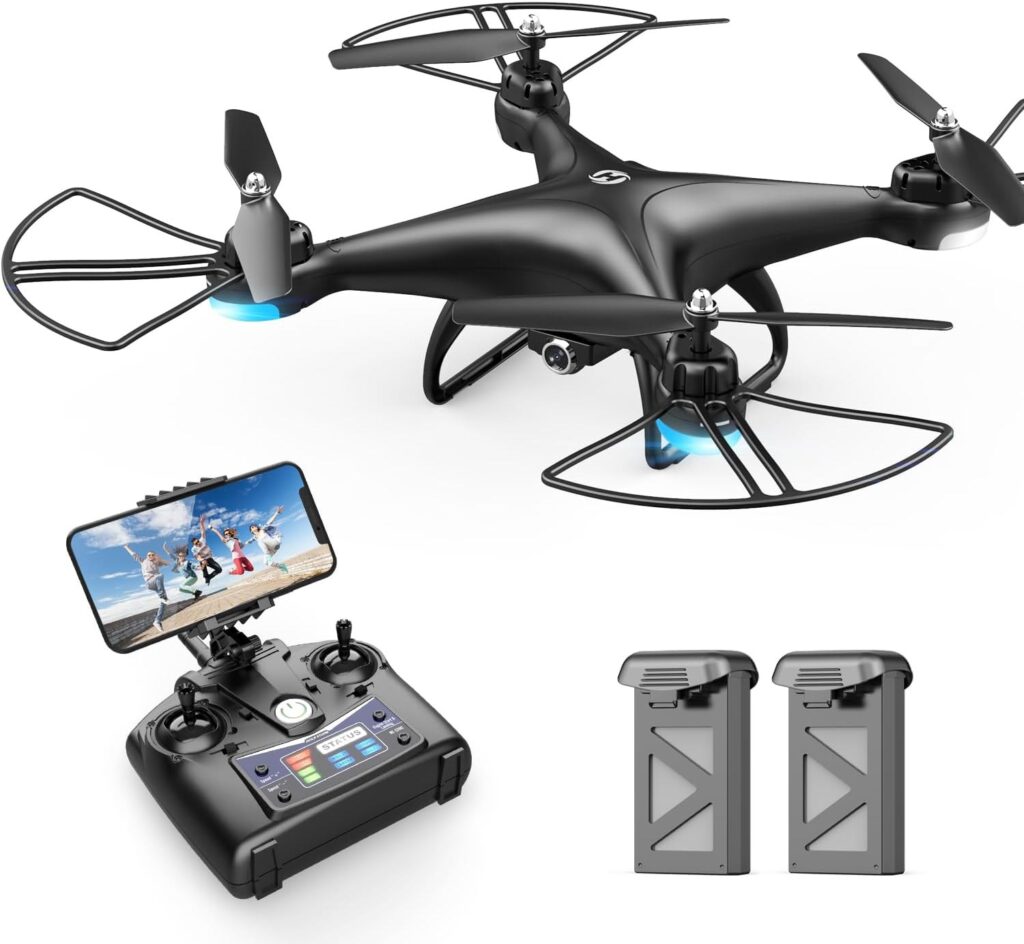
The D10 copies the folding layout of more expensive camera drones: the arms swing out, the camera sits in the nose and the whole thing packs into the supplied carrying case with its controller and two batteries. It weighs about 164 g, light enough to stay under the 250 g registration threshold while being heavier and steadier than a nano drone. The plastic build is typical of the price, and owners generally report it survives the bumps that come with learning. There is no memory card slot, which is the most important design detail to understand before buying.
Camera and flight
DEERC advertises a 2K camera, but everything you capture goes to your phone over Wi-Fi rather than to a card in the drone, and owners and spec databases describe the saved footage as roughly 720p. There is no gimbal and no electronic stabilization, so the video shows each stick movement. It works for casual clips of a park or a beach on a calm day; it will not compete with a gimbal drone. In flight, the D10 is easy to manage. Altitude hold keeps it at a set height, one-key takeoff and landing remove the trickiest moments, and headless mode helps beginners who lose track of orientation. For variety, you can draw a path on the phone screen and the drone follows it, set it to circle, or trigger photos and video with a hand gesture. DEERC quotes up to 15 minutes per battery; owners commonly report 10 to 12, which is still good for a drone in this price class and gives about 20 to 24 minutes with both batteries. Without GPS, the D10 drifts with the wind and cannot fly home on its own, so keep it close and fly on calm days.
Living with it
The app is the weak point. Reviews mention pairing problems and app reliability that varies between phones, with Android owners reporting more issues. Update the app before the first flight and test the connection indoors. Batteries are removable and spares are reasonably priced. The controller’s phone holder is fine for standard phones. As with any toy-grade drone, motors and propellers are wear items. In the US, flying outdoors recreationally means passing the free FAA TRUST test, even though the D10 does not need registering.
Value for money
At the time of writing the D10 typically sells for about $60 to $90 on Amazon with two batteries and the case, and coupons often bring it to the low end. That undercuts most foldable camera drones and includes more flying time than nano toys. Step up to the Holy Stone HS110D and you gain a memory card slot for sharper recordings; step up further to a GPS drone like the Holy Stone HS175D and you gain position hold and return-to-home.
Alternatives
- Holy Stone HS110D: pick it if you want 1080p recording to a microSD card and do not mind a non-folding frame.
- Loolinn Z3: pick it if you want optical flow positioning for steadier hovering indoors at a similar price.
- DEERC D20: pick it for a younger child who wants a smaller, lighter camera drone to fly mostly indoors.
The bottom line
The DEERC D10 is a cheap, foldable and genuinely fun way to learn outdoor flying, with two batteries and a case included. Its 2K camera claim deserves skepticism and the app can be temperamental. As an inexpensive first outdoor drone for calm days, it is fair value.
.gap-review{margin:2.5rem 0 0}.gap-review h2{font-size:1.5rem;margin:0 0 1.25rem}.gap-verdict{background:#0E1A2B;color:#fff;border-radius:16px;padding:1.5rem 1.75rem}.gap-verdict__head{display:flex;gap:1.25rem;align-items:center}.gap-score{margin:0;width:84px;height:84px;border-radius:50%;background:#FF5A1F;color:#fff;display:flex;flex-direction:column;align-items:center;justify-content:center;font-weight:800;font-size:1.9rem;line-height:1}.gap-score small{font-size:.7rem;font-weight:600;opacity:.85}.gap-eyebrow{margin:0 0 .35rem;text-transform:uppercase;letter-spacing:.08em;font-size:.75rem;font-weight:700;color:#FF5A1F}.gap-verdict__line{margin:0;font-size:1.125rem;line-height:1.45}.gap-proscons{display:grid;grid-template-columns:1fr 1fr;gap:1.25rem 2rem;margin-top:1.5rem;padding-top:1.25rem;border-top:1px solid rgba(255,255,255,.15)}.gap-proscons h3{margin:0 0 .6rem;font-size:.9rem;text-transform:uppercase;letter-spacing:.05em;color:inherit}.gap-proscons ul{list-style:none;margin:0;padding:0}.gap-proscons li{position:relative;padding-left:1.6em;margin:0 0 .45em}.gap-proscons li::before{position:absolute;left:0;top:0;font-weight:800}.gap-pros li::before{content:’+’;color:#4ADE80}.gap-cons li::before{content:’2013′;color:#F87171}.gap-specs,.gap-faq{margin-top:2rem}.gap-specs h3,.gap-faq h3{font-size:1.2rem;margin:0 0 .75rem}.gap-specs table{width:100%;border-collapse:collapse;font-size:.95rem}.gap-specs th,.gap-specs td{text-align:left;padding:.65rem .9rem;border-bottom:1px solid #E2E8F0;vertical-align:top}.gap-specs th{width:38%;background:#F4F6F9}.gap-faq details{border:1px solid #E2E8F0;border-radius:10px;padding:0 1rem;margin:0 0 .6rem}.gap-faq summary{cursor:pointer;padding:.85rem 0;font-weight:600}.gap-cta{margin-top:2rem;padding:1.25rem 1.5rem;background:#F4F6F9;border-radius:16px;display:flex;flex-wrap:wrap;gap:.75rem;align-items:center}.gap-btn{display:inline-block;padding:.85em 1.5em;border-radius:10px;font-weight:600;text-decoration:none!important;background:#FF5A1F;color:#fff!important}.gap-btn–secondary{background:transparent;color:#0E1A2B!important;border:2px solid #E2E8F0}.gap-disclosure,.gap-note{font-size:.875rem;color:#4A5568;margin:.75rem 0 0}@media(max-width:640px){.gap-proscons{grid-template-columns:1fr}}
DEERC D10 review
6.3/10
madagear.com verdict
Buy it as a first outdoor-capable camera drone for a teenager or adult beginner on a tight budget; skip it if you need sharp video, GPS return-to-home or a dependable app on every phone.
What we like
- Two batteries good for roughly 10 to 12 minutes each in real use
- Folds into the included carrying case
- Altitude hold and one-key takeoff and landing make the first flights easy
- Waypoint drawing, circle fly and gesture photos add variety
- At around 164 g, it stays under the 250 g registration threshold
What we don’t
- Recordings are saved to the phone over Wi-Fi, so quality drops to about 720p
- No gimbal and no GPS: shaky footage and drift in wind
- App reliability varies between phones, especially on Android
- Claimed 15 min per battery is optimistic
Specs at a glance
| Weight | About 164 g |
|---|---|
| Camera | Advertised as 2K; video and photos saved to the phone over Wi-Fi at about 720p |
| Storage | No memory card slot |
| Stabilization | None |
| Flight time | Up to 15 min per battery claimed; owners report 10 to 12 min; 2 batteries included |
| Control range | Up to about 80 to 100 m |
| Top speed | About 8 m/s |
| Positioning | Barometric altitude hold; no GPS |
| Flight modes | Headless, waypoints, circle fly, gesture photo and video, speed modes |
Frequently asked questions
Is the DEERC D10 really a 2K camera drone?
The camera is advertised as 2K, but there is no memory card slot. Footage and photos travel to your phone over Wi-Fi and are saved there, and owners and reviewers describe the result as roughly 720p. It is fine for casual clips, not for footage you would print or edit seriously.
Do I need to register the D10?
No. At about 164 g it is under the FAA’s 250 g threshold for recreational flying. US pilots flying outdoors should still pass the free TRUST test and follow the usual recreational rules.
Can the D10 return home on its own?
Not in the GPS sense. It has no GPS, so there is no automatic return to its launch point. Keep it within sight and close, especially in any breeze.
Is it suitable for kids?
For kids around 12 and up who can handle a phone app and an outdoor drone, yes. Younger children should start with a guarded indoor drone such as the Holy Stone HS210.
Typically $60 to $90 on Amazon for the two-battery kit with carrying case; frequent coupons push it toward the low end. Price and availability checked on 2026-11-10.
madagear.com is reader-supported. When you buy through links on our site we may earn an affiliate commission, at no extra cost to you. This never affects what we recommend.


Reviews
There are no reviews yet.