



Description
Who it’s for
The HS600 is for the pilot who has accepted registration in exchange for a drone that flies longer and handles wind better than the sub-250 g crowd. It suits beginners who live somewhere breezy, people who want long sessions for scouting property or coastline, and anyone stepping up from a toy who would rather have stability than pocketability. It is not for buyers who want to avoid the FAA, travel light, or put image quality first.
Design and build
This is a much larger drone than Holy Stone’s 249 g models. Folded it measures 202 by 95 by 83 mm and it weighs 603 g, well above the 377 g of the Holy Stone HS720G. The extra weight pays for an 11.1 V 3500 mAh battery rated for up to 40 minutes and a sturdier airframe with brushless motors. Holy Stone rates it for Level 6 wind, 7.9 m/s, which is noticeably more than the 5.5 m/s rating of its sub-250 g HS360E.
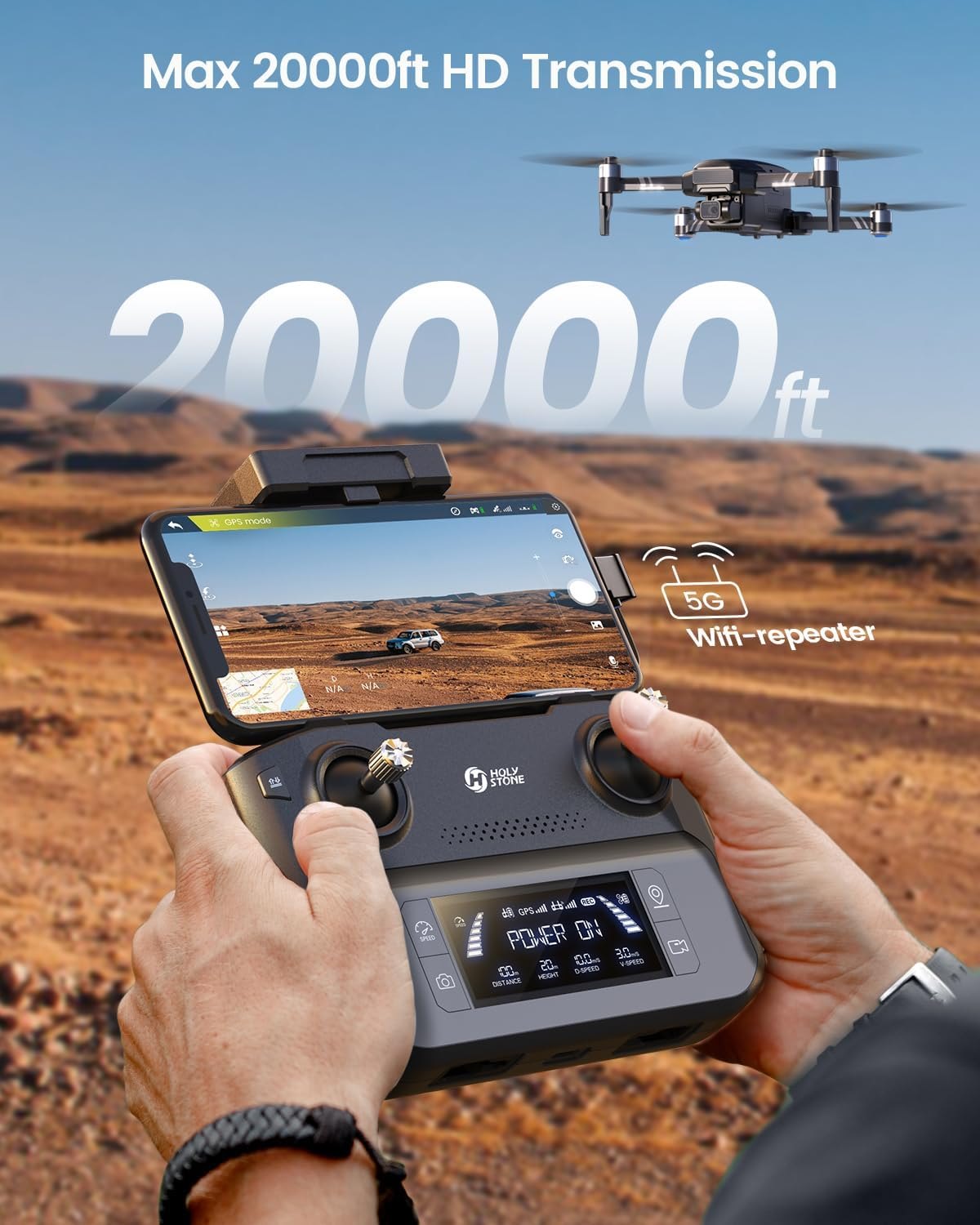
The camera hangs on a two-axis mechanical gimbal that stabilizes tilt and roll, with electronic stabilization helping on the remaining axis. The controller connects to your phone with a cable rather than Wi-Fi and runs on its own 1100 mAh battery. Remote ID is built in, so there is no module to buy.
Camera and flight
The camera records 4K at 30 fps to a microSD card of up to 128 GB, shoots 3840 by 2160 stills through a 100 degree lens, and sends a 720p feed to your phone. Holy Stone describes the sensor only as a Sony 4K unit. The two-axis gimbal is the important part: it keeps horizons level and takes out most of the shake that ruins footage from EIS-only drones, though yaw movement can still show through in gusts. Expect footage good enough for family videos and social posts, with the usual small-sensor limits in shade and at dusk.
Flight is the HS600’s strongest suit. GPS holds position and brings it home, the long battery means fewer interruptions, and the heavier airframe stays steadier in wind. Holy Stone’s spec sheet rates the 5.8 GHz link to 6 km in open conditions, although its site navigation lists 3 km; either figure is beyond legal line-of-sight flying. The app includes Point of Interest, Spiral Up, Tap Fly with up to 16 waypoints, gesture selfies, time-lapse, a bird’s eye ascent and a catapult move.
There is no obstacle avoidance, and a 603 g drone does more damage in a crash than a 249 g one, so fly in open spaces.
Living with it
You fly with Holy Stone’s HS600 app on iOS or Android, or with the optional RC243A screen controller. The wired phone link avoids the 5 GHz Wi-Fi compatibility issues of older Holy Stone drones. Each battery charges in about two hours.
The paperwork is the main difference from a sub-250 g drone. In the US you must register the HS600 with the FAA, which costs $5, pass the free TRUST test and fly with Remote ID broadcasting, which the built-in module handles. As an existing FCC-authorized model, it is not affected by the December 2025 Covered List action on new foreign drones.
Value for money
At the time of writing Holy Stone lists the HS600 at $399.99, and its store has offered $100-off codes that bring it to $299.99. At $300 it is a solid deal for a 40-minute, wind-capable gimbal drone. At full price it competes with the Potensic Atom 2, which has a three-axis gimbal, a better sensor and no registration requirement, but less wind tolerance and shorter flights.
Alternatives
- Holy Stone HS720G: pick it if you want a lighter registered Holy Stone with a similar two-axis gimbal for less money.
- Potensic Atom 2: pick it if you want better image quality and a three-axis gimbal without registration.
- Ruko F11GIM2: pick it if you want another long-flying budget GPS drone with a gimbal to compare.
The bottom line
The HS600 is a stable, long-flying Holy Stone that justifies its weight with 40-minute batteries and genuine wind tolerance. Registration and a two-axis gimbal are the compromises. Buy it on a discount, register it, and it will outlast most budget drones in the air.
.gap-review{margin:2.5rem 0 0}.gap-review h2{font-size:1.5rem;margin:0 0 1.25rem}.gap-verdict{background:#0E1A2B;color:#fff;border-radius:16px;padding:1.5rem 1.75rem}.gap-verdict__head{display:flex;gap:1.25rem;align-items:center}.gap-score{margin:0;width:84px;height:84px;border-radius:50%;background:#FF5A1F;color:#fff;display:flex;flex-direction:column;align-items:center;justify-content:center;font-weight:800;font-size:1.9rem;line-height:1}.gap-score small{font-size:.7rem;font-weight:600;opacity:.85}.gap-eyebrow{margin:0 0 .35rem;text-transform:uppercase;letter-spacing:.08em;font-size:.75rem;font-weight:700;color:#FF5A1F}.gap-verdict__line{margin:0;font-size:1.125rem;line-height:1.45}.gap-proscons{display:grid;grid-template-columns:1fr 1fr;gap:1.25rem 2rem;margin-top:1.5rem;padding-top:1.25rem;border-top:1px solid rgba(255,255,255,.15)}.gap-proscons h3{margin:0 0 .6rem;font-size:.9rem;text-transform:uppercase;letter-spacing:.05em;color:inherit}.gap-proscons ul{list-style:none;margin:0;padding:0}.gap-proscons li{position:relative;padding-left:1.6em;margin:0 0 .45em}.gap-proscons li::before{position:absolute;left:0;top:0;font-weight:800}.gap-pros li::before{content:’+’;color:#4ADE80}.gap-cons li::before{content:’2013′;color:#F87171}.gap-specs,.gap-faq{margin-top:2rem}.gap-specs h3,.gap-faq h3{font-size:1.2rem;margin:0 0 .75rem}.gap-specs table{width:100%;border-collapse:collapse;font-size:.95rem}.gap-specs th,.gap-specs td{text-align:left;padding:.65rem .9rem;border-bottom:1px solid #E2E8F0;vertical-align:top}.gap-specs th{width:38%;background:#F4F6F9}.gap-faq details{border:1px solid #E2E8F0;border-radius:10px;padding:0 1rem;margin:0 0 .6rem}.gap-faq summary{cursor:pointer;padding:.85rem 0;font-weight:600}.gap-cta{margin-top:2rem;padding:1.25rem 1.5rem;background:#F4F6F9;border-radius:16px;display:flex;flex-wrap:wrap;gap:.75rem;align-items:center}.gap-btn{display:inline-block;padding:.85em 1.5em;border-radius:10px;font-weight:600;text-decoration:none!important;background:#FF5A1F;color:#fff!important}.gap-btn–secondary{background:transparent;color:#0E1A2B!important;border:2px solid #E2E8F0}.gap-disclosure,.gap-note{font-size:.875rem;color:#4A5568;margin:.75rem 0 0}@media(max-width:640px){.gap-proscons{grid-template-columns:1fr}}
Holy Stone HS600 review
7.0/10
madagear.com verdict
Buy it if you want long flights and better wind handling than a sub-250 g drone and do not mind registering; skip it if you want to avoid the FAA paperwork or care most about image quality.
What we like
- Rated for up to 40 minutes per 3500 mAh battery
- Two-axis mechanical gimbal plus EIS
- Level 6 wind rating (7.9 m/s), stronger than sub-250 g drones
- Built-in Remote ID, so it is ready for US rules once registered
- Wired phone connection and a link rated to 6 km
What we don’t
- At 603 g it must be registered with the FAA
- Two-axis gimbal, not three, and 4K tops out at 30 fps
- Bulky next to folding sub-250 g drones
- No obstacle avoidance
Specs at a glance
| Takeoff weight | 603 g |
|---|---|
| Folded size | 202 x 95 x 83 mm |
| Camera | 4K Sony sensor, 100 degree field of view |
| Video | 3840 x 2160 at 30fps to microSD, 720p live view |
| Stabilization | 2-axis gimbal (tilt and roll) plus EIS |
| Flight time | Up to 40 min per battery (manufacturer figure) |
| Battery | 11.1 V 3500 mAh, about 2 hours to charge |
| Range | Up to 6 km, outdoor and unobstructed (5.8 GHz) |
| Wind resistance | Level 6, 7.9 m/s |
| Remote ID | Built in |
Frequently asked questions
Do I need to register the Holy Stone HS600?
Yes in the US. At 603 g it is over the FAA’s 250 g threshold, so recreational pilots must register it (the FAA fee is $5), pass the free TRUST test and fly with Remote ID broadcasting, which the HS600 has built in.
Does the HS600 have a three-axis gimbal?
No. It uses a two-axis mechanical gimbal for tilt and roll, with electronic image stabilization handling the remaining axis. That is better than EIS alone, but not quite as smooth as a full three-axis gimbal in yaw.
What is the range of the Holy Stone HS600?
Holy Stone’s spec sheet rates control and transmission to 6,000 m in open, unobstructed conditions, although one summary on its site says 3 km. Either way, US rules require you to keep the drone within visual line of sight.
Can I use a screen controller with the HS600?
Yes. Holy Stone lists its RC243A screen remote as compatible with the HS600, HS600D, HS360E and HS360D.
Holy Stone’s list price for the one-battery version is $399.99, and its store has run $100-off codes that bring it to $299.99. Amazon pricing moves with coupons, so check the current deal. Price and availability checked on 2026-11-10.
madagear.com is reader-supported. When you buy through links on our site we may earn an affiliate commission, at no extra cost to you. This never affects what we recommend.


Reviews
There are no reviews yet.