


Description
Who it’s for
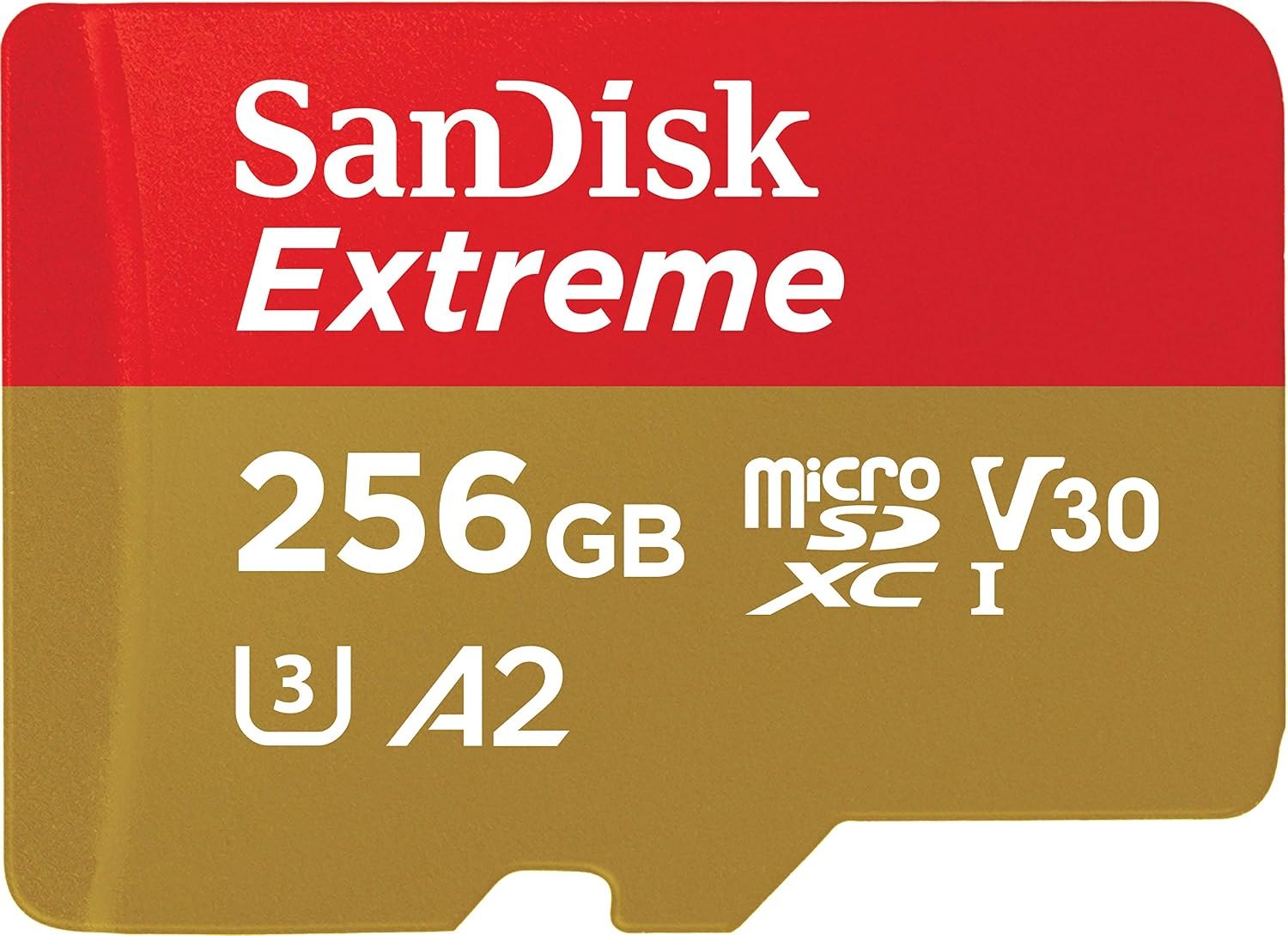
If you fly a camera drone, run an action cam on a helmet or chest mount, or record FPV footage to goggles, the card is not an accessory you think about until it drops frames mid-flight. This SanDisk Extreme 256GB sits in the slot most pilots end up in: enough capacity for a full day of 4K clips without swapping, and a sustained write rating that covers the bitrates consumer drones actually produce.
It also suits people running one card across several devices. The A2 rating points at phone and handheld use, where random read and write performance affects how quickly apps load off the card, while the V30 rating is the number that matters for video. That dual billing means the card is equally at home in a drone, a GoPro-class action cam, a Nintendo-style handheld or a Raspberry Pi.
Who it is not for: anyone whose storage needs are photos, music and documents. The premium here buys sustained write performance you will never call on, and a generic Class 10 card at the same capacity will cost noticeably less.
Design and build
There is not much to say about the physical form of a microSD card, and that is the point. This one weighs 5 g and measures roughly 0.59 inches across, in the standard microSDXC shape, in SanDisk’s red and gold Extreme livery. The color coding is genuinely useful if you keep several cards in a case and want to tell the fast ones from the slow spares at a glance.
The durability claims are where SanDisk puts its marketing effort. The listing describes the card as shockproof, temperature-proof, waterproof and X-ray-proof. Those are standard claims across the Extreme line rather than anything unique to this capacity, and they are aimed at the reality of outdoor gear: cards that get handled with cold fingers on a hillside, dropped in grass, and run through airport scanners. Treat it as sensible engineering margin rather than a guarantee, and keep backing footage up after each session.
The warranty is listed simply as limited, with no term stated. SanDisk has historically offered long warranty periods on the Extreme range, but since the listing does not specify, it is worth checking the terms that come with the card you receive rather than assuming.
What the specs tell us
The two headline numbers are 190MB/s read and 130MB/s write. Read the asterisk carefully: SanDisk states the quoted read figure comes from pairing the card with its own PRO-READER for SD and microSD, which is a separate purchase. Plugged into a laptop slot or a generic USB adapter, expect a UHS-I card to land closer to the 100MB/s region. That is not a fault specific to this card, it is a limit of the UHS-I bus, but it does mean the box number and your actual offload time will not match.
The ratings that govern recording are U3 and V30. Both set a sustained write floor of 30MB/s. Every consumer 4K drone and action cam mode on the market records below that ceiling, often well below, so the card has real headroom rather than sitting exactly at the limit. If you move to a camera or drone that offers very high bitrate or 8K capture, V30 becomes the minimum rather than a comfortable margin, and a V60 or V90 card becomes the sensible choice.
The A2 specification covers random performance for app use. It makes no difference to video capture, but it is the reason this card is often recommended for handhelds and single-board computers as well as cameras.
Living with it
Buyers rate the card 4.8 out of 5 across 15,945 ratings, which is a strong signal for a product category where failures are loud and get reported quickly. Owners of SanDisk Extreme cards generally report consistent recording behavior and no dropped clips in 4K, which is the main thing being asked of it.
The practical habit worth forming is formatting the card in the device that will record to it, not in a computer. Drones and action cams are particular about file systems, and most capture problems that get blamed on the card come down to formatting or to a card that has been filled and left fragmented. Doing a full format before a shoot day is cheap insurance.
The counterfeit problem is real in this category. SanDisk Extreme cards are among the most faked storage products in circulation, so buy from a seller you trust and run a capacity verification tool on arrival. The model number to look for is SDSQXAV-256G-GN6MN.
Value for money
At the time of writing the price seen was $62.57. That puts it above generic 256GB cards and below the V60 and V90 tier aimed at cinema cameras. For drone and action cam work, that middle position is the right one: you are paying for a sustained write rating that matters and skipping a tier you would not use.
microSD pricing moves with flash supply and seasonal sales, often substantially. The same card can appear well below the figure above during promotional periods, so it is worth watching rather than buying at the first price you see. Capacity pricing is rarely linear either, and the 512GB version sometimes offers better value per gigabyte depending on the day.
Alternatives
The Samsung Pro Plus microSD is the closest direct rival on specification and often undercuts the SanDisk on price, making it the pick if you want the same V30 class for less and have no preference between flash makers.
The Lexar Professional 1066x Silver microSD is another V30 option that frequently sells cheaper at the 256GB mark, worth considering if you want a spare card to pair with your main one rather than a single premium card.
If you shoot on a camera that offers high bitrate or 8K modes, step up to a V60-rated card such as the Kingston Canvas React Plus, where the sustained write floor doubles and you stop thinking about dropped frames entirely.
The bottom line
This is the default answer for a drone or action cam card at 256GB, and the reason is unglamorous: the sustained write rating covers what consumer 4K capture actually demands, from a flash maker with a long record in the category. The headline read speed needs SanDisk’s own reader to reach, so judge the card on its V30 floor rather than its marketing ceiling. Buy it when the price dips, format it in the device, and verify the card on arrival.
.gap-review{margin:2.5rem 0 0}.gap-review h2{font-size:1.5rem;margin:0 0 1.25rem}.gap-verdict{background:#0E1A2B;color:#fff;border-radius:16px;padding:1.5rem 1.75rem}.gap-verdict__head{display:flex;gap:1.25rem;align-items:center}.gap-score{margin:0;width:84px;height:84px;border-radius:50%;background:#FF5A1F;color:#fff;display:flex;flex-direction:column;align-items:center;justify-content:center;font-weight:800;font-size:1.9rem;line-height:1}.gap-score small{font-size:.7rem;font-weight:600;opacity:.85}.gap-eyebrow{margin:0 0 .35rem;text-transform:uppercase;letter-spacing:.08em;font-size:.75rem;font-weight:700;color:#FF5A1F}.gap-verdict__line{margin:0;font-size:1.125rem;line-height:1.45}.gap-proscons{display:grid;grid-template-columns:1fr 1fr;gap:1.25rem 2rem;margin-top:1.5rem;padding-top:1.25rem;border-top:1px solid rgba(255,255,255,.15)}.gap-proscons h3{margin:0 0 .6rem;font-size:.9rem;text-transform:uppercase;letter-spacing:.05em;color:inherit}.gap-proscons ul{list-style:none;margin:0;padding:0}.gap-proscons li{position:relative;padding-left:1.6em;margin:0 0 .45em}.gap-proscons li::before{position:absolute;left:0;top:0;font-weight:800}.gap-pros li::before{content:’+’;color:#4ADE80}.gap-cons li::before{content:’2013′;color:#F87171}.gap-specs,.gap-faq{margin-top:2rem}.gap-specs h3,.gap-faq h3{font-size:1.2rem;margin:0 0 .75rem}.gap-specs table{width:100%;border-collapse:collapse;font-size:.95rem}.gap-specs th,.gap-specs td{text-align:left;padding:.65rem .9rem;border-bottom:1px solid #E2E8F0;vertical-align:top}.gap-specs th{width:38%;background:#F4F6F9}.gap-faq details{border:1px solid #E2E8F0;border-radius:10px;padding:0 1rem;margin:0 0 .6rem}.gap-faq summary{cursor:pointer;padding:.85rem 0;font-weight:600}.gap-cta{margin-top:2rem;padding:1.25rem 1.5rem;background:#F4F6F9;border-radius:16px;display:flex;flex-wrap:wrap;gap:.75rem;align-items:center}.gap-btn{display:inline-block;padding:.85em 1.5em;border-radius:10px;font-weight:600;text-decoration:none!important;background:#FF5A1F;color:#fff!important}.gap-btn–secondary{background:transparent;color:#0E1A2B!important;border:2px solid #E2E8F0}.gap-disclosure,.gap-note{font-size:.875rem;color:#4A5568;margin:.75rem 0 0}@media(max-width:640px){.gap-proscons{grid-template-columns:1fr}}
SanDisk Extreme microSDXC 256GB (SDSQXAV-256G) review
8.6/10
madagear.com verdict
Buy it if you record 4K on a drone, action cam or FPV goggles and want a card from a known flash maker; skip it if you only need storage for photos and app data, where a cheaper Class 10 card will do.
What we like
- V30 and U3 ratings cover sustained 4K recording on drones and action cams
- Rated 190MB/s read speeds shorten offloads after a day of flying
- A2 rating helps when the card doubles as app storage in a phone or handheld
- Shock, temperature, water and X-ray resistance suits outdoor and travel use
- 256GB is a practical sweet spot for multi-flight 4K sessions
- Buyers rate it 4.8 out of 5 across 15,945 ratings
What we don’t
- Headline 190MB/s read needs SanDisk’s own PRO-READER to reach, sold separately
- Pricier per gigabyte than generic Class 10 cards at the same capacity
- V30 is the floor for 8K or high-bitrate cinema modes on newer drones
- Warranty is listed only as limited, with no term stated on the listing
Specs at a glance
| Brand | SanDisk |
|---|---|
| Model | Extreme (SDSQXAV-256G-GN6MN) |
| Capacity | 256GB |
| Format | microSDXC |
| Read speed | Up to 190MB/s |
| Write speed | Up to 130MB/s |
| Speed class | Class 10, U3, V30 |
| App performance | A2 |
| Durability | Shockproof, temperature-proof, waterproof, X-ray-proof |
| Weight | 5 g |
Frequently asked questions
Is this card fast enough for 4K drone footage?
On paper yes. The V30 and U3 ratings mean the card is specified to sustain 30MB/s of continuous write, which covers the 4K bitrates most consumer drones and action cams produce. The listed 130MB/s write ceiling gives plenty of headroom above that floor.
Will I actually see 190MB/s when copying files?
Not from a typical laptop slot or cheap USB dongle. SanDisk states the quoted read speed is achieved with its own PRO-READER for SD and microSD, which is sold separately. A standard UHS-I reader will usually top out closer to the 100MB/s range.
Does the A2 rating matter for a drone?
Not much. A2 describes random read and write performance for running apps off the card, which matters in phones, handhelds and single-board computers. For video capture, the V30 sustained write rating is the number that counts.
What does the durability rating cover?
The listing describes the card as shockproof, temperature-proof, waterproof and X-ray-proof. That is aimed at outdoor and travel use rather than a promise against every failure mode, so keep a second card and back up footage after each session.
At the time of writing the price seen was $62.57 for the 256GB single card, and microSD pricing swings often with flash supply and sale events, so the same card can land well under that during promotional periods. Price and availability checked on 2026-11-14.
madagear.com is reader-supported. When you buy through links on our site we may earn an affiliate commission, at no extra cost to you. This never affects what we recommend.


Reviews
There are no reviews yet.