




Description
Who it’s for
This kit is aimed at one specific person: someone building their first analog FPV quad who does not want to research which camera pairs with which transmitter. AKK sells the KC03 as a bundle — an 800TVL camera, a 600mW 5.8GHz video transmitter, and the cable that joins them — so the guesswork about connectors, voltage and pinouts is mostly handled before the box arrives.
That makes it a reasonable fit for a 3-inch or 5-inch build running 2S to 4S, a cheap toothpick project, or a fixed-wing foamie where you want video out without spending much. It also suits people rebuilding after a crash who need a cheap stopgap rather than a permanent upgrade.
It is not for anyone invested in digital FPV. If you fly a digital system, nothing here is relevant, since analog and digital air units do not mix. It is also a poor fit for 6S builds, which is a meaningful limitation given how much of the modern 5-inch freestyle scene has moved to 6S packs.
Design and build
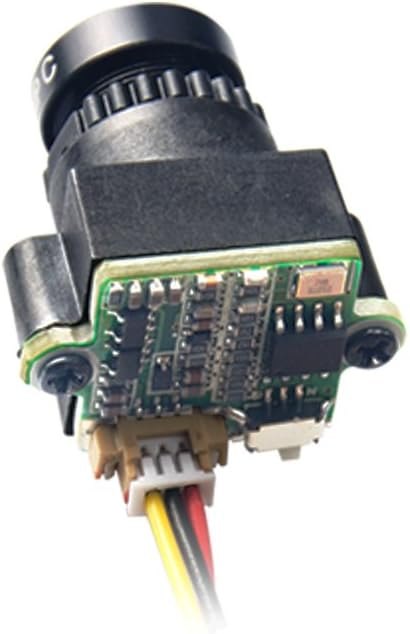
The listing describes the camera as a micro-size unit with low power consumption, which is the standard formula for entry-level FPV cameras. The 2.8mm lens with a 120 degree field of view is a common and sensible choice: wide enough to give useful situational awareness in flight, not so wide that the fisheye distortion makes judging gaps difficult.
The transmitter uses two push buttons to change band and channel, which is worth more than it sounds. Cheaper VTXs often use a single button with a cryptic blink pattern, or solder pads you have to bridge. Two buttons with an on-unit readout make it far easier to get onto a free channel at a field where other pilots are already flying.
One thing to be careful about is the detail table on the listing itself, which includes entries like wall mount, IP54 waterproofing, motion alerts, infrared light source and room types including kitchen and classroom. Those are security-camera fields that do not describe an FPV camera at all, and they appear to be template leftovers rather than real claims. Judge this kit on the camera and VTX specs in the bullets, not on that table.
What the specs tell us
800TVL is the reference point for analog FPV cameras. It is not a sharpness figure in the way a digital resolution is, and the real quality of an analog camera comes down to the sensor and how its image processing handles sudden light changes — flying out from under a tree canopy into bright sky, for instance. The listing mentions an image sensor as a special feature but does not name it, so the honest position is that you cannot predict dynamic range performance from the numbers given.
NTSC/PAL switchable is useful. NTSC gives a higher frame rate and lower latency at a slightly reduced vertical resolution, PAL gives more lines at a lower frame rate. Most racers pick NTSC; most people flying scenery prefer PAL. Having both avoids locking you in.
The VTX side is the clearer part of the picture. 600mW on 5.8GHz is plenty of output for the flying most people do, and the 7-20V input with a 5V output for the camera means you can run it straight off a 2S to 4S battery without a separate regulator. The explicit warning against 6S is the single most important spec in the listing.
Living with it
Buyers rate this kit 4.1 out of 5 across 352 ratings, which is respectable for budget FPV hardware but not spotless. In this product class, scores in that range usually reflect a mix of people who got a unit that worked fine and people who hit a dead-on-arrival board or a flaky connector. Budget VTXs are also notorious for running hot without airflow, so plan on mounting it where prop wash can reach it and avoid long arming sessions on the bench.
Setup should be straightforward. Plug the supplied cable between camera and VTX, feed the VTX from your battery or a 4-in-1 ESC pad within the stated voltage range, add a decent antenna, and scan on your goggles. The push buttons mean you can change channel at the field without a laptop or Betaflight.
The things to expect from any camera at this price are washed-out highlights when you point at the sky and some noise in low light. The listing’s claim about minimum illumination is unquantified, so treat night flying as unproven rather than promised.
Value for money
At $35.99 at the time of writing, this sits roughly where a reasonable standalone VTX alone would land, with the camera effectively bundled. That is the main argument for it: one purchase, one cable, no compatibility research.
The counter-argument is that buying a known-good camera separately — something from RunCam or Caddx — and pairing it with a VTX you choose yourself gives you better low-light behavior and a part you can carry into a future build. You will spend more, and you will spend time picking parts.
For a first build, a spare, or a cheap wing, the economics of the bundle hold up. For a main freestyle quad you plan to keep flying, the money is better spent on components you would not want to replace within a season.
Alternatives
The RunCam Phoenix 2 is the obvious step up on the camera side: better handling of harsh light and a well-earned reputation among freestyle pilots, though you buy it on its own and supply your own VTX.
The Caddx Ratel 2 is the other standard recommendation for low-light flying, and worth the extra outlay if you fly at dusk or in woods where the light changes fast.
For the transmitter side, a Rush Tank or similar name-brand VTX with SmartAudio lets you change channels from your radio rather than by pressing buttons on the quad, which matters once you are flying with other people regularly.
The bottom line
As a starting point for a first analog build, this bundle removes a set of decisions that beginners find genuinely confusing, and it does so for less than the cost of most standalone transmitters. The 6S restriction and the unspecified sensor are the two things that should give a more experienced builder pause before committing it to a quad they care about.
.gap-review{margin:2.5rem 0 0}.gap-review h2{font-size:1.5rem;margin:0 0 1.25rem}.gap-verdict{background:#0E1A2B;color:#fff;border-radius:16px;padding:1.5rem 1.75rem}.gap-verdict__head{display:flex;gap:1.25rem;align-items:center}.gap-score{margin:0;width:84px;height:84px;border-radius:50%;background:#FF5A1F;color:#fff;display:flex;flex-direction:column;align-items:center;justify-content:center;font-weight:800;font-size:1.9rem;line-height:1}.gap-score small{font-size:.7rem;font-weight:600;opacity:.85}.gap-eyebrow{margin:0 0 .35rem;text-transform:uppercase;letter-spacing:.08em;font-size:.75rem;font-weight:700;color:#FF5A1F}.gap-verdict__line{margin:0;font-size:1.125rem;line-height:1.45}.gap-proscons{display:grid;grid-template-columns:1fr 1fr;gap:1.25rem 2rem;margin-top:1.5rem;padding-top:1.25rem;border-top:1px solid rgba(255,255,255,.15)}.gap-proscons h3{margin:0 0 .6rem;font-size:.9rem;text-transform:uppercase;letter-spacing:.05em;color:inherit}.gap-proscons ul{list-style:none;margin:0;padding:0}.gap-proscons li{position:relative;padding-left:1.6em;margin:0 0 .45em}.gap-proscons li::before{position:absolute;left:0;top:0;font-weight:800}.gap-pros li::before{content:’+’;color:#4ADE80}.gap-cons li::before{content:’2013′;color:#F87171}.gap-specs,.gap-faq{margin-top:2rem}.gap-specs h3,.gap-faq h3{font-size:1.2rem;margin:0 0 .75rem}.gap-specs table{width:100%;border-collapse:collapse;font-size:.95rem}.gap-specs th,.gap-specs td{text-align:left;padding:.65rem .9rem;border-bottom:1px solid #E2E8F0;vertical-align:top}.gap-specs th{width:38%;background:#F4F6F9}.gap-faq details{border:1px solid #E2E8F0;border-radius:10px;padding:0 1rem;margin:0 0 .6rem}.gap-faq summary{cursor:pointer;padding:.85rem 0;font-weight:600}.gap-cta{margin-top:2rem;padding:1.25rem 1.5rem;background:#F4F6F9;border-radius:16px;display:flex;flex-wrap:wrap;gap:.75rem;align-items:center}.gap-btn{display:inline-block;padding:.85em 1.5em;border-radius:10px;font-weight:600;text-decoration:none!important;background:#FF5A1F;color:#fff!important}.gap-btn–secondary{background:transparent;color:#0E1A2B!important;border:2px solid #E2E8F0}.gap-disclosure,.gap-note{font-size:.875rem;color:#4A5568;margin:.75rem 0 0}@media(max-width:640px){.gap-proscons{grid-template-columns:1fr}}
AKK KC03 800TVL FPV Camera and 600mW VTX Kit review
6.6/10
madagear.com verdict
Buy it if you want a cheap, pre-matched camera and VTX to get a first analog build flying; skip it if you fly digital, need long range, or want a camera that holds up in harsh light.
What we like
- Camera and transmitter sold as a matched pair with the cable included
- 800TVL analog resolution is standard for entry-level FPV builds
- 600mW output is enough power for park and bando flying
- VTX feeds 5V to the camera, so no separate regulator is needed
- Push-button channel and band changes avoid fiddly solder pads
- Wide 7-20V input covers 2S through 4S packs
What we don’t
- Not rated for 6S, which rules out many modern 5-inch builds
- Analog only, so no path to digital video later
- Buyer rating of 4.1 from 352 ratings points to some unit-to-unit variance
- Listing detail table mixes in security-camera specs, muddying the real numbers
Specs at a glance
| Brand | AKK |
|---|---|
| Model | AKK KC03 |
| Camera resolution | 800TVL |
| Lens | 2.8mm, 120 degree field of view |
| Video standard | NTSC/PAL switchable |
| VTX power | 600mW, 5.8GHz |
| VTX input voltage | 7-20V (2S-4S) |
| Camera power out | 5V from VTX |
| Band/channel control | Dual push buttons |
| Price at time of writing | $35.99 |
Frequently asked questions
Can I run this on a 6S quad?
No. The listing is explicit that the transmitter accepts 7-20V and supports 2S to 4S packs only, and says it cannot be used on 6S. A fully charged 6S pack sits around 25.2V, well past the stated limit, so you would need a separate regulator or a different VTX.
Does the camera need its own power wire?
Not usually. The transmitter provides a 5V output specifically for the camera, and the kit ships with a connecting cable between the two. That is the main convenience of buying them as a pair rather than mixing brands.
Is 600mW enough power for long range?
It is enough for typical park, field and bando flying with a decent set of antennas, and it sits at the upper end of what most hobby VTXs offer. True long range analog depends far more on antenna quality and line of sight than on raw milliwatts, and 600mW is not a substitute for a clear path to your goggles.
Will this work with any FPV goggles?
It should work with any analog 5.8GHz goggles or monitor, since it uses the standard 5.8GHz bands and channels that the whole analog ecosystem shares. It will not work with digital systems like DJI or Walksnail, which use their own closed air units.
At the time of writing the kit is $35.99, which covers both the 800TVL camera, the 600mW 5.8GHz transmitter and the connecting cable between them, and budget FPV parts like this tend to drift a few dollars either way with stock levels rather than following big sales. Price and availability checked on 2026-11-14.
madagear.com is reader-supported. When you buy through links on our site we may earn an affiliate commission, at no extra cost to you. This never affects what we recommend.


Reviews
There are no reviews yet.