
Description
Who it’s for
This is the card you buy in pairs. If you fly a camera drone, run an action camera on the helmet, or shoot stills on a crop-sensor body, you need more microSD capacity than you think, and you need it cheap enough that losing a card in a field is annoying rather than painful. The Amazon Basics 128GB sits exactly in that slot: a mainstream-spec card at a price that makes a three-card rotation realistic.
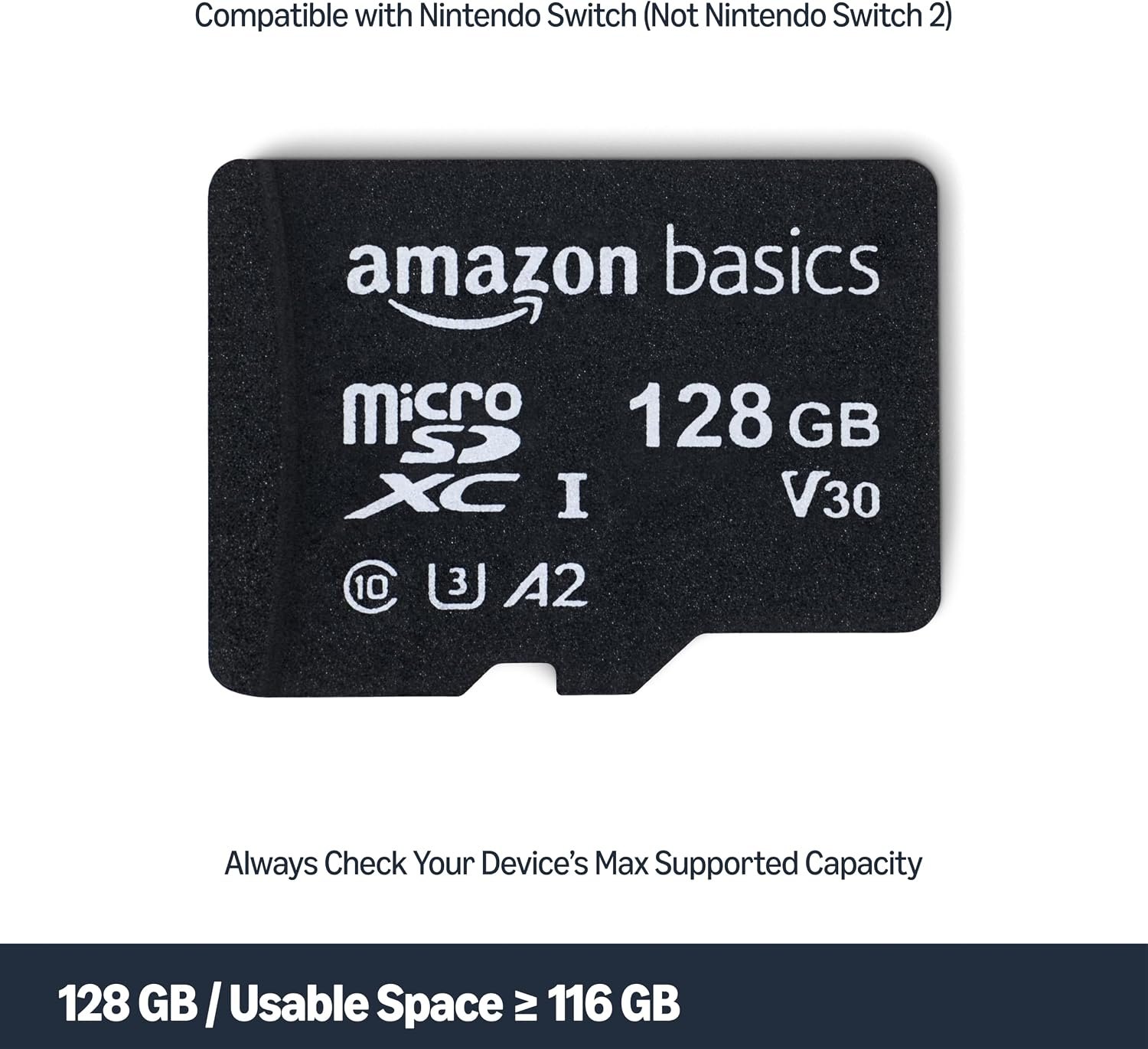
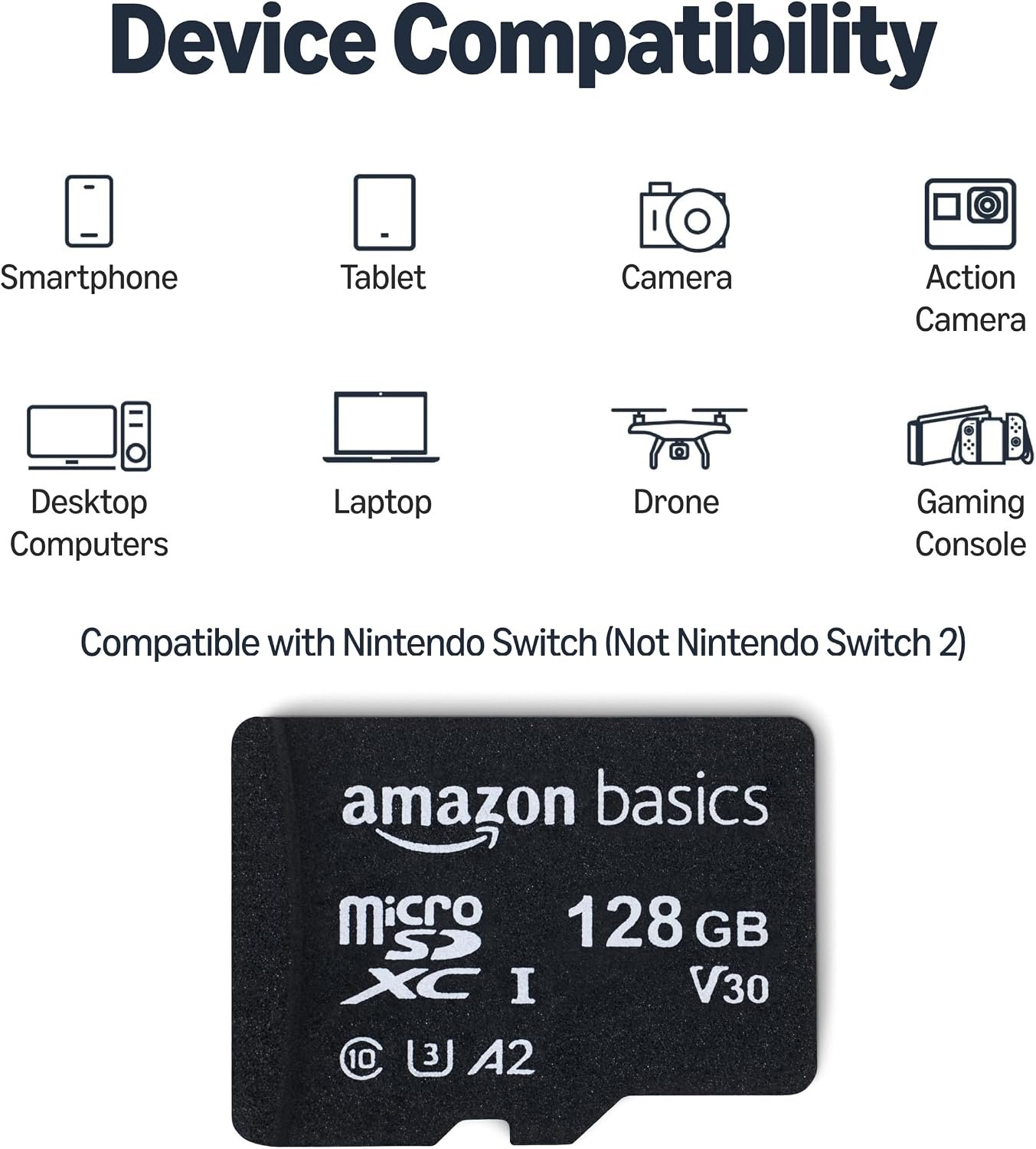
It also suits anyone topping up storage in a phone, tablet, or dashcam. The listing names cameras, drones, laptops, smartphones and tablets as compatible devices, and the A2 application class means it is built to handle app data and small random reads rather than just dumping video files. The original Nintendo Switch is covered too, though the listing is blunt that the Switch 2 is not.
Who should look elsewhere: anyone shooting high-bitrate formats on a cinema camera, or recording ProRes-class files where a V60 or V90 card is specified in the manual. The write ceiling here is listed at up to 60MB/s, which is comfortable for consumer 4K and nothing beyond it.
Design and build
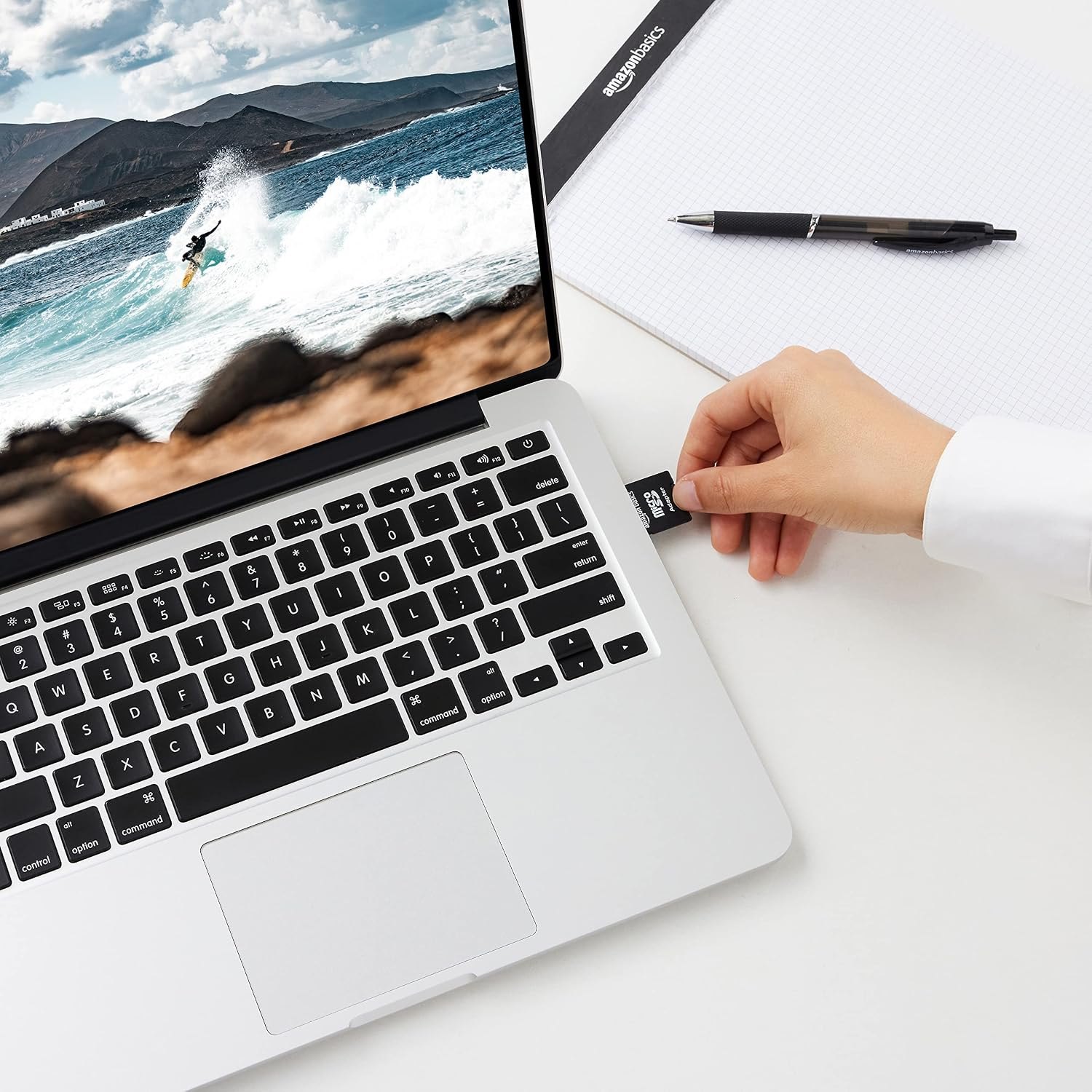
There is not much to say about the industrial design of a microSD card, and that is a compliment. It is a black card with a full-size SD adapter in the box, which matters more than it sounds: plenty of laptop card readers and older camera bodies still take full-size SD only, and buying the adapter separately is a small irritation you avoid here.
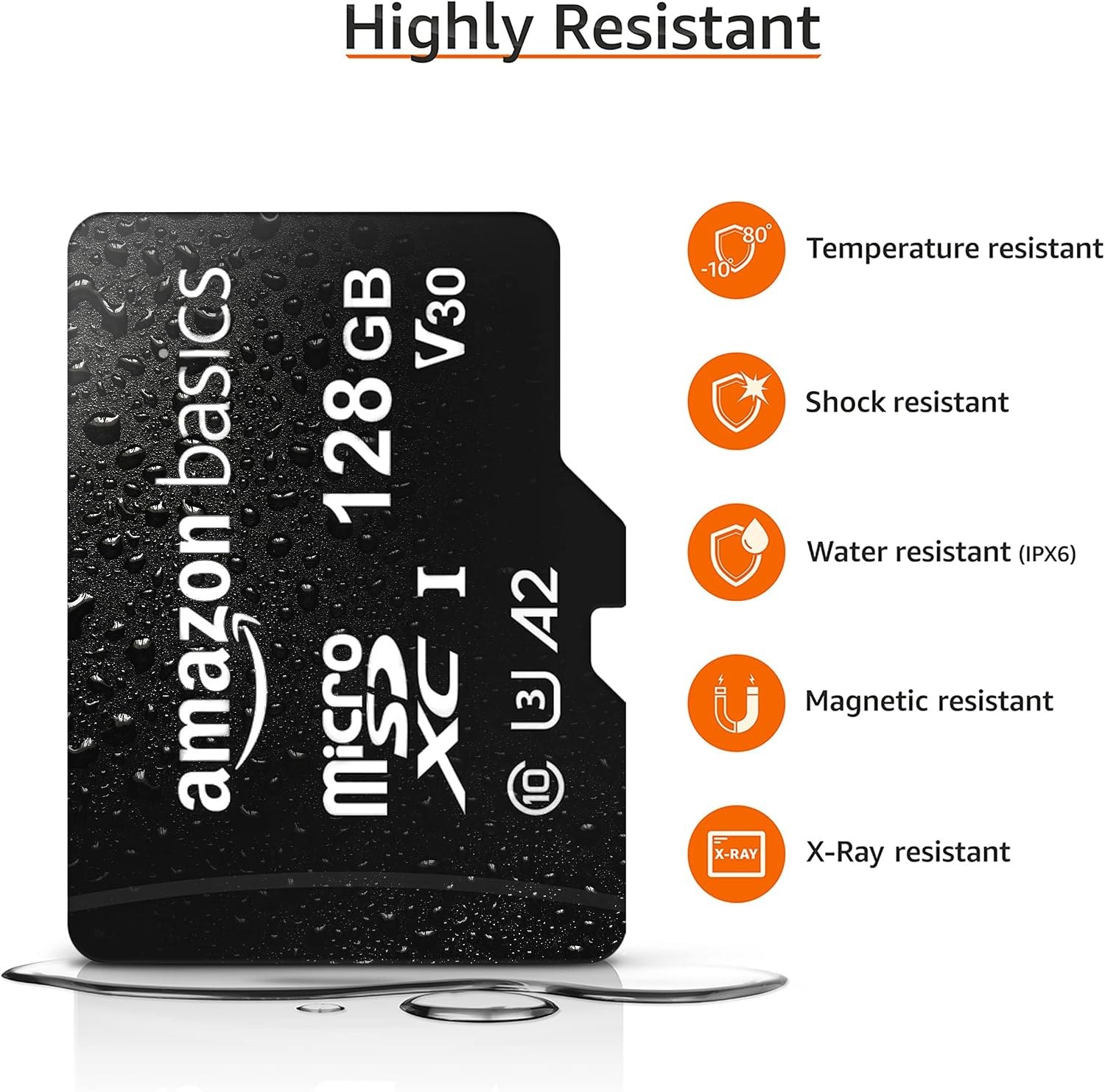
The durability claims are where the listing spends its effort. It is described as shock-resistant, IPX6 water-resistant, rated from -10°C to +80°C, and resistant to X-rays and magnetic fields. Those are standard claims across the memory card category rather than a differentiator, but they are the claims you want on a card that lives in a drone that occasionally meets the ground harder than planned, or in a backpack that goes through airport scanners every few weeks.
The -10°C lower bound is worth noting if you fly in genuine winter conditions. Some competing cards are rated down to -25°C. In practice your drone battery will give up before the card does, but it is a line in the spec sheet that a cold-weather pilot should read.
What the specs tell us
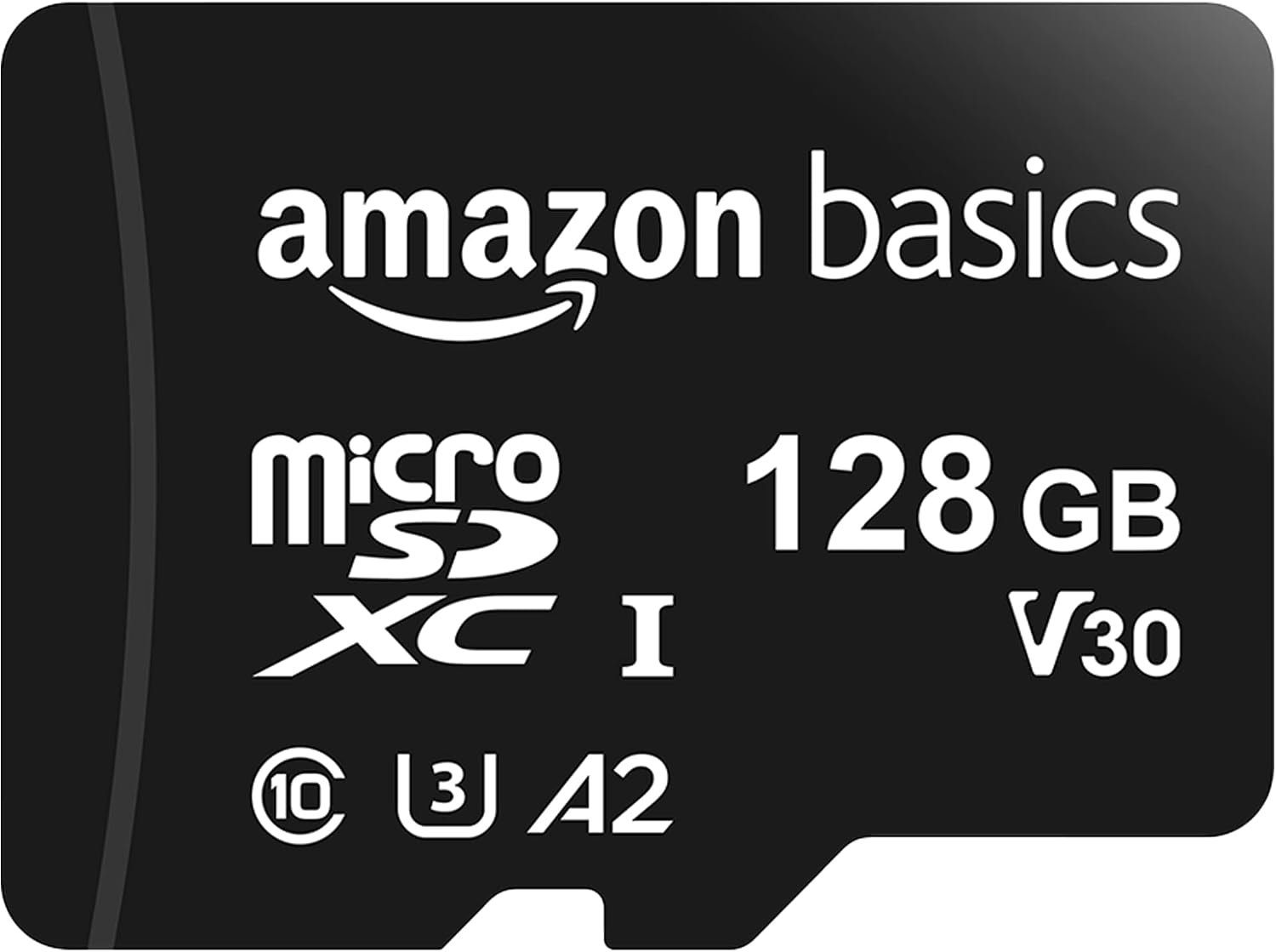
The headline figures are up to 100MB/s read and up to 60MB/s write, with C10, U3 and V30 speed class ratings over a UHS-I bus, plus A2 application performance class. Read that as: this is a well-specified UHS-I card rather than a UHS-II card. UHS-I has a hard ceiling around 104MB/s, so the quoted 100MB/s read is essentially the bus maximum, and the listing is honest in calling it lab-tested.
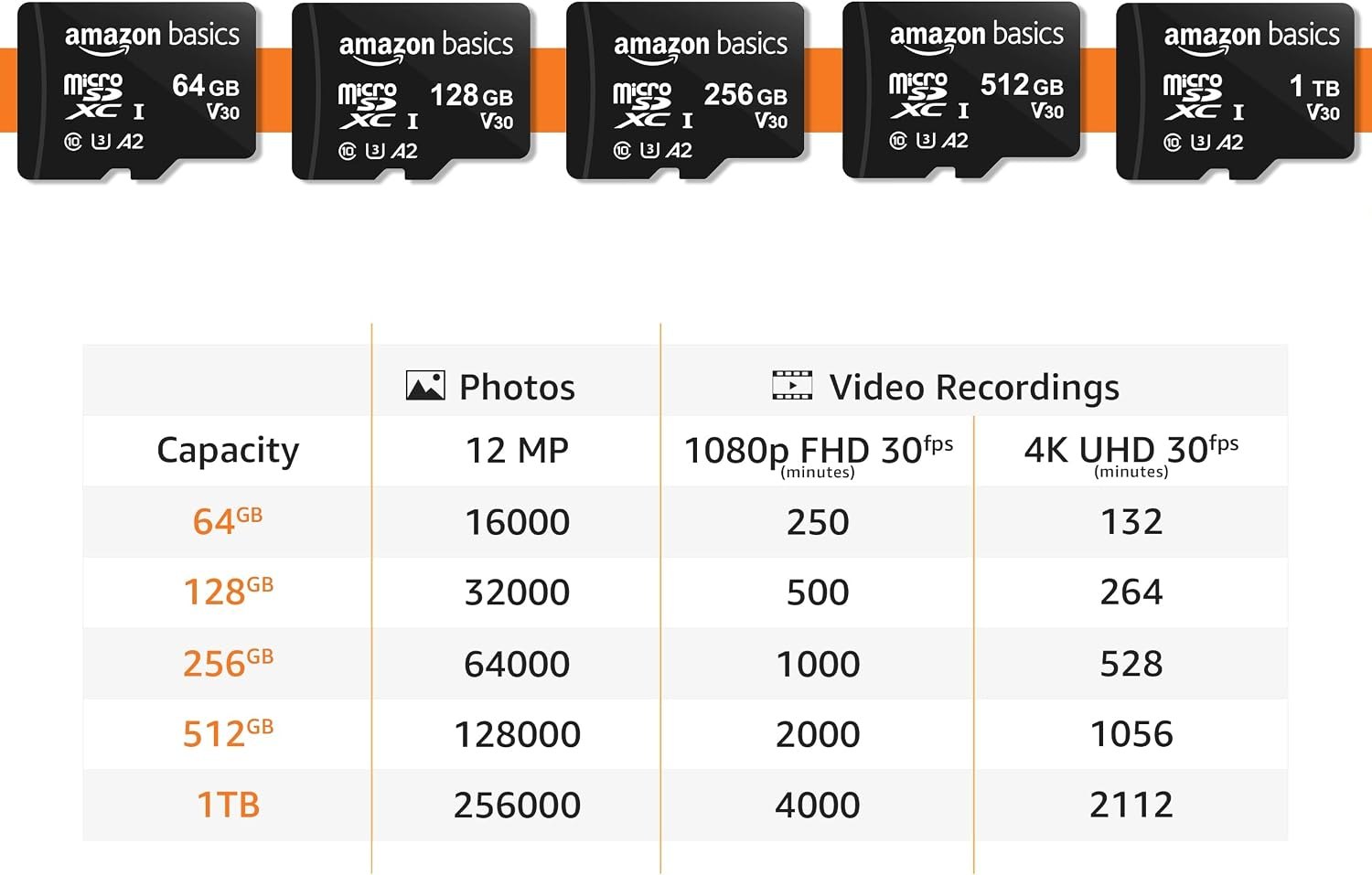
The V30 rating is the number that matters for video. It guarantees a sustained 30MB/s write floor, which is the standard that consumer 4K recording is built around. The listing translates that into 264 minutes of 4K UHD at 30fps, 500 minutes of 1080p at 30fps, or roughly 32,000 photos at 12MP. For a drone pilot working through three or four batteries a session, that is more capacity than a single outing will use.
The A2 class is the quieter spec. It targets random read and write operations rather than sequential throughput, which is why it shows up on cards intended for phones, tablets and handheld consoles. If the card is going to be pure video storage, A2 adds little. If it doubles as phone storage, it helps.
Living with it
Buyers rate it 4.7 out of 5, which is a strong score for a value storage line and suggests the failure rate owners encounter is low. Reliability is the only quality metric that really matters with memory cards, and a high aggregate score across a very large owner base is the best proxy available short of long-term lab abuse testing.
One practical detail the listing handles better than most: it publishes the usable capacity alongside the labeled capacity, so 128GB becomes 116GB or more after formatting. Every card behaves this way, but stating it upfront saves the support ticket where someone thinks they were shortchanged.
The usual card discipline applies. Format in the device that will record to it rather than on a computer, keep a second card as backup rather than filling one to the brim, and offload footage the same day. None of that is specific to this card, but cheap storage makes the discipline easier to follow because you can afford spares.
Value for money
At the time of writing the card lists at $35.14 for 128GB with the adapter included. That is middle-of-the-road pricing for a V30 A2 card rather than a clearance bargain, and microSD prices swing hard with flash supply and sale events, so the figure to judge is dollars per gigabyte on the day you look.
The value case rests on the spec sheet being complete rather than cherry-picked. You get the ratings that actually govern 4K recording, an adapter in the box, and a published usable-capacity figure. Cards that undercut this on price frequently drop the V30 rating, the A2 rating, or both, and the saving disappears the moment a recording drops frames.
Alternatives
The SanDisk Extreme microSDXC is the default recommendation in this category and typically quotes higher write speeds than this card, so pick it if you shoot high-bitrate 4K or want more headroom for future hardware. The Samsung EVO Select is the closest like-for-like competitor on price and specification, and is worth comparing on the day since the two frequently trade places on discount. For anyone whose card is going into a Nintendo Switch 2 or a cinema camera, step up to a card explicitly rated for that hardware, because neither use case is covered here.
The bottom line
This is competent, unglamorous storage that hits the ratings a consumer 4K workflow actually needs and nothing above them. The strong owner score and the honestly stated usable capacity do more for confidence than the durability marketing does. Judge it on dollars per gigabyte on the day, and buy two.
.gap-review{margin:2.5rem 0 0}.gap-review h2{font-size:1.5rem;margin:0 0 1.25rem}.gap-verdict{background:#0E1A2B;color:#fff;border-radius:16px;padding:1.5rem 1.75rem}.gap-verdict__head{display:flex;gap:1.25rem;align-items:center}.gap-score{margin:0;width:84px;height:84px;border-radius:50%;background:#FF5A1F;color:#fff;display:flex;flex-direction:column;align-items:center;justify-content:center;font-weight:800;font-size:1.9rem;line-height:1}.gap-score small{font-size:.7rem;font-weight:600;opacity:.85}.gap-eyebrow{margin:0 0 .35rem;text-transform:uppercase;letter-spacing:.08em;font-size:.75rem;font-weight:700;color:#FF5A1F}.gap-verdict__line{margin:0;font-size:1.125rem;line-height:1.45}.gap-proscons{display:grid;grid-template-columns:1fr 1fr;gap:1.25rem 2rem;margin-top:1.5rem;padding-top:1.25rem;border-top:1px solid rgba(255,255,255,.15)}.gap-proscons h3{margin:0 0 .6rem;font-size:.9rem;text-transform:uppercase;letter-spacing:.05em;color:inherit}.gap-proscons ul{list-style:none;margin:0;padding:0}.gap-proscons li{position:relative;padding-left:1.6em;margin:0 0 .45em}.gap-proscons li::before{position:absolute;left:0;top:0;font-weight:800}.gap-pros li::before{content:’+’;color:#4ADE80}.gap-cons li::before{content:’2013′;color:#F87171}.gap-specs,.gap-faq{margin-top:2rem}.gap-specs h3,.gap-faq h3{font-size:1.2rem;margin:0 0 .75rem}.gap-specs table{width:100%;border-collapse:collapse;font-size:.95rem}.gap-specs th,.gap-specs td{text-align:left;padding:.65rem .9rem;border-bottom:1px solid #E2E8F0;vertical-align:top}.gap-specs th{width:38%;background:#F4F6F9}.gap-faq details{border:1px solid #E2E8F0;border-radius:10px;padding:0 1rem;margin:0 0 .6rem}.gap-faq summary{cursor:pointer;padding:.85rem 0;font-weight:600}.gap-cta{margin-top:2rem;padding:1.25rem 1.5rem;background:#F4F6F9;border-radius:16px;display:flex;flex-wrap:wrap;gap:.75rem;align-items:center}.gap-btn{display:inline-block;padding:.85em 1.5em;border-radius:10px;font-weight:600;text-decoration:none!important;background:#FF5A1F;color:#fff!important}.gap-btn–secondary{background:transparent;color:#0E1A2B!important;border:2px solid #E2E8F0}.gap-disclosure,.gap-note{font-size:.875rem;color:#4A5568;margin:.75rem 0 0}@media(max-width:640px){.gap-proscons{grid-template-columns:1fr}}
Amazon Basics 128GB microSDXC Card (A2 review
7.4/10
madagear.com verdict
Buy it if you want a cheap spare card for 4K drone and action footage; skip it if your camera needs sustained write speeds above the V30 floor.
What we like
- A2 and V30 ratings cover 4K UHD recording and app-class random access
- Full-size SD adapter included, so card readers and older slots are handled
- Rated capacity is stated honestly: 128GB label, 116GB or more usable
- Shock, IPX6 water, X-ray and magnetic resistance for travel and field use
- Buyers rate it 4.7 out of 5, which is strong for a budget storage line
- 264 minutes of 4K UHD 30fps claimed, enough for a long flying session
What we don’t
- Write speed tops out around 60MB/s, below faster V60 and V90 cards
- Not compatible with Nintendo Switch 2, only the original Switch
- Low-temperature rating stops at -10C, tighter than some rival cards
- Read speed of 100MB/s is lab-tested, so card reader results will vary
Specs at a glance
| Capacity | 128 GB (≥116GB usable) |
|---|---|
| Model | LSMICRO128GU3 |
| Format | microSDXC |
| Speed class | C10 / U3 / V30 |
| App class | A2 |
| Bus interface | UHS-I |
| Read speed | Up to 100 MB/s |
| Write speed | Up to 60 MB/s |
| 4K UHD 30fps capacity | 264 minutes |
| Temperature range | -10°C to 80°C |
Frequently asked questions
Is this card fast enough for 4K drone footage?
On paper, yes. The V30 rating guarantees a sustained 30MB/s write floor, which is the standard requirement for 4K UHD recording on current consumer drones and action cameras. Only high-bitrate modes on pro-tier bodies push past what V30 covers.
Why does the card show less than 128GB when I format it?
The listing states 116GB or more usable on the 128GB card. That gap comes from the difference between decimal and binary capacity math plus the space the file system reserves. Every manufacturer has the same gap, this one just spells it out.
Does it work with the Nintendo Switch?
The listing confirms compatibility with the original Nintendo Switch but explicitly rules out the Switch 2. If you own the newer console, look for a card listed as Switch 2 compatible instead, since that hardware uses a different card standard.
What does the A2 rating actually change?
A2 is about random read and write performance rather than big sequential transfers, so it mainly helps when a card is running apps or handling many small files. For pure video capture the V30 rating matters more, but A2 is useful if the card doubles as phone or tablet storage.
At the time of writing the card is $35.14, which covers the 128GB card and a full-size SD adapter, and microSD pricing moves constantly with flash supply and sales events. Price and availability checked on 2026-11-14.
madagear.com is reader-supported. When you buy through links on our site we may earn an affiliate commission, at no extra cost to you. This never affects what we recommend.


Reviews
There are no reviews yet.