




Description
Who it’s for
The HS900 is for the buyer who wants the formula DJI made popular, a sub-250 g folding drone with a three-axis gimbal, from a budget brand at a budget price. It suits beginners stepping up from a toy or an EIS-only drone, and casual travelers who want smooth clips without registering anything. It is not for pilots who rely on obstacle sensing, want slow-motion 4K, or need the most refined app experience.
Design and build
Folded, the HS900 measures 143 by 82.8 by 62 mm and Holy Stone lists it at 249 g, just under the FAA’s registration threshold. Brushless motors drive folding props, and the battery is a 7.7 V 2250 mAh LiPo rated for up to 30 minutes.
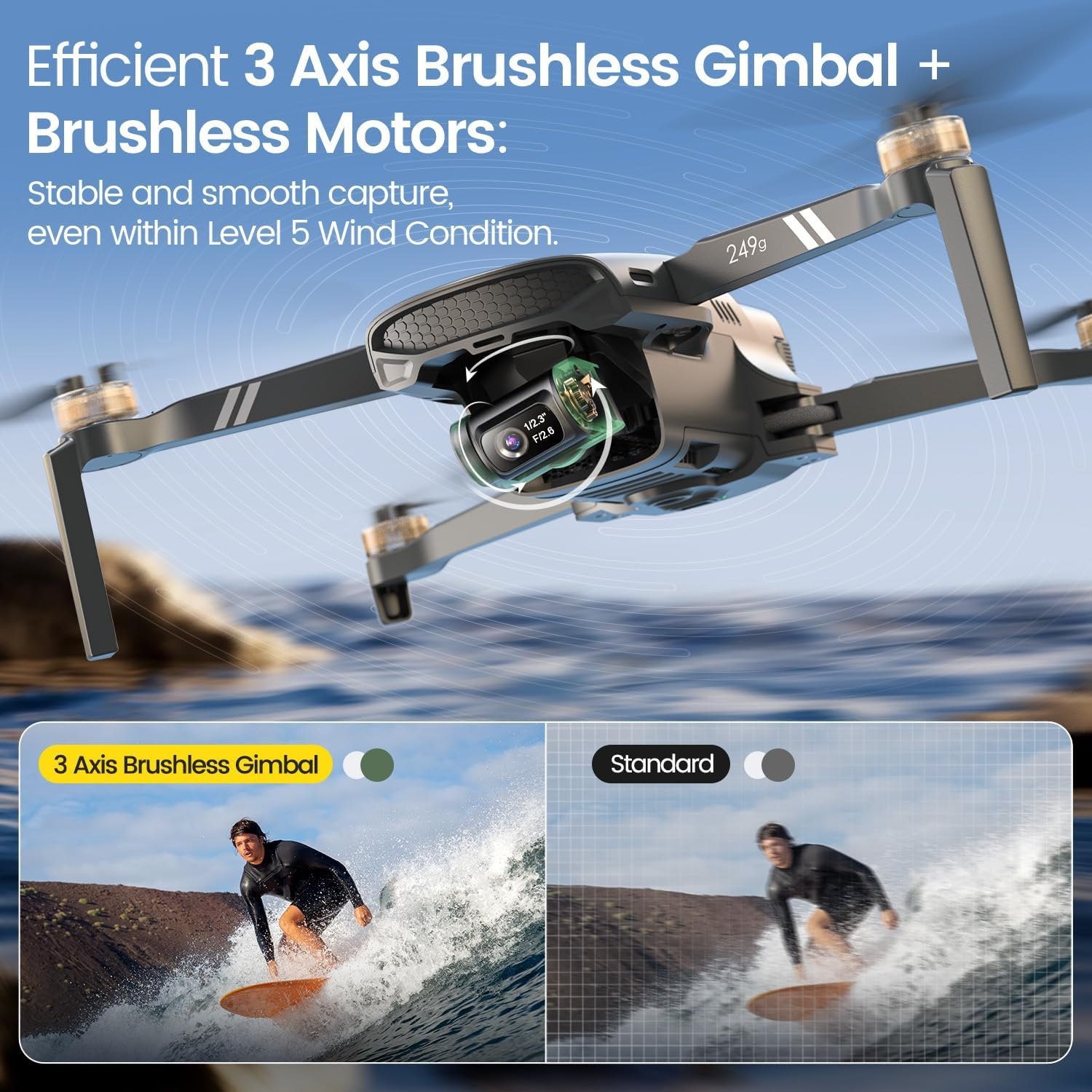
The camera is the reason to buy it. A 1/2.3-inch 48 MP sensor sits on a three-axis mechanical gimbal that tilts from straight down to 30 degrees above the horizon, with Holy Stone quoting stabilization accuracy of 0.01 degrees. Under the body, a downward ToF sensor and visual positioning help it hold a steady hover close to the ground.
The box includes the drone, controller, battery, spare props, a gimbal cover, cables for both Lightning and USB-C phones, and a backpack. A microSD card up to 128 GB is not included.
Camera and flight
Video records at 4K and 30 fps or 1080p at 60 fps, with a bit rate of up to 100 Mbps, and stills come out at 48 MP. On paper that is a meaningful step up from Holy Stone’s EIS models such as the HS360E, and the gimbal is the real difference: pans stay smooth and horizons stay level in a breeze, which electronic stabilization cannot fully match. Expect the usual 1/2.3-inch limits in shade and at dusk, and expect a 30 fps ceiling rather than the 60 fps 4K of more expensive drones.
Flight relies on GPS for position hold and return-to-home, and Holy Stone lists a Level 5 wind rating. The link is rated to 6 km and uses a cable from controller to phone rather than Wi-Fi, which tends to give a steadier feed and avoids the 5 GHz phone-compatibility trap of older Holy Stone models. Holy Stone’s store describes the Fly More version’s link as 5.8 GHz digital, while the standard edition runs on 2.4 GHz. Smart modes include Cruise Control, Waypoint Flight, Point of Interest, Spiral Up, Tap Fly, Gesture Selfie and time-lapse.
There is no obstacle avoidance beyond the downward sensors, so automated modes near trees need your attention.
Living with it
You fly with Holy Stone’s HS900 app on iOS or Android and a phone cabled to the controller, whose built-in 3900 mAh battery means no AA cells. Holy Stone’s apps cover the basics and the smart modes, but they are plainer than DJI’s, so expect fewer guided tutorials and editing tools.
Legally it is simple in the US: at 249 g, recreational flyers do not need to register it or broadcast Remote ID. The HS900 is an existing, FCC-authorized model, so the December 2025 Covered List action on new foreign drones does not stop it being sold.
Value for money
At the time of writing Holy Stone’s own store lists the HS900 from $269.99, with the two-battery Fly More Combo at $379.99. At under $300 it competes directly with the Potensic Atom, which offers a similar gimbal-and-tracking package, and undercuts the Potensic Atom 2, which has a larger sensor and a 10 km link. The HS900 has a slightly larger sensor than the original Atom and a wider lens; the Atom has better-known tracking.
Alternatives
- Potensic Atom 2: pick it if you can spend a bit more for a 1/2-inch sensor, 4K HDR and AI tracking.
- Potensic Atom: pick it if you want a similar gimbal drone with established visual tracking at about the same price.
- Holy Stone HS720G: pick it if longer flights matter more than staying under 250 g.
The bottom line
The HS900 is the best-equipped sub-250 g drone Holy Stone sells at this price, and the three-axis gimbal makes it a real camera drone rather than a flying webcam. No obstacle sensing and a 30 fps 4K ceiling are the trade-offs. Check which edition you are buying, add a spare battery, and it is a solid budget alternative to the DJI Mini range.
.gap-review{margin:2.5rem 0 0}.gap-review h2{font-size:1.5rem;margin:0 0 1.25rem}.gap-verdict{background:#0E1A2B;color:#fff;border-radius:16px;padding:1.5rem 1.75rem}.gap-verdict__head{display:flex;gap:1.25rem;align-items:center}.gap-score{margin:0;width:84px;height:84px;border-radius:50%;background:#FF5A1F;color:#fff;display:flex;flex-direction:column;align-items:center;justify-content:center;font-weight:800;font-size:1.9rem;line-height:1}.gap-score small{font-size:.7rem;font-weight:600;opacity:.85}.gap-eyebrow{margin:0 0 .35rem;text-transform:uppercase;letter-spacing:.08em;font-size:.75rem;font-weight:700;color:#FF5A1F}.gap-verdict__line{margin:0;font-size:1.125rem;line-height:1.45}.gap-proscons{display:grid;grid-template-columns:1fr 1fr;gap:1.25rem 2rem;margin-top:1.5rem;padding-top:1.25rem;border-top:1px solid rgba(255,255,255,.15)}.gap-proscons h3{margin:0 0 .6rem;font-size:.9rem;text-transform:uppercase;letter-spacing:.05em;color:inherit}.gap-proscons ul{list-style:none;margin:0;padding:0}.gap-proscons li{position:relative;padding-left:1.6em;margin:0 0 .45em}.gap-proscons li::before{position:absolute;left:0;top:0;font-weight:800}.gap-pros li::before{content:’+’;color:#4ADE80}.gap-cons li::before{content:’2013′;color:#F87171}.gap-specs,.gap-faq{margin-top:2rem}.gap-specs h3,.gap-faq h3{font-size:1.2rem;margin:0 0 .75rem}.gap-specs table{width:100%;border-collapse:collapse;font-size:.95rem}.gap-specs th,.gap-specs td{text-align:left;padding:.65rem .9rem;border-bottom:1px solid #E2E8F0;vertical-align:top}.gap-specs th{width:38%;background:#F4F6F9}.gap-faq details{border:1px solid #E2E8F0;border-radius:10px;padding:0 1rem;margin:0 0 .6rem}.gap-faq summary{cursor:pointer;padding:.85rem 0;font-weight:600}.gap-cta{margin-top:2rem;padding:1.25rem 1.5rem;background:#F4F6F9;border-radius:16px;display:flex;flex-wrap:wrap;gap:.75rem;align-items:center}.gap-btn{display:inline-block;padding:.85em 1.5em;border-radius:10px;font-weight:600;text-decoration:none!important;background:#FF5A1F;color:#fff!important}.gap-btn–secondary{background:transparent;color:#0E1A2B!important;border:2px solid #E2E8F0}.gap-disclosure,.gap-note{font-size:.875rem;color:#4A5568;margin:.75rem 0 0}@media(max-width:640px){.gap-proscons{grid-template-columns:1fr}}
Holy Stone HS900 review
7.4/10
madagear.com verdict
Buy it if you want gimbal-stabilized 4K and no registration for under $300; skip it if you need obstacle avoidance, high-frame-rate video or the polish of DJI’s app.
What we like
- Three-axis mechanical gimbal, tilt -90 to +30 degrees
- 249 g, so no FAA registration for recreational flying
- 1/2.3-inch 48 MP sensor with 4K/30 at up to 100 Mbps
- Wired phone connection and a link rated to 6 km
- Cruise control, waypoints and Point of Interest modes
What we don’t
- No obstacle avoidance
- 4K limited to 30 fps
- Two editions with different radio bands make shopping confusing
- Holy Stone’s app is less polished than DJI’s or Potensic’s
Specs at a glance
| Takeoff weight | 249 g |
|---|---|
| Folded size | 143 x 82.8 x 62 mm |
| Camera | 1/2.3-inch CMOS, 48 MP, 83 degree field of view |
| Video | 4K/30fps, 1080p/60fps, up to 100 Mbps |
| Gimbal | 3-axis mechanical, pitch -90 to +30 degrees |
| Flight time | Up to 30 min per battery (manufacturer figure) |
| Battery | 7.7 V 2250 mAh LiPo |
| Transmission | Up to 6 km, wired connection from controller to phone |
| Wind resistance | Level 5 |
| Positioning | GPS plus downward ToF and visual positioning |
Frequently asked questions
Do I need to register the Holy Stone HS900?
Not for recreational flying in the US. Holy Stone lists it at 249 g, below the FAA’s 250 g threshold, so registration and Remote ID are not required unless you fly commercially under Part 107.
What is the difference between the HS900 standard edition and the Fly More Combo?
Holy Stone sells a 2.4 GHz standard edition with one battery and a 5.8 GHz Fly More Combo with two batteries and a charging hub. Check which version a listing is before you buy, because the controller and price differ.
Does the HS900 have obstacle avoidance?
No. It has downward ToF and visual sensors for steady low hovering and landing, but nothing facing forward or sideways.
Is the HS900 the same as the HS900 PRO?
No. The HS900 PRO is a separate, newer model sold at a higher price. This review covers the standard HS900.
Holy Stone’s store lists the HS900 from $269.99 for the 2.4 GHz standard edition; the 5.8 GHz Fly More Combo with two batteries and a charging hub is $379.99 (list $499.99). Amazon prices vary by kit. Price and availability checked on 2026-11-10.
madagear.com is reader-supported. When you buy through links on our site we may earn an affiliate commission, at no extra cost to you. This never affects what we recommend.


Reviews
There are no reviews yet.