


Description
Who it’s for
This is the charger you buy when the one that came in your drone box has stopped being enough. Nearly every ready-to-fly quad, RC car and boat ships with a basic brick that pushes a single cell count at a fixed current, gives you no balance readout and no way to bring a pack down to storage voltage. The moment you own a second battery, or a second model, that brick becomes the bottleneck.
The HTRC N2B6V2 is aimed squarely at that upgrade step. On paper it handles 1-6S LiPo, LiFe and Li-ion, 1-15 cell NiMH and NiCD, and lead acid from 2 to 20V, which is a spread wide enough to cover a cinewhoop, a 1/10 scale buggy running NiMH, and a receiver pack in the same drawer. If you are flying 7-inch long range or anything above 6S, this is not your charger. If you are running 2S whoops up to 6S freestyle quads, it is in range.
It also suits people who want functions rather than speed. Terminal voltage control, capacity and voltage checking, storage mode, and data memory for repeated pack profiles are all listed features. Those belong to a class of charger that usually costs more.
Design and build
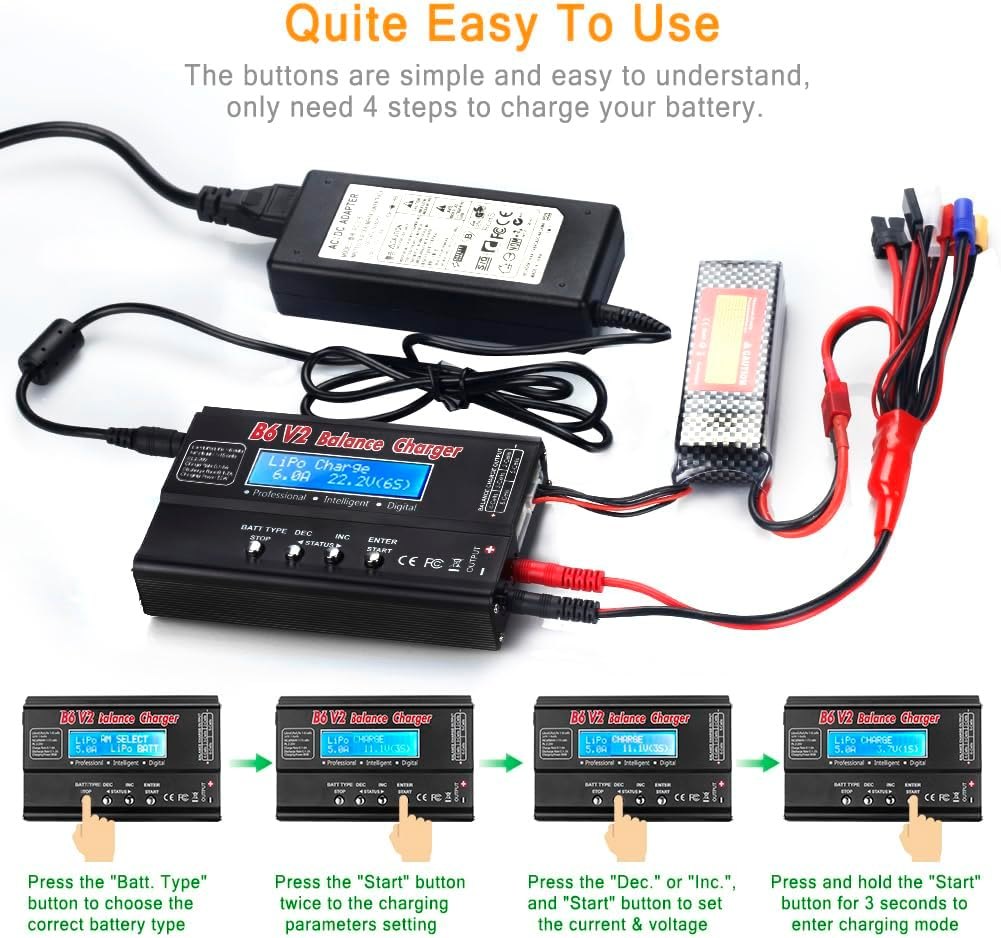
The unit is black, small, and built around a single output with two ports, a barrel jack cable feed and crocodile clips for pulling power off a car battery or bench supply. The listing says the shell is fire-resistant material, which is a reasonable claim to make about a device that sits unattended next to lithium packs, though it is worth treating as a last line of defense rather than a license to leave a charge running overnight.
The important design decision here is that it runs on DC input only, 11V to 18V. The included 15V 6A adapter makes that invisible on a desk, but it means two pieces of kit instead of one. Chargers with built-in AC power supplies are tidier for travel. The upside of the DC-only approach is that at the field you can clip it directly to a car battery and keep charging after the mains runs out.
Controls on this class of unit are a small screen and a handful of buttons, and the listing is clear that charge and discharge modes expect you to set voltage and current yourself while balance mode adjusts automatically. That split is standard, and it is also where new owners make mistakes.
What the specs tell us
Eighty watts and six amps is the number that defines the experience. Power is the constraint, not current: at 6A you could theoretically fill a 1500mAh 4S pack at 4C, but 80W across a 4S pack at roughly 16.8V caps you closer to 4.5A, and on 6S closer to 3A. In practice that means comfortable 1C to 2C charging on typical quad packs and slower work on anything large.
The cell count range is more generous than the wattage. NiMH and NiCD up to 15 cells is unusual on a modern charger and useful if you still run older ground models or transmitter packs. Smart battery support and the Pb range round out a feature list that reads more like a mid-tier unit than a $40 one.
The automatic cutoff when a pack reaches full charge is listed, as is a two-year warranty description. Buyers rate it 4.5 out of 5, which suggests the basics hold up. The Best Sellers Rank of #22 in RC Battery Chargers indicates it moves steadily rather than sitting as a niche listing.
Living with it
The daily reality of a charger like this is a queue. One output means packs go through in sequence, so a four-battery flying session becomes an hour or more of charging if you start from storage voltage. The included connector splitter opens the door to parallel charging, but that technique demands packs at matched voltage and matched cell count, and getting it wrong is how people start fires.
Storage mode is the feature that will actually change your habits. Leaving LiPo packs at 4.2V per cell for weeks measurably ages them, and having a one-button way to bring them back to roughly 3.8V per cell after a session is worth more over a year than a faster charge rate would be.
The setup caveats in the listing are worth repeating: do not connect the AC cable and DC cord simultaneously, and do not substitute a laptop adapter. Both are the kind of warning that exists because people have done it.
Value for money
At $39.99 at the time of writing, the bundle does most of the arguing. A standalone charger at this price usually arrives bare, leaving you to source a power supply for another $25 to $40. Getting the 15V 6A adapter, crocodile clips, splitter, AC cable and a protective bag in the box makes the real cost of entry lower than the sticker suggests.
What you give up is headroom. Spend double and you get 200W-plus, dual channels, and often an integrated AC supply. Whether that matters depends entirely on how many packs you own and how impatient you are between flights.
Alternatives
The SkyRC IMAX B6 family is the reference point in this category and the design most clones trace back to; pick it if you want the most widely documented interface and the largest pool of community troubleshooting advice.
ISDT chargers such as the Q6 series cost more but push far higher wattage in a smaller body with a better screen; choose one if you are charging 6S packs regularly and the extra minutes per pack genuinely bother you.
ToolkitRC M6 or M7 units sit in similar territory with sharper displays and built-in servo and ESC testing; they suit builders who want the charger to double as a bench diagnostic tool.
The bottom line
As a first real charger, the N2B6V2 does the job that matters: it balances, it stores, and it covers nearly every chemistry you are likely to own, for less than the cost of two spare packs. The wattage ceiling is the honest limitation, and it is the thing that will eventually push a busy pilot toward a bigger unit. Until then, this is a sensible and well-equipped way to stop treating batteries as disposable.
.gap-review{margin:2.5rem 0 0}.gap-review h2{font-size:1.5rem;margin:0 0 1.25rem}.gap-verdict{background:#0E1A2B;color:#fff;border-radius:16px;padding:1.5rem 1.75rem}.gap-verdict__head{display:flex;gap:1.25rem;align-items:center}.gap-score{margin:0;width:84px;height:84px;border-radius:50%;background:#FF5A1F;color:#fff;display:flex;flex-direction:column;align-items:center;justify-content:center;font-weight:800;font-size:1.9rem;line-height:1}.gap-score small{font-size:.7rem;font-weight:600;opacity:.85}.gap-eyebrow{margin:0 0 .35rem;text-transform:uppercase;letter-spacing:.08em;font-size:.75rem;font-weight:700;color:#FF5A1F}.gap-verdict__line{margin:0;font-size:1.125rem;line-height:1.45}.gap-proscons{display:grid;grid-template-columns:1fr 1fr;gap:1.25rem 2rem;margin-top:1.5rem;padding-top:1.25rem;border-top:1px solid rgba(255,255,255,.15)}.gap-proscons h3{margin:0 0 .6rem;font-size:.9rem;text-transform:uppercase;letter-spacing:.05em;color:inherit}.gap-proscons ul{list-style:none;margin:0;padding:0}.gap-proscons li{position:relative;padding-left:1.6em;margin:0 0 .45em}.gap-proscons li::before{position:absolute;left:0;top:0;font-weight:800}.gap-pros li::before{content:’+’;color:#4ADE80}.gap-cons li::before{content:’2013′;color:#F87171}.gap-specs,.gap-faq{margin-top:2rem}.gap-specs h3,.gap-faq h3{font-size:1.2rem;margin:0 0 .75rem}.gap-specs table{width:100%;border-collapse:collapse;font-size:.95rem}.gap-specs th,.gap-specs td{text-align:left;padding:.65rem .9rem;border-bottom:1px solid #E2E8F0;vertical-align:top}.gap-specs th{width:38%;background:#F4F6F9}.gap-faq details{border:1px solid #E2E8F0;border-radius:10px;padding:0 1rem;margin:0 0 .6rem}.gap-faq summary{cursor:pointer;padding:.85rem 0;font-weight:600}.gap-cta{margin-top:2rem;padding:1.25rem 1.5rem;background:#F4F6F9;border-radius:16px;display:flex;flex-wrap:wrap;gap:.75rem;align-items:center}.gap-btn{display:inline-block;padding:.85em 1.5em;border-radius:10px;font-weight:600;text-decoration:none!important;background:#FF5A1F;color:#fff!important}.gap-btn–secondary{background:transparent;color:#0E1A2B!important;border:2px solid #E2E8F0}.gap-disclosure,.gap-note{font-size:.875rem;color:#4A5568;margin:.75rem 0 0}@media(max-width:640px){.gap-proscons{grid-template-columns:1fr}}
HTRC N2B6V2 80W 6A Balance Charger review
7.4/10
madagear.com verdict
Buy it if you fly or drive on loose LiPo packs and want storage charging without spending much; skip it if you need high wattage, multiple simultaneous channels, or an all-in-one AC unit you can throw in a field bag.
What we like
- Handles LiPo, LiFe, Li-ion, NiMH, NiCD, Pb and smart batteries in one unit
- Covers 1-6S lithium packs, which fits most consumer drone and FPV sizes
- Includes storage mode, important for LiPo pack life between sessions
- Ships with adapter, clips, splitter and a protective bag, so no extra buys
- Buyers rate it 4.5 out of 5, with cutoff and fire-resistant shell noted
- Two-year warranty description is longer than most budget chargers list
What we don’t
- 80W and 6A limits charge speed on larger 4S-6S packs
- Single output means packs get charged one at a time
- Needs the DC adapter, so it is not a compact field unit
- Manual mode setup has a learning curve for first-time charger owners
Specs at a glance
| Brand | HTRC |
|---|---|
| Model | N2B6V2 |
| Max power | 80W |
| Max current | 6 A |
| Input voltage | DC 11V-18V |
| Lithium cell count | 1-6S LiPo, LiFe, Li-ion |
| NiMH / NiCD cells | 1-15 cells |
| Lead acid range | 2-20V |
| Ports | 2 |
| Warranty | 2 year warranty |
Frequently asked questions
Can it charge a 6S FPV pack?
Yes, the listed lithium range covers 1-6 cells for LiPo, LiFe and Li-ion. At 80W the current will be limited on a big 6S pack, so expect longer charge times than a 200W-plus unit would give you.
Does it run straight from a wall outlet?
It is a DC charger that takes 11V-18V input, and the bundle includes a 15V 6A adapter plus an AC cable. The listing warns against using the AC cable and DC cord at the same time, and against substituting a laptop adapter.
Does it have a storage mode for LiPo packs?
Yes, storage mode is one of the listed functions alongside charge, discharge and balance. That matters because leaving LiPo packs at full charge for weeks shortens their usable life.
How many packs can it charge at once?
One at a time. The connector splitter in the box helps with parallel charging setups, but that is an advanced technique and carries real risk if the packs are not closely matched in voltage.
At the time of writing it sells for $39.99, which covers the charger, a 15V 6A adapter, crocodile clips, a connector splitter, AC cable and a protective bag, and prices on this class of charger move with seasonal hobby sales. Price and availability checked on 2026-11-14.
madagear.com is reader-supported. When you buy through links on our site we may earn an affiliate commission, at no extra cost to you. This never affects what we recommend.


Reviews
There are no reviews yet.