


Description
Who it’s for
The Atom SE is for the beginner who wants to learn to fly a real GPS drone, one that holds position, comes home on its own and stays up for half an hour, without spending gimbal money or registering it. It suits teenagers, casual hobbyists and anyone who has crashed a toy drone and wants something that behaves. It is not for buyers who judge drones by their footage; at this price Potensic made a clear trade, putting the money into flight hardware rather than camera stabilization.
Design and build
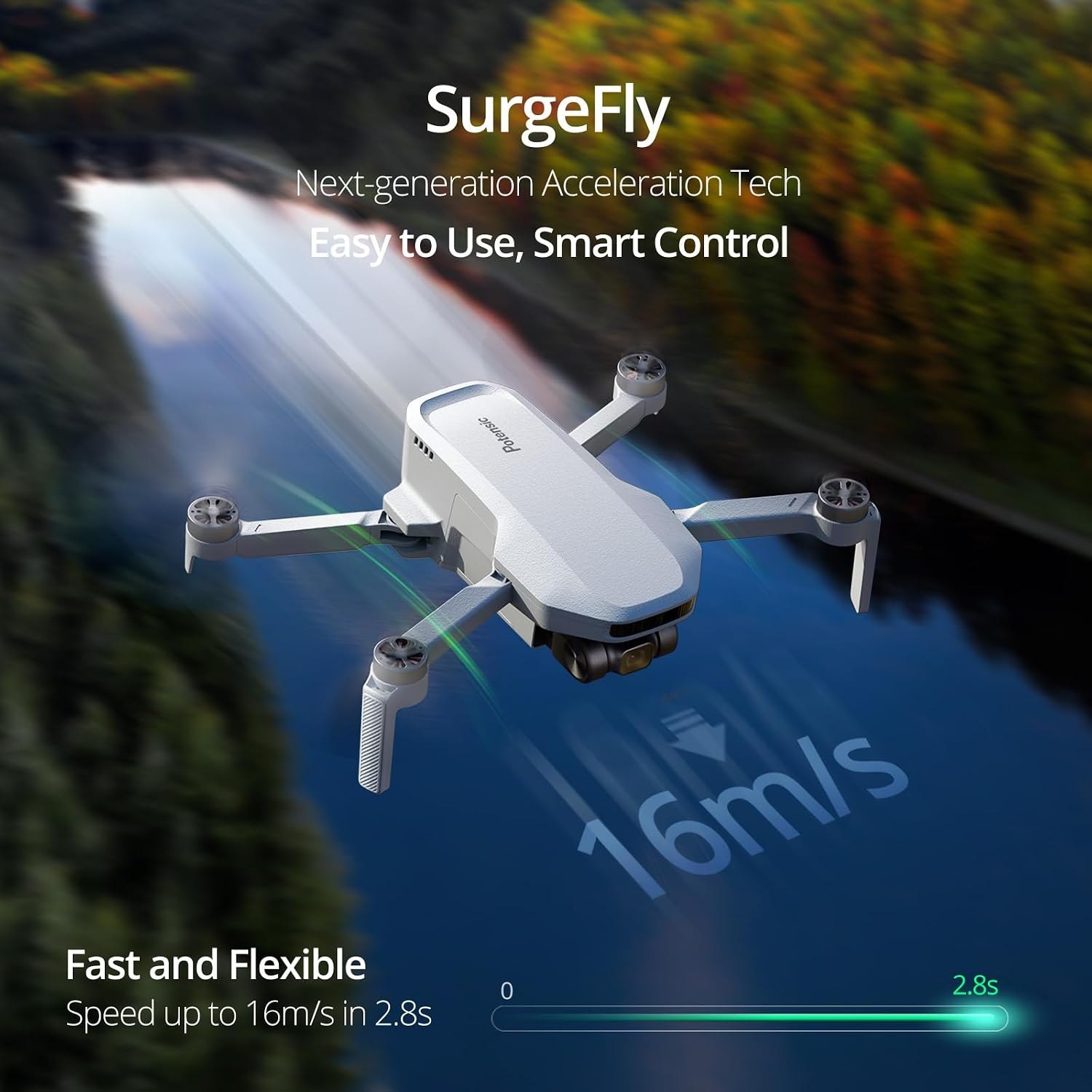
The SE uses the folding layout that Potensic shares across its Atom line, and it weighs under 249 g with the battery fitted. Brushless motors are the important detail; they are more efficient and more durable than the brushed motors found on most drones below $150, and they are why the SE can claim a Level 5 wind rating and a 16 m/s Sport mode.
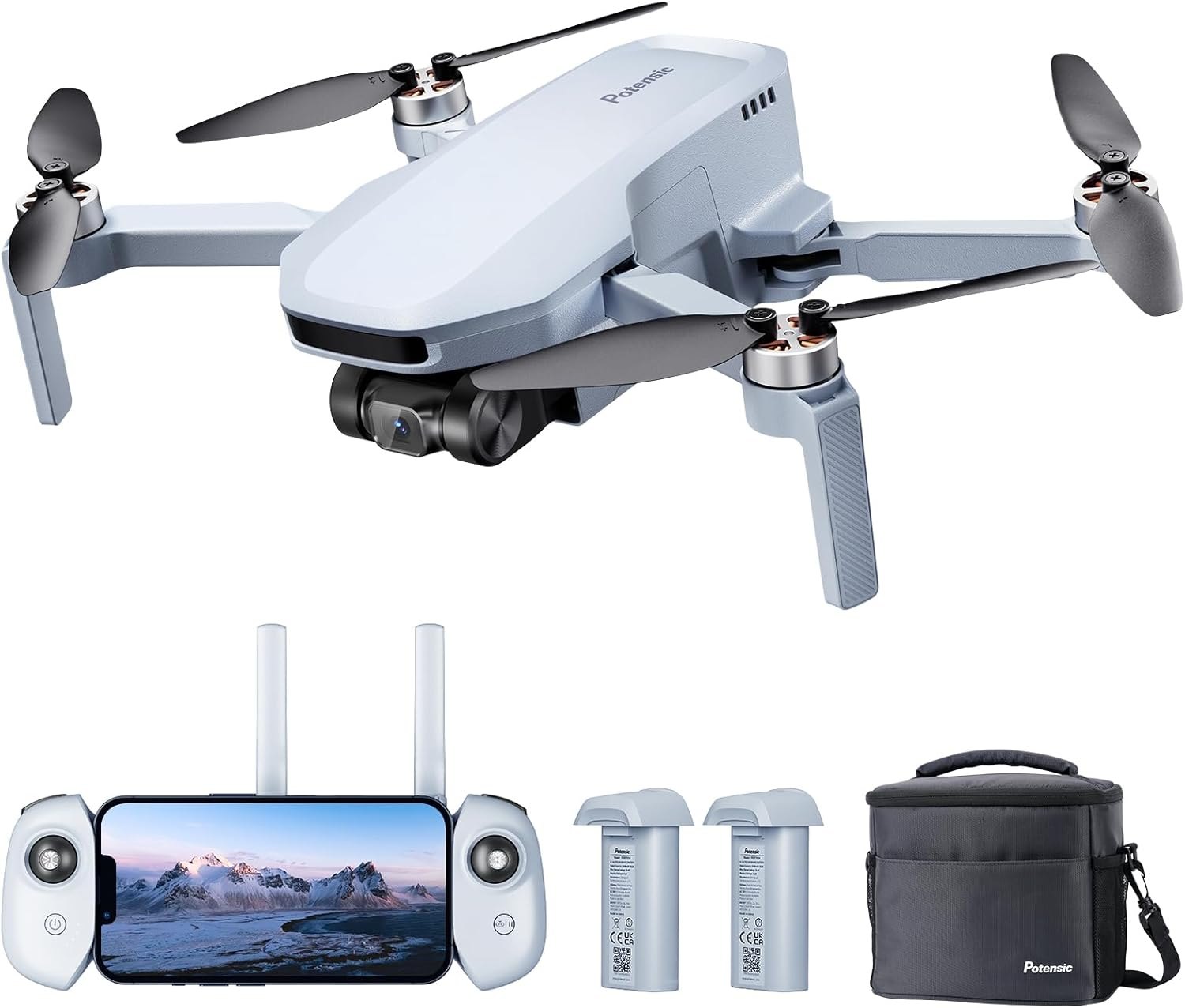
The camera sits in the nose on a single-axis tilt mechanism that moves from straight down to 20 degrees up. Potensic handles the other axes with ShakeVanish electronic stabilization. The standard kit ships with two 2500 mAh batteries, which is a meaningful extra at this price. Bring your own microSD card.
Camera and flight
The 12 MP Sony sensor records 4K at up to 30 fps, plus 2.7K and 1080p at up to 60 fps, and saves stills in JPEG or RAW DNG. Comparison sites list the sensor at 1/3 inch, which explains the results: in bright, even light the footage is clean enough for social clips, while shadows, sunsets and indoor light expose the small sensor quickly. Reviews have been consistent on this point: the SE flies well and is packed with features, but the camera underwhelms.
Stabilization is the other limit. EIS crops the frame and works on what the sensor captured, so it smooths gentle pans well but cannot fully hide the drone rocking in gusts. If you shoot slow, deliberate moves in calm air, the SE produces usable clips. If you want the floating look of a gimbal drone, step up to the Atom.
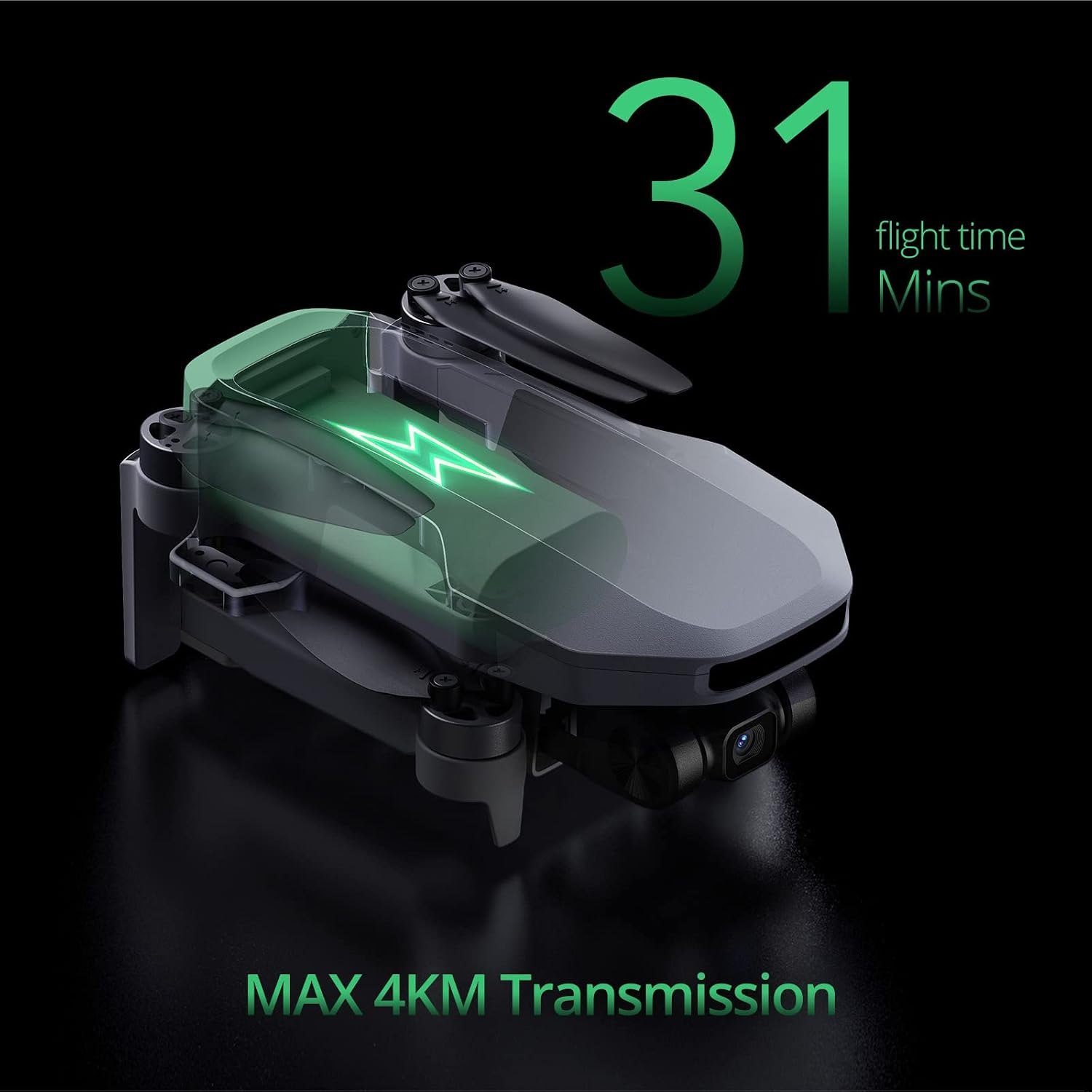
As a flying machine, the SE is easy to recommend. GPS, a ToF sensor and downward vision give a steady hover, return-to-home triggers on low battery, signal loss or a button press, and the app offers Follow Me, Circle, Waypoint and Point of Interest modes. Potensic quotes 31 minutes per battery; comparison testing puts real flights in the mid-20s, which is still a long session for a beginner. The PixSync 2.0 link is rated to 4 km with a 720p feed, though comparison testing puts a stable picture at a few hundred meters.
Living with it
You fly with the PotensicPro app on iOS or Android and the included controller. The app is straightforward, and three speed modes (Video, Normal and Sport) make it easy to start slow. Two batteries per kit means two flights before charging, and Potensic sells a parallel charging hub in combo kits.
On the legal side, the SE is simple in the US: under 249 g and flown for fun, it needs neither FAA registration nor Remote ID. Its FCC authorization predates the December 2025 Covered List action, so it stays on sale.
Value for money
At the time of writing Potensic’s store lists the two-battery kit from $249.99, while Amazon has regularly sold it for around $200 and sometimes less in sales. At around $200 it is a solid deal for a brushless GPS drone with two batteries. Closer to $250 it is harder to justify, because the Potensic Atom with a real three-axis gimbal starts at about the same price.
Alternatives
- Potensic Atom: pick it if smooth video matters; the three-axis gimbal is the upgrade the SE is missing.
- Potensic ATOM LT: pick it if you want maximum flight time and the lowest price, and can accept 2.5K video.
- DJI Mini 2 SE: pick it if you want DJI’s app and a three-axis gimbal at a similar budget.
The bottom line
The Atom SE is a well-behaved, long-flying beginner drone with a camera that is fine in good light and ordinary everywhere else. Buy it on sale, as a flying trainer rather than a filmmaking tool, and it delivers. If footage is the point, spend a little more.
.gap-review{margin:2.5rem 0 0}.gap-review h2{font-size:1.5rem;margin:0 0 1.25rem}.gap-verdict{background:#0E1A2B;color:#fff;border-radius:16px;padding:1.5rem 1.75rem}.gap-verdict__head{display:flex;gap:1.25rem;align-items:center}.gap-score{margin:0;width:84px;height:84px;border-radius:50%;background:#FF5A1F;color:#fff;display:flex;flex-direction:column;align-items:center;justify-content:center;font-weight:800;font-size:1.9rem;line-height:1}.gap-score small{font-size:.7rem;font-weight:600;opacity:.85}.gap-eyebrow{margin:0 0 .35rem;text-transform:uppercase;letter-spacing:.08em;font-size:.75rem;font-weight:700;color:#FF5A1F}.gap-verdict__line{margin:0;font-size:1.125rem;line-height:1.45}.gap-proscons{display:grid;grid-template-columns:1fr 1fr;gap:1.25rem 2rem;margin-top:1.5rem;padding-top:1.25rem;border-top:1px solid rgba(255,255,255,.15)}.gap-proscons h3{margin:0 0 .6rem;font-size:.9rem;text-transform:uppercase;letter-spacing:.05em;color:inherit}.gap-proscons ul{list-style:none;margin:0;padding:0}.gap-proscons li{position:relative;padding-left:1.6em;margin:0 0 .45em}.gap-proscons li::before{position:absolute;left:0;top:0;font-weight:800}.gap-pros li::before{content:’+’;color:#4ADE80}.gap-cons li::before{content:’2013′;color:#F87171}.gap-specs,.gap-faq{margin-top:2rem}.gap-specs h3,.gap-faq h3{font-size:1.2rem;margin:0 0 .75rem}.gap-specs table{width:100%;border-collapse:collapse;font-size:.95rem}.gap-specs th,.gap-specs td{text-align:left;padding:.65rem .9rem;border-bottom:1px solid #E2E8F0;vertical-align:top}.gap-specs th{width:38%;background:#F4F6F9}.gap-faq details{border:1px solid #E2E8F0;border-radius:10px;padding:0 1rem;margin:0 0 .6rem}.gap-faq summary{cursor:pointer;padding:.85rem 0;font-weight:600}.gap-cta{margin-top:2rem;padding:1.25rem 1.5rem;background:#F4F6F9;border-radius:16px;display:flex;flex-wrap:wrap;gap:.75rem;align-items:center}.gap-btn{display:inline-block;padding:.85em 1.5em;border-radius:10px;font-weight:600;text-decoration:none!important;background:#FF5A1F;color:#fff!important}.gap-btn–secondary{background:transparent;color:#0E1A2B!important;border:2px solid #E2E8F0}.gap-disclosure,.gap-note{font-size:.875rem;color:#4A5568;margin:.75rem 0 0}@media(max-width:640px){.gap-proscons{grid-template-columns:1fr}}
Potensic Atom SE review
7.0/10
madagear.com verdict
Buy it if you want a registration-free GPS drone that flies well and lasts; skip it if you care about smooth, cinematic video, because electronic stabilization is no substitute for a three-axis gimbal.
What we like
- Under 249 g, so no FAA registration or Remote ID for recreational flying
- Two 2500 mAh batteries in the standard kit, about 31 min each
- GPS return-to-home plus downward vision for steady hovering
- Brushless motors and a Sport mode rated at 16 m/s
- Shoots RAW DNG stills as well as JPEG
What we don’t
- Single-axis tilt with EIS, not a three-axis gimbal
- 720p live feed and a 4 km rated link that is shorter in practice
- Small 12 MP sensor struggles in anything but good light
- No obstacle avoidance
Specs at a glance
| Takeoff weight | Under 249 g |
|---|---|
| Camera | 12 MP Sony CMOS, 118 degree field of view |
| Video | 4K at 24/25/30fps, 2.7K at 30fps, 1080p up to 60fps |
| Stabilization | Single-axis mechanical tilt plus ShakeVanish EIS |
| Flight time | Up to 31 min per 2500 mAh battery (manufacturer figure) |
| Transmission | PixSync 2.0, up to 4 km, 720p live view |
| Max speed | 16 m/s in Sport mode |
| Wind resistance | Level 5, up to 38 km/h |
| Positioning | GPS, ToF sensor and downward vision |
Frequently asked questions
Do I need to register the Potensic Atom SE?
Not for recreational flying in the US. It weighs under 249 g, so it sits below the FAA’s 250 g registration threshold and does not need Remote ID. Commercial Part 107 flying still requires registration.
Does the Atom SE have a gimbal?
Only a single-axis tilt mechanism. Roll and yaw shake are handled electronically by ShakeVanish EIS, which works well in calm air but cannot match a three-axis gimbal in wind or during fast turns.
What is the difference between the Atom SE and the Atom?
The Atom adds a three-axis gimbal, a 6 km link, visual tracking and QuickShots for a similar or slightly higher price, depending on the kit and current deals. The SE ships with two batteries in its standard kit and is the better value if flight time matters more than footage.
Is the Atom SE still legal to buy in the US after the FCC drone rules?
Yes. The FCC’s December 2025 Covered List action applies to new foreign-made models seeking authorization. Previously authorized models like the Atom SE remain legal to sell and fly.
Potensic’s store lists the two-battery kit from $249.99 (list $289.99); Amazon pricing for the same kit has ranged from about $180 to $250 depending on sales and bundle. Price and availability checked on 2026-11-10.
madagear.com is reader-supported. When you buy through links on our site we may earn an affiliate commission, at no extra cost to you. This never affects what we recommend.


Reviews
There are no reviews yet.