


Description
Who it’s for
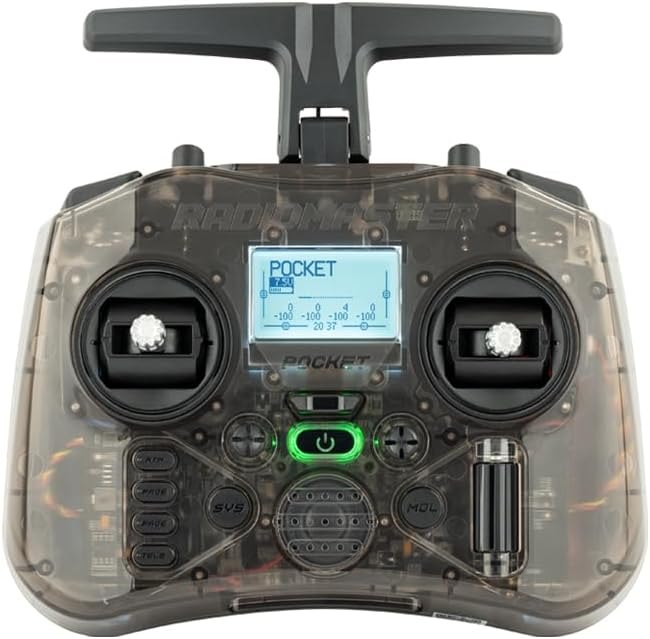
The RadioMaster Pocket is for the pilot buying a first proper radio. Maybe you started with the gamepad radio from a BETAFPV kit, or you have spent a few weeks in a simulator with a borrowed controller, and now you want something that will bind to ELRS whoops, 3-inch cinewhoops and 5-inch freestyle quads alike. It is also a popular second radio for experienced pilots who want something small for travel. It is not for pilots with large hands who like a full-size feel, or for long-range pilots who need a 1 W transmitter.
Design and build
As the name suggests, it is small. The radio weighs 288 g without batteries, the stick ends unscrew, the antenna folds down and the body shrinks to 156.6 × 65.1 × 125.3 mm, which really does fit a large jacket pocket. RadioMaster includes a carry pouch, a screen protector and four low-tension springs for pilots who like lighter sticks. The gimbals are X5 Hall-effect units on four ball bearings, so there is no potentiometer wear or drift, and the tension and throttle centering are adjustable from the back. Two LEDs show the positions of the SA and SD switches, a small touch that helps when you glance down to check if you are armed. Power comes from two 18650 cells that you buy separately.
Firmware and RF
EdgeTX comes pre-installed, which means the Pocket runs the same operating system as radios costing three times as much: model templates, logical switches, telemetry, voice alerts and Lua scripts for configuring ELRS from the radio. The 128 × 64 monochrome screen is smaller than a color touchscreen, but the menus are quick to learn with the navigation buttons. You choose the internal RF module at purchase: ExpressLRS 2.4 GHz, which is what nearly every current BNF quad uses, or CC2500 multi-protocol for FrSky-era models. The ELRS module is rated up to 250 mW on the FCC version and 100 mW on the EU LBT version. That is plenty for park freestyle and whoops; Oscar Liang’s radio guide flags the limited output as one of the Pocket’s few drawbacks for longer flights. If you outgrow it, the nano module bay on the back accepts RadioMaster Nano modules and TBS Nano Crossfire or Tracer modules.
Living with it
Battery life is a strength; Oscar Liang’s guide puts it at 8 hours or more, and the cells charge in the radio over USB-C QC3. Connected to a computer, the Pocket works as a USB joystick in Liftoff, Velocidrone and other simulators, which is where any new pilot should spend their first hours. The one real compromise is ergonomics: the nano gimbals are short, and pilots who pinch the sticks or come from a TX16S often find them cramped. RadioMaster’s AG01 Nano CNC gimbals are a $59.99 upgrade if you want a better feel later, though at that point the Boxer becomes worth considering.
Value for money
At the time of writing RadioMaster lists the ELRS version at $71.50 and the CC2500 version at $59.99, and US shops sell it for roughly $70 to $80. Add about $12 for a pair of 18650 cells. Nothing else at this price gives you EdgeTX, Hall gimbals and a module bay. Gamepad radios like the BETAFPV LiteRadio 3 Pro cost more, and the Boxer adds full-size gimbals and a 1 W link for about twice the money.
Alternatives
- RadioMaster Boxer: pick it if you want full-size gimbals, a 1 W ELRS link and room to grow into long range.
- RadioMaster TX16S Mark II: pick it if you want the color touchscreen and the most switches and plan to fly many kinds of models.
- BETAFPV LiteRadio 3 Pro: pick it if you prefer a gamepad shape with a built-in battery and only fly small quads.
The bottom line
The RadioMaster Pocket is the default first radio for ELRS quads: cheap, small and running the same EdgeTX as the big radios. Its gimbals are compact and its output modest, but for whoops, freestyle and travel it does everything you need. If you are unsure which radio to start with, start here.
.gap-review{margin:2.5rem 0 0}.gap-review h2{font-size:1.5rem;margin:0 0 1.25rem}.gap-verdict{background:#0E1A2B;color:#fff;border-radius:16px;padding:1.5rem 1.75rem}.gap-verdict__head{display:flex;gap:1.25rem;align-items:center}.gap-score{margin:0;width:84px;height:84px;border-radius:50%;background:#FF5A1F;color:#fff;display:flex;flex-direction:column;align-items:center;justify-content:center;font-weight:800;font-size:1.9rem;line-height:1}.gap-score small{font-size:.7rem;font-weight:600;opacity:.85}.gap-eyebrow{margin:0 0 .35rem;text-transform:uppercase;letter-spacing:.08em;font-size:.75rem;font-weight:700;color:#FF5A1F}.gap-verdict__line{margin:0;font-size:1.125rem;line-height:1.45}.gap-proscons{display:grid;grid-template-columns:1fr 1fr;gap:1.25rem 2rem;margin-top:1.5rem;padding-top:1.25rem;border-top:1px solid rgba(255,255,255,.15)}.gap-proscons h3{margin:0 0 .6rem;font-size:.9rem;text-transform:uppercase;letter-spacing:.05em;color:inherit}.gap-proscons ul{list-style:none;margin:0;padding:0}.gap-proscons li{position:relative;padding-left:1.6em;margin:0 0 .45em}.gap-proscons li::before{position:absolute;left:0;top:0;font-weight:800}.gap-pros li::before{content:’+’;color:#4ADE80}.gap-cons li::before{content:’2013′;color:#F87171}.gap-specs,.gap-faq{margin-top:2rem}.gap-specs h3,.gap-faq h3{font-size:1.2rem;margin:0 0 .75rem}.gap-specs table{width:100%;border-collapse:collapse;font-size:.95rem}.gap-specs th,.gap-specs td{text-align:left;padding:.65rem .9rem;border-bottom:1px solid #E2E8F0;vertical-align:top}.gap-specs th{width:38%;background:#F4F6F9}.gap-faq details{border:1px solid #E2E8F0;border-radius:10px;padding:0 1rem;margin:0 0 .6rem}.gap-faq summary{cursor:pointer;padding:.85rem 0;font-weight:600}.gap-cta{margin-top:2rem;padding:1.25rem 1.5rem;background:#F4F6F9;border-radius:16px;display:flex;flex-wrap:wrap;gap:.75rem;align-items:center}.gap-btn{display:inline-block;padding:.85em 1.5em;border-radius:10px;font-weight:600;text-decoration:none!important;background:#FF5A1F;color:#fff!important}.gap-btn–secondary{background:transparent;color:#0E1A2B!important;border:2px solid #E2E8F0}.gap-disclosure,.gap-note{font-size:.875rem;color:#4A5568;margin:.75rem 0 0}@media(max-width:640px){.gap-proscons{grid-template-columns:1fr}}
RadioMaster Pocket review
8.8/10
madagear.com verdict
Buy it if you want a first real radio for ELRS whoops and 5-inch quads, or a travel radio; skip it if you have large hands or need a 1 W link for long-range flying.
What we like
- Full EdgeTX and internal ELRS for well under $100
- X5 Hall-effect gimbals on four ball bearings, upgradable to AG01 Nano
- Folds to 156.6 × 65.1 × 125.3 mm with removable sticks and a folding antenna
- Runs on two 18650 cells for many hours and charges over USB-C
- Nano module bay accepts TBS Crossfire or Tracer modules later
- Works as a USB joystick for FPV simulators
What we don’t
- Small gimbals feel cramped to pilots used to full-size radios
- Internal ELRS is limited to 250 mW, low for serious long range
- 18650 batteries are not included
Specs at a glance
| Firmware | EdgeTX (pre-installed) |
|---|---|
| Internal RF | ExpressLRS 2.4 GHz or CC2500 multi-protocol |
| ELRS output | Up to 250 mW (FCC), 100 mW on EU LBT version |
| Gimbals | X5 Hall-effect, quad ball-bearing nano gimbals (AG01 Nano compatible) |
| Channels | Up to 16, receiver dependent |
| Display | 128 × 64 monochrome backlit LCD |
| Module bay | Nano size (RadioMaster Nano modules, TBS Nano Crossfire / Nano Tracer) |
| Power | 2 × 18650 cells, 6.6–8.4 V, not included |
| Charging | Built-in USB-C QC3 |
| Weight | 288 g |
Frequently asked questions
Should I buy the ELRS or CC2500 version of the RadioMaster Pocket?
ELRS for almost everyone. ExpressLRS is the standard link on current FPV quads, and receivers are cheap and light. Pick CC2500 only if you already own FrSky D8/D16 or other CC2500-protocol models.
Does the RadioMaster Pocket come with batteries?
No. It takes two 18650 Li-ion cells, which you buy separately; RadioMaster sells a pair, and some Amazon bundles include them. The cells charge inside the radio over USB-C.
Can I use the RadioMaster Pocket with FPV simulators?
Yes. Plug it into a computer over USB-C and choose joystick mode; it is recognized as a game controller by Liftoff, Velocidrone, Uncrashed and other simulators.
Is the Pocket good enough for 5-inch freestyle?
Yes for most pilots. The 250 mW ELRS link covers typical freestyle distances easily, and the Hall gimbals are precise. If your thumbs feel cramped, the Boxer offers full-size gimbals with the same firmware.
Typical US price for the ELRS version; RadioMaster lists it at $71.50 and the CC2500 version at $59.99. 18650 cells are not included. Price and availability checked on 2026-11-10.
madagear.com is reader-supported. When you buy through links on our site we may earn an affiliate commission, at no extra cost to you. This never affects what we recommend.

Reviews
There are no reviews yet.