



Description
Who it’s for
The RP3 is for pilots who already fly ExpressLRS and want a receiver that holds on to the link a little harder than the usual single-antenna nano. It suits freestyle quads from 3 to 7 inches, cinewhoops that fly behind buildings and trees, and fixed wings, where the airframe often shadows one antenna. It is also a natural upgrade if you have had a failsafe on a cheaper receiver and want to rule the radio link out. If you only fly a 65 mm whoop indoors, it is more receiver than you need.
What’s in the box and design
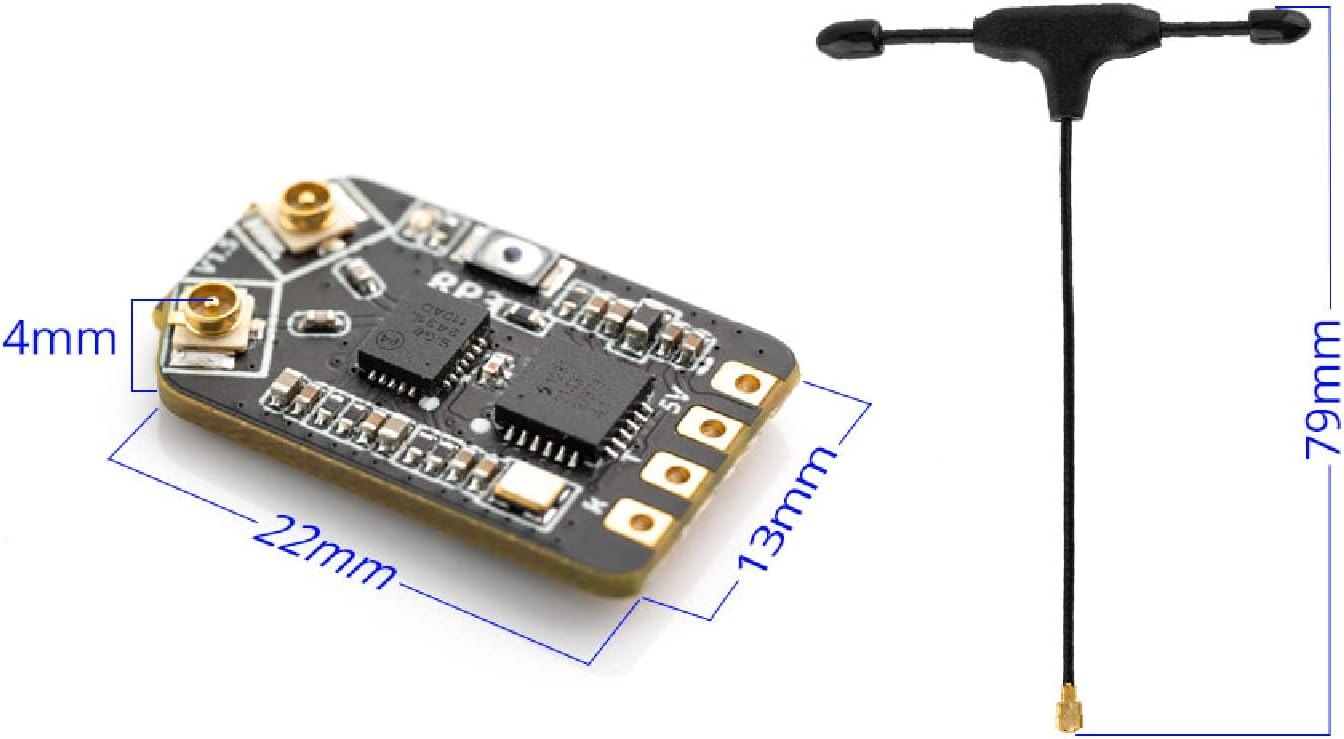
You get the receiver, a CRSF wiring lead and two 65 mm 2.4 GHz T antennas on U.FL connectors. RadioMaster quotes 22 × 13 × 4 mm and 4.6 g including both antennas, small enough for most 2-inch and larger builds. Under the heat shrink sit an ESP8285 microcontroller, an SX1280-series 2.4 GHz radio and a Skyworks SE2431L front end that adds a low-noise amplifier for receive sensitivity and a power amplifier for up to 100 mW of telemetry. There is a TCXO for frequency stability, which RadioMaster lists among the features. The design point is the second antenna: rather than one antenna that may be blocked by carbon or a battery, the RP3 picks whichever antenna has the better signal.
Compatibility and setup
The RP3 runs ExpressLRS 3.x out of the box and supports both LoRa and FLRC modes, with packet rates from 25 Hz up to 500 Hz and F1000. It talks to the flight controller over a CRSF serial connection, so on Betaflight or INAV you wire it to a free UART, set that UART to Serial RX and pick CRSF as the receiver protocol. It binds to any 2.4 GHz ELRS transmitter, from the RadioMaster Pocket and Boxer to the TX16S and BETAFPV’s LiteRadio 3, ideally with a bind phrase so you never need to press a button. Firmware updates happen over Wi-Fi using the RadioMaster RP3 Diversity 2400 RX target. Keep the receiver and transmitter on the same ELRS major version.
One listing note: the Amazon product is listed under the SpeedyBee brand, with RadioMaster named as the manufacturer. RadioMaster’s current version is the RP3 V2, so check the board before flashing and use the target RadioMaster lists for your version.
How it performs and what owners report
Antenna mounting matters as much as the receiver. The standard advice is to mount the two antennas at right angles to each other and away from carbon and the video transmitter, which is the whole point of diversity. Done properly, the RP3 is widely recommended in the FPV community as a dependable small diversity receiver, and the Amazon listing reflects that with 4.6 stars from about 180 ratings at the time of writing. The practical friction is routing two antennas on a tight frame and picking the right firmware target, not link quality.
Value for money
At $23.99 on Amazon at the time of writing, the RP3 costs a few dollars more than a basic nano receiver and a few dollars more than RadioMaster’s own direct price. For the extra antenna, LNA and telemetry PA, that is small money relative to the cost of a lost quad, and it is the receiver we would put on any build that flies beyond line of sight around obstacles.
Alternatives
- BETAFPV ExpressLRS Micro Receiver: pick it for planes, helicopters, cars and boats that need PWM outputs to drive servos directly.
- RadioMaster RP1 or RP2: pick one of RadioMaster’s single-antenna nano receivers for whoops and small quads where weight and space are tight.
- RadioMaster Pocket: if you are still choosing a radio, this compact EdgeTX ELRS radio pairs well with the RP3.
The bottom line
The RP3 brings true antenna diversity to a receiver that weighs under 5 g, for barely more than a basic nano. Mount the antennas properly and it is the easy choice for freestyle quads and wings; leave it for the whoops.
.gap-review{margin:2.5rem 0 0}.gap-review h2{font-size:1.5rem;margin:0 0 1.25rem}.gap-verdict{background:#0E1A2B;color:#fff;border-radius:16px;padding:1.5rem 1.75rem}.gap-verdict__head{display:flex;gap:1.25rem;align-items:center}.gap-score{margin:0;width:84px;height:84px;border-radius:50%;background:#FF5A1F;color:#fff;display:flex;flex-direction:column;align-items:center;justify-content:center;font-weight:800;font-size:1.9rem;line-height:1}.gap-score small{font-size:.7rem;font-weight:600;opacity:.85}.gap-eyebrow{margin:0 0 .35rem;text-transform:uppercase;letter-spacing:.08em;font-size:.75rem;font-weight:700;color:#FF5A1F}.gap-verdict__line{margin:0;font-size:1.125rem;line-height:1.45}.gap-proscons{display:grid;grid-template-columns:1fr 1fr;gap:1.25rem 2rem;margin-top:1.5rem;padding-top:1.25rem;border-top:1px solid rgba(255,255,255,.15)}.gap-proscons h3{margin:0 0 .6rem;font-size:.9rem;text-transform:uppercase;letter-spacing:.05em;color:inherit}.gap-proscons ul{list-style:none;margin:0;padding:0}.gap-proscons li{position:relative;padding-left:1.6em;margin:0 0 .45em}.gap-proscons li::before{position:absolute;left:0;top:0;font-weight:800}.gap-pros li::before{content:’+’;color:#4ADE80}.gap-cons li::before{content:’2013′;color:#F87171}.gap-specs,.gap-faq{margin-top:2rem}.gap-specs h3,.gap-faq h3{font-size:1.2rem;margin:0 0 .75rem}.gap-specs table{width:100%;border-collapse:collapse;font-size:.95rem}.gap-specs th,.gap-specs td{text-align:left;padding:.65rem .9rem;border-bottom:1px solid #E2E8F0;vertical-align:top}.gap-specs th{width:38%;background:#F4F6F9}.gap-faq details{border:1px solid #E2E8F0;border-radius:10px;padding:0 1rem;margin:0 0 .6rem}.gap-faq summary{cursor:pointer;padding:.85rem 0;font-weight:600}.gap-cta{margin-top:2rem;padding:1.25rem 1.5rem;background:#F4F6F9;border-radius:16px;display:flex;flex-wrap:wrap;gap:.75rem;align-items:center}.gap-btn{display:inline-block;padding:.85em 1.5em;border-radius:10px;font-weight:600;text-decoration:none!important;background:#FF5A1F;color:#fff!important}.gap-btn–secondary{background:transparent;color:#0E1A2B!important;border:2px solid #E2E8F0}.gap-disclosure,.gap-note{font-size:.875rem;color:#4A5568;margin:.75rem 0 0}@media(max-width:640px){.gap-proscons{grid-template-columns:1fr}}
RadioMaster RP3 ELRS Receiver review
8.6/10
madagear.com verdict
Buy it if you want a more robust ELRS link than a single-antenna nano receiver on a 3-inch to 7-inch quad or a wing; skip it for 65 mm whoops where every gram counts.
What we like
- Antenna diversity with two 65 mm T antennas for a more stable link
- LNA for receive sensitivity and a PA for up to 100 mW telemetry
- About 4.6 g with both antennas and 22 × 13 × 4 mm, so it fits most builds
- Ships with ExpressLRS 3.x and updates over Wi-Fi
- Strong owner rating for a small receiver
What we don’t
- Two antennas to route and mount, which is fiddly on small frames
- Overkill for whoops that never leave the living room
- 2.4 GHz only; no 900 MHz option on this model
Specs at a glance
| Protocol | ExpressLRS 2.4 GHz, LoRa and FLRC links |
|---|---|
| Firmware | ExpressLRS 3.x pre-installed; target RadioMaster RP3 Diversity 2400 RX |
| Chips | ESP8285 MCU, SX1280-series RF, Skyworks SE2431L LNA/PA |
| Telemetry power | Up to 100 mW |
| Antennas | 2 × 65 mm 2.4 GHz T antennas (diversity) |
| Packet rate | 25 Hz to 500 Hz, F1000 |
| Output | CRSF serial |
| Input voltage | 5 V |
| Size | 22 × 13 × 4 mm |
| Weight | 4.6 g with antennas (RadioMaster spec) |
Frequently asked questions
What is antenna diversity, and do I need it?
The RP3 has two antennas and switches to whichever is receiving the stronger signal, which reduces dropouts when the quad’s frame or your body blocks one antenna. It helps most on freestyle and long-range quads and on wings; for indoor whoops a single-antenna nano receiver is enough.
Which radios work with the RadioMaster RP3?
Any radio or module running 2.4 GHz ExpressLRS, including the RadioMaster Pocket, Boxer and TX16S and the BETAFPV LiteRadio 3. Keep transmitter and receiver on the same ELRS major version and bind with a shared bind phrase.
How do I connect it to my flight controller?
Wire 5 V, ground and the receiver’s TX and RX pads to a free UART on the flight controller (TX to RX, RX to TX), then set that UART to Serial RX and the receiver protocol to CRSF in Betaflight.
Is the Amazon version the same as RadioMaster’s?
The listing carries the SpeedyBee brand name and names RadioMaster as the manufacturer. RadioMaster’s current version is the RP3 V2; check the board marking and use the matching target when you flash firmware.
Amazon price for a single receiver (listed under the SpeedyBee brand); RadioMaster lists the RP3 V2 direct at $19.99 to $22.99. Price and availability checked on 2026-11-10.
madagear.com is reader-supported. When you buy through links on our site we may earn an affiliate commission, at no extra cost to you. This never affects what we recommend.



Reviews
There are no reviews yet.