
Description
Who it’s for
If you fly a small drone in the hour around sunset, or you hold a Part 107 certificate with a night waiver or the current night privileges, you need something on the airframe that makes it visible to other aircraft and to you. The stock navigation LEDs on most consumer drones are bright enough to tell you which end is the nose at thirty feet, and not much more. That gap is what this product class exists to fill.
This particular kit suits the hobbyist or part-time commercial pilot who wants a cheap, removable solution rather than a permanent install. Three lights in a box means you can fit one to your primary aircraft, keep a spare charged, and still have a third for a second drone or for marking a landing pad on the ground. Buyers rate it 4.7 out of 5 across 815 ratings, which for a sub-forty-dollar accessory is a reasonable signal that the basics work.
It is not for the pilot who needs documented, certified performance. If your operation is audited, or your insurer or client asks what the light’s output is, a product with no published candela figure will not answer that question for you. That is a real limitation and it is worth being honest about up front.
Design and build
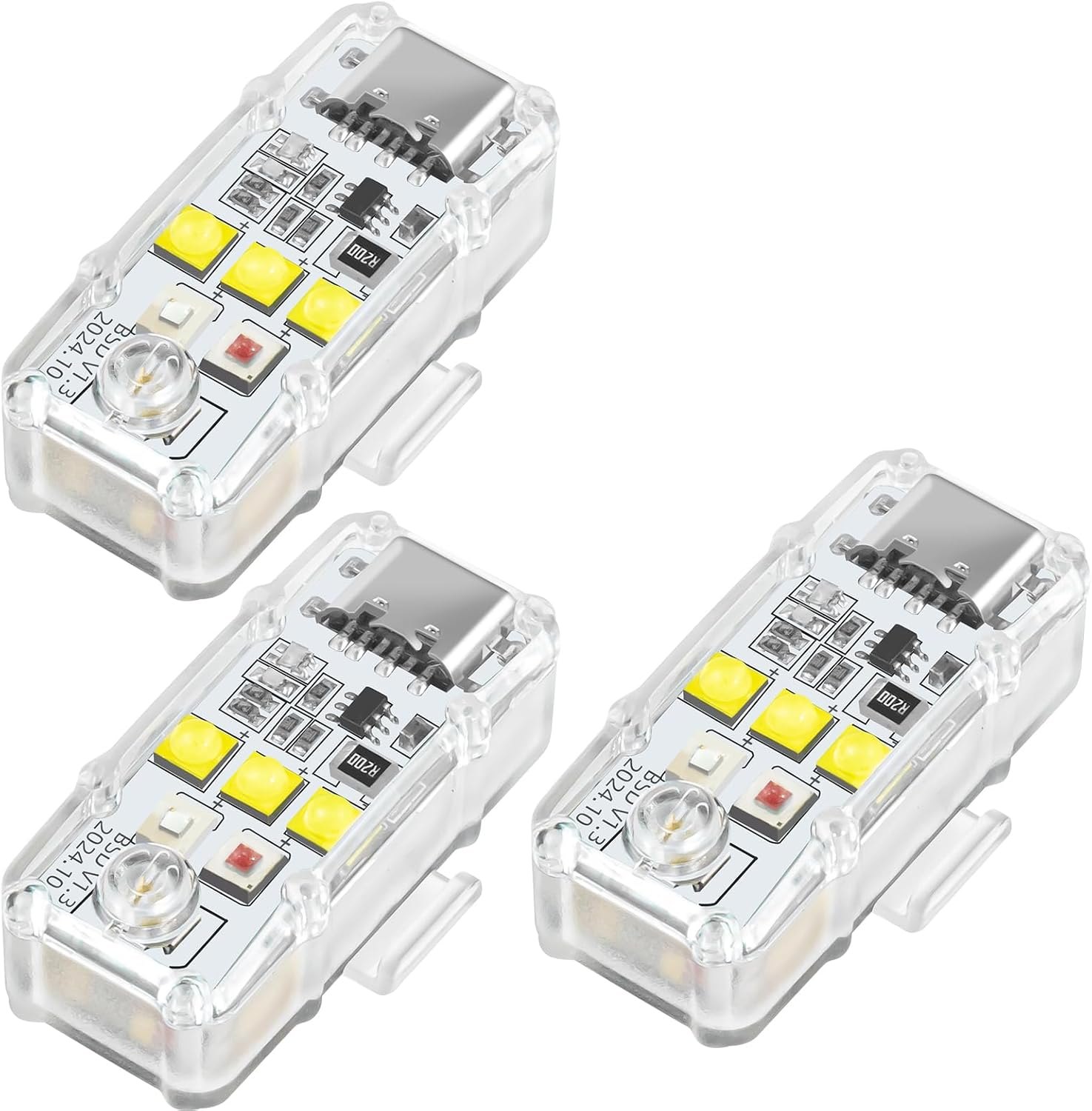
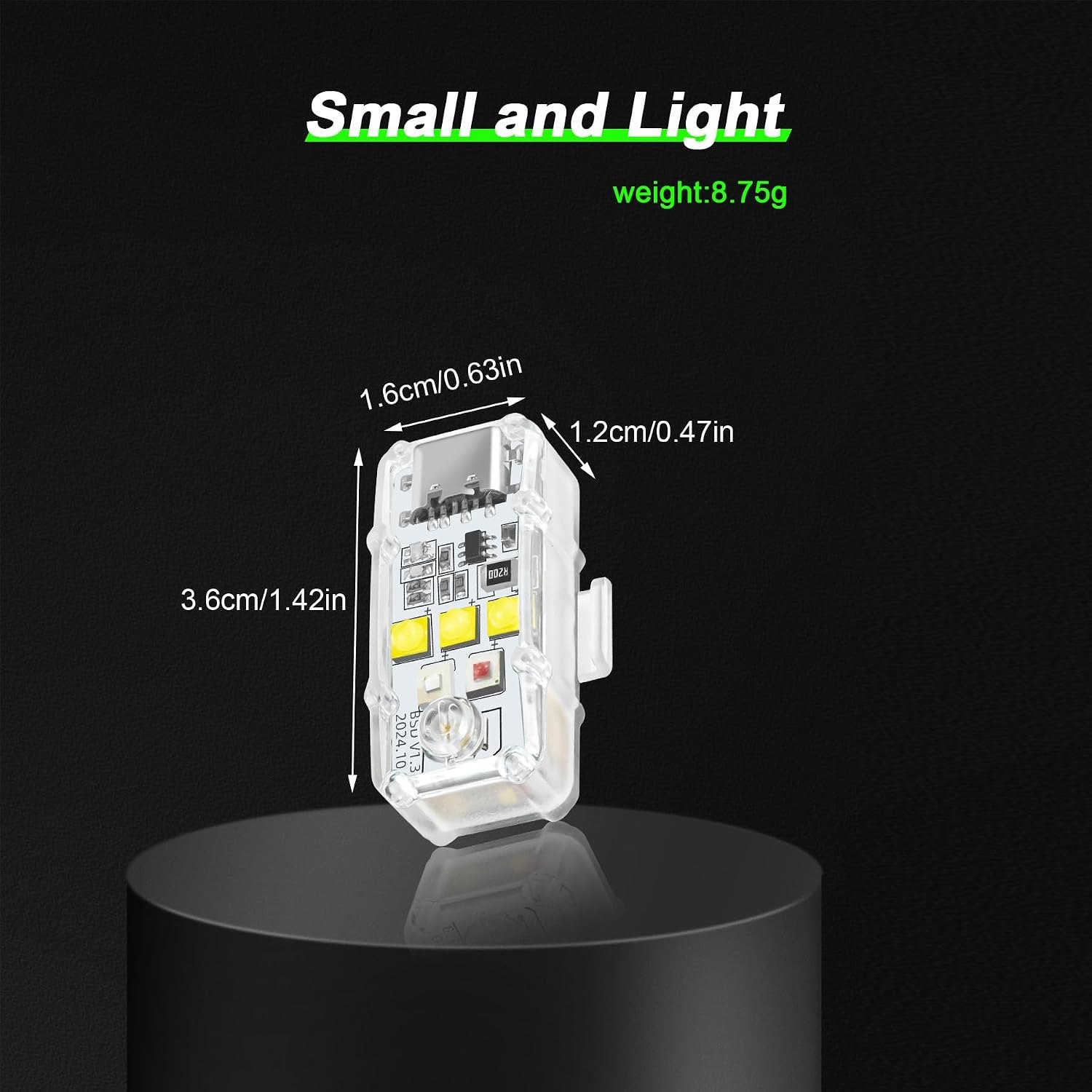
Each unit measures 1.46 by 0.87 by 0.55 inches and weighs 0.31 ounces, or 8.85 grams. On a 249 gram class drone that is under four percent of takeoff weight, which is about as light as a self-powered strobe gets. The housing is plastic with a rectangular profile, and the listing describes the finish as unfinished, which in practice means a plain molded shell rather than anything coated or textured.
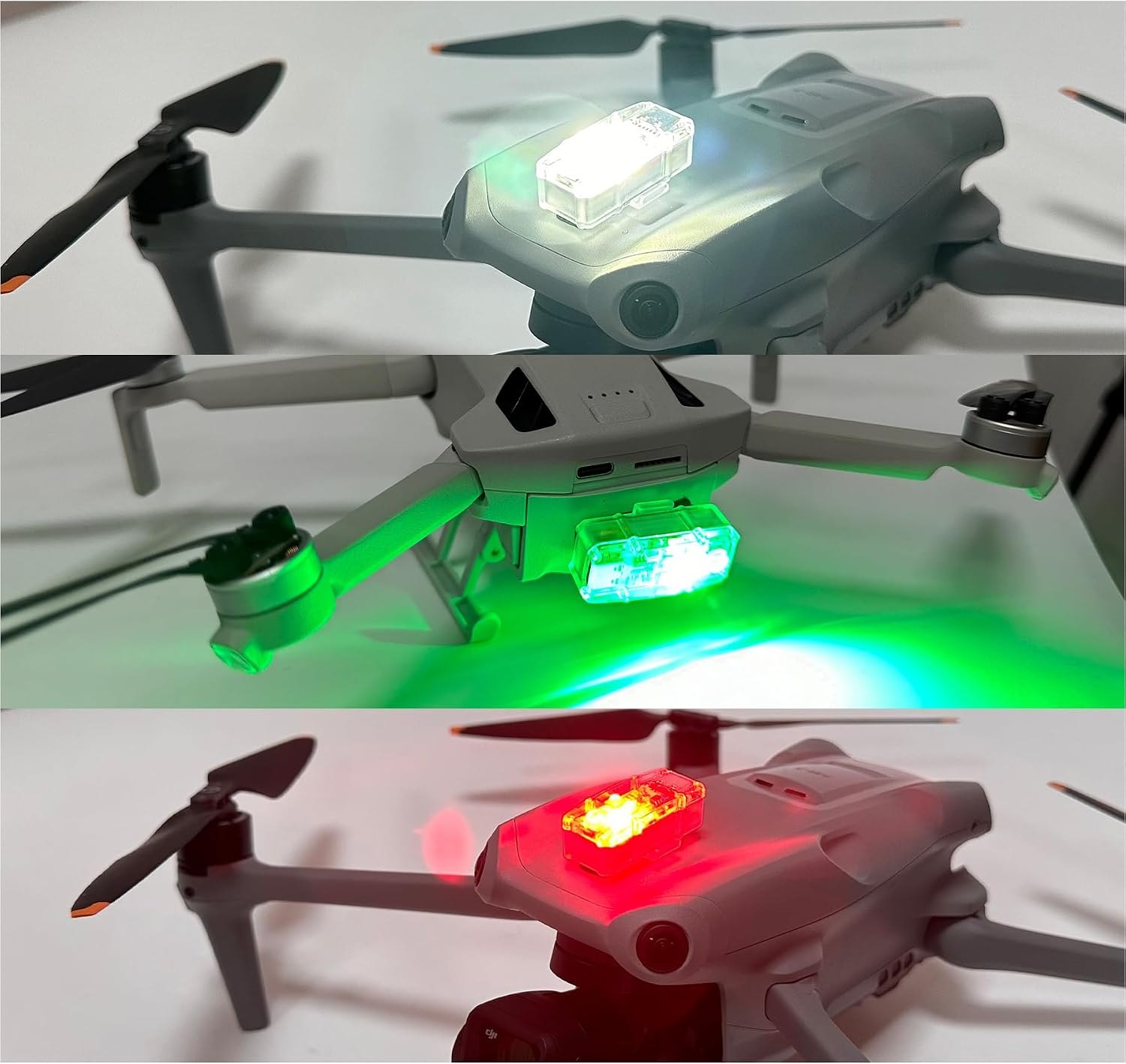
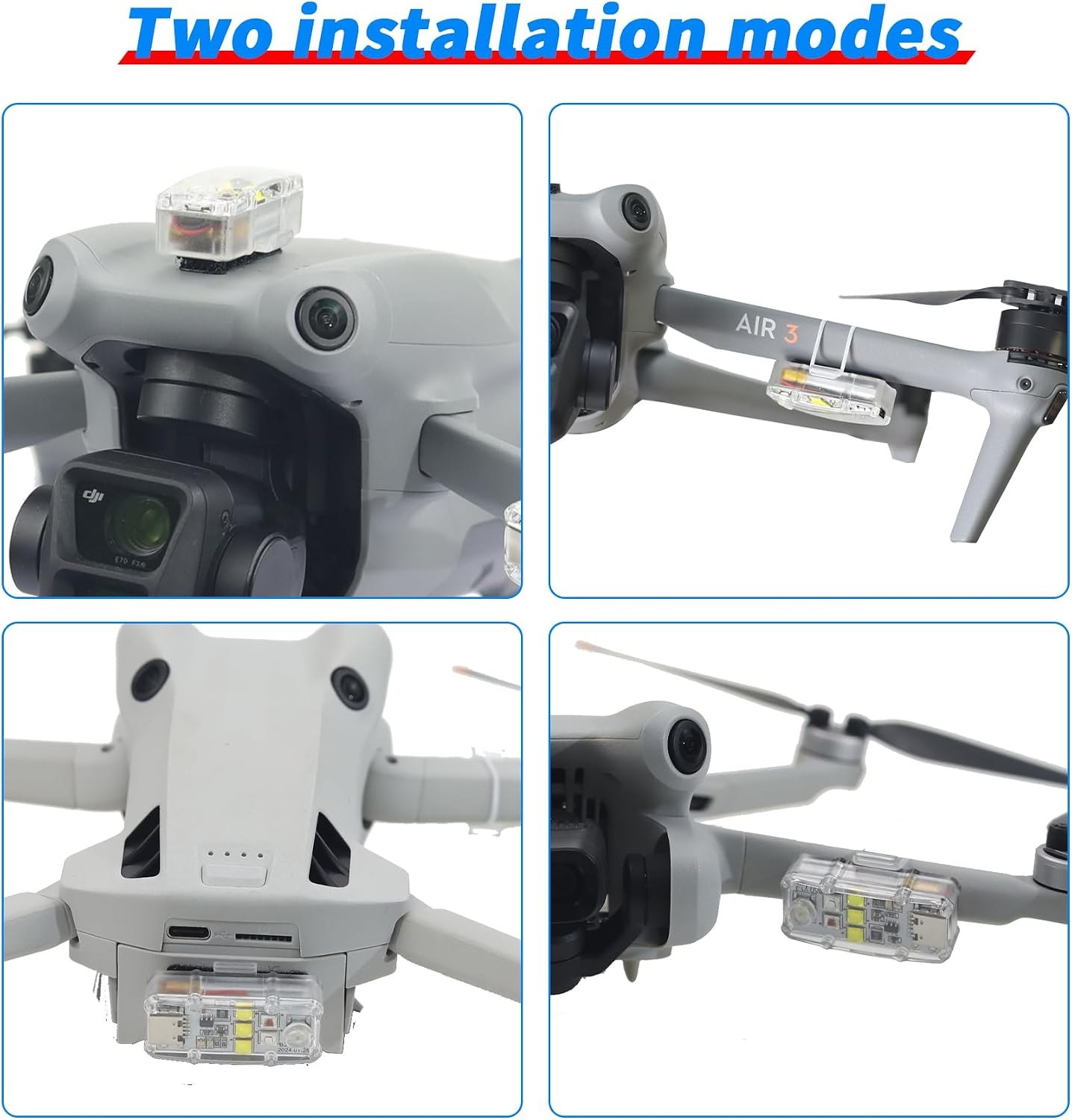
Mounting is deliberately low-tech. You get twelve velcro pairs for sticking the light to a flat surface, which covers the top shell, the tail and the sides of most airframes, and twelve silicone rings for strapping it around an arm. The arm option is the more secure of the two on paper, since a ring under tension has no adhesive to fail, but it is only practical on drones with exposed arms rather than folded-in Mini-style geometry.
The weak points are predictable for the price. Velcro loses grip over repeated cycles and in damp conditions, and a plastic shell this small is not going to survive a hard landing that lands on it. The listing claims high-quality LEDs for brightness and life, which is the kind of statement that cannot be checked from a spec sheet. Treat the whole unit as a consumable rather than a lifetime purchase, and the three-pack starts to make more sense as a design decision.
What the specs tell us
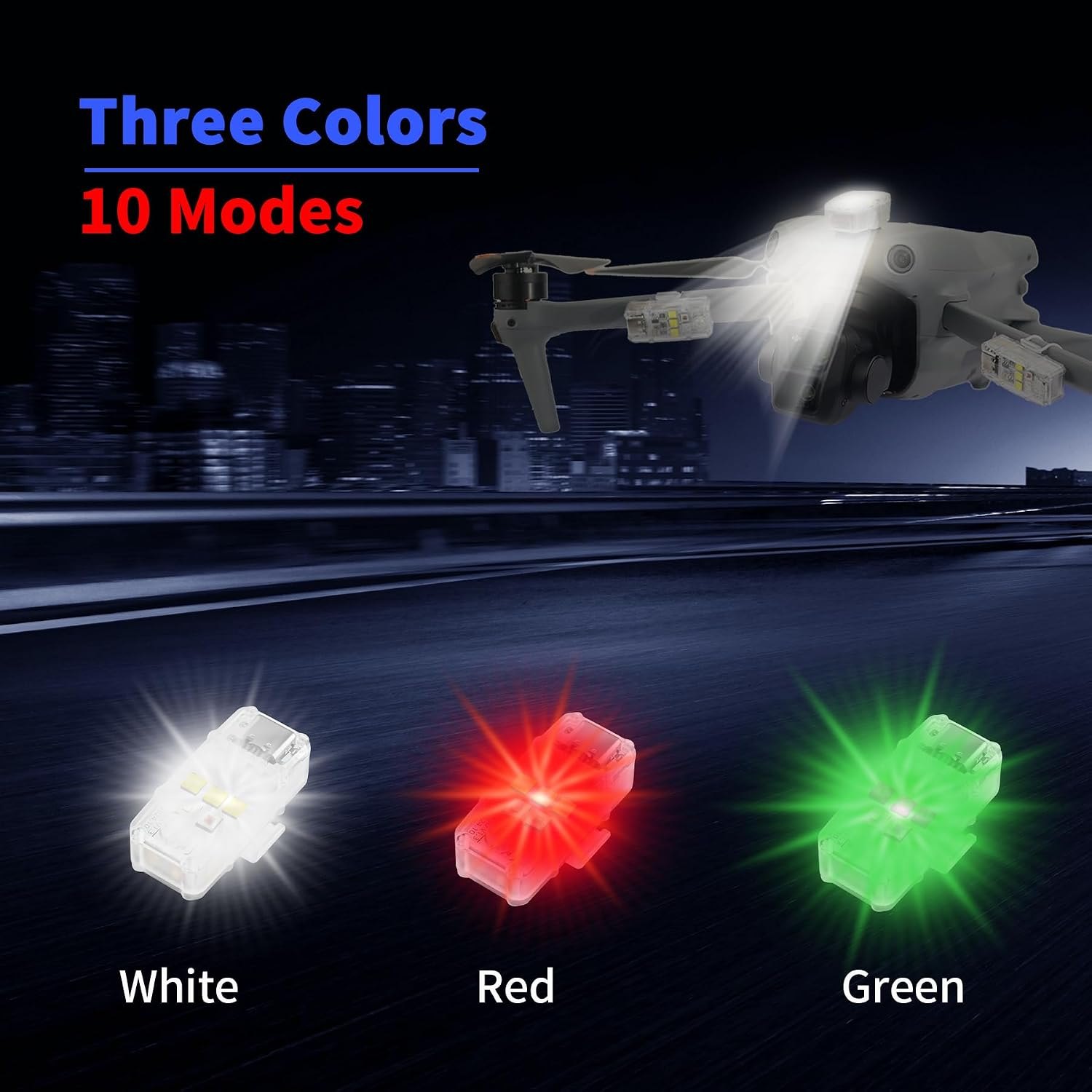
The headline numbers are a 150 mAh rechargeable lithium-ion cell per light, three colors, and ten modes. Those modes run from steady white through fast and slow blink in each color, plus three two-color fast-blink combinations. The practical use of that range is orientation: a white strobe on the nose and a red or green on a tail boom gives you a readable attitude cue at distance, which is the thing you lose fastest in low light.
Runtime is quoted as 1 to 7 hours depending on mode. That spread is wide but physically sensible, since a steady white LED draws continuously while a slow blink duty-cycles down to a fraction of that. The honest reading is that steady white is a one-flight-session setting and the blink modes will cover a full day of intermittent flying. A 150 mAh cell is small, so expect to charge after every couple of outings rather than treating it as set-and-forget.
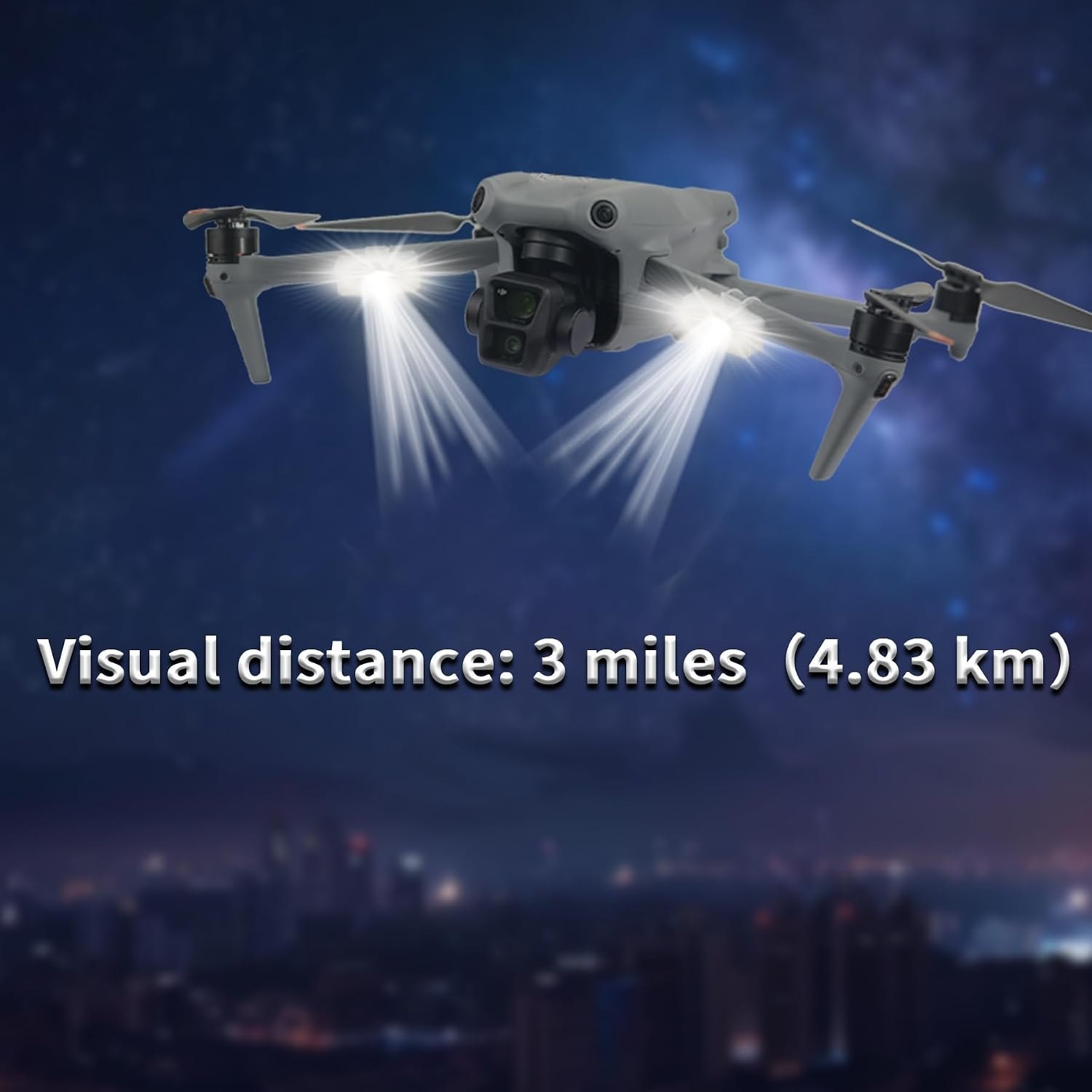
What the specs do not tell us matters as much. There is no candela rating, no stated visibility distance, and no IP rating for moisture. The FAA’s night requirement is framed around a light visible for three statute miles, and nothing in this listing lets you check against that number. Owners report it is bright, which is useful but not the same thing as a measurement.
Living with it
The day-to-day pattern with lights like these is charge, stick, fly, peel off. Three USB cables in the box means you can top up all three units at once from a multi-port charger, which is a small convenience that matters more than it sounds when you are packing a bag at dusk. The cable count also means a lost cable is not an immediate problem.
The friction points are the ones common to the whole category. Velcro residue builds up on the drone shell over time, and you will want to pick a mounting spot that does not block a downward sensor, an obstacle-avoidance camera or a vent. On Mini-class aircraft that leaves fewer options than you would expect, and the tail is often the only clean flat surface. The silicone rings sidestep adhesive entirely but need an arm or a boom to wrap around.
There is also a habit to build. A strobe that is not charged is just extra weight, and a 150 mAh cell gives no low-battery warning you can see from the ground. The sensible routine is to charge all three after each session and fly with one fitted and one in the bag, which is exactly the use case the three-pack supports.
Value for money
At the time of writing the kit is $31.99 for three lights, twelve silicone rings, twelve velcro pairs and three charging cables. That works out to roughly ten dollars per light with mounting hardware included, which sits at the budget end of the anti-collision strobe market. Single branded strobes with published output figures typically cost more per unit than this entire pack.
The value case depends on what you are buying for. If the goal is visibility and orientation for recreational dusk flying, the per-unit price is hard to argue with and the spares have genuine worth given how easily small accessories get lost or broken. If the goal is documented regulatory compliance, you are paying less and getting less, and the saving is not the relevant number.
Prices on accessories like this move frequently with coupons and seasonal promotions, so the figure above is a snapshot rather than a fixed point. Buying at a discount strengthens an already reasonable case.
Alternatives
The Firehouse Technology ARC V is the reference point in this category, with a published 100-plus lumen output and a widely cited three-mile visibility claim. Pick it if you fly commercially at night and need a specification you can point to when asked.
Ultra Bright Lumecube-style strobes and the various Lume Cube drone lighting kits take a different approach, offering continuous illumination rather than pure strobe function. Choose one of those if you want light for filming or for seeing your landing area rather than for being seen by others.
For the budget end, generic three-packs from brands like FSLabs and the various no-name sellers occupy the same price bracket with broadly similar specs. The reason to pick one of those over this kit comes down to current price, since none of them publish the output figures that would let you compare on performance.
The bottom line
This is a sensibly priced solution to a real problem, with enough units in the box that losing one is an inconvenience rather than a repurchase. The gap between what it claims and what it documents is the thing to weigh, and it matters far more for commercial pilots than for someone flying in a field at sunset. Judge it as a useful, disposable accessory rather than a piece of certified equipment and it holds up well.
.gap-review{margin:2.5rem 0 0}.gap-review h2{font-size:1.5rem;margin:0 0 1.25rem}.gap-verdict{background:#0E1A2B;color:#fff;border-radius:16px;padding:1.5rem 1.75rem}.gap-verdict__head{display:flex;gap:1.25rem;align-items:center}.gap-score{margin:0;width:84px;height:84px;border-radius:50%;background:#FF5A1F;color:#fff;display:flex;flex-direction:column;align-items:center;justify-content:center;font-weight:800;font-size:1.9rem;line-height:1}.gap-score small{font-size:.7rem;font-weight:600;opacity:.85}.gap-eyebrow{margin:0 0 .35rem;text-transform:uppercase;letter-spacing:.08em;font-size:.75rem;font-weight:700;color:#FF5A1F}.gap-verdict__line{margin:0;font-size:1.125rem;line-height:1.45}.gap-proscons{display:grid;grid-template-columns:1fr 1fr;gap:1.25rem 2rem;margin-top:1.5rem;padding-top:1.25rem;border-top:1px solid rgba(255,255,255,.15)}.gap-proscons h3{margin:0 0 .6rem;font-size:.9rem;text-transform:uppercase;letter-spacing:.05em;color:inherit}.gap-proscons ul{list-style:none;margin:0;padding:0}.gap-proscons li{position:relative;padding-left:1.6em;margin:0 0 .45em}.gap-proscons li::before{position:absolute;left:0;top:0;font-weight:800}.gap-pros li::before{content:’+’;color:#4ADE80}.gap-cons li::before{content:’2013′;color:#F87171}.gap-specs,.gap-faq{margin-top:2rem}.gap-specs h3,.gap-faq h3{font-size:1.2rem;margin:0 0 .75rem}.gap-specs table{width:100%;border-collapse:collapse;font-size:.95rem}.gap-specs th,.gap-specs td{text-align:left;padding:.65rem .9rem;border-bottom:1px solid #E2E8F0;vertical-align:top}.gap-specs th{width:38%;background:#F4F6F9}.gap-faq details{border:1px solid #E2E8F0;border-radius:10px;padding:0 1rem;margin:0 0 .6rem}.gap-faq summary{cursor:pointer;padding:.85rem 0;font-weight:600}.gap-cta{margin-top:2rem;padding:1.25rem 1.5rem;background:#F4F6F9;border-radius:16px;display:flex;flex-wrap:wrap;gap:.75rem;align-items:center}.gap-btn{display:inline-block;padding:.85em 1.5em;border-radius:10px;font-weight:600;text-decoration:none!important;background:#FF5A1F;color:#fff!important}.gap-btn–secondary{background:transparent;color:#0E1A2B!important;border:2px solid #E2E8F0}.gap-disclosure,.gap-note{font-size:.875rem;color:#4A5568;margin:.75rem 0 0}@media(max-width:640px){.gap-proscons{grid-template-columns:1fr}}
LYONGTECH Drone Anti-Collision Strobe Lights (3-Pack) review
7.4/10
madagear.com verdict
Buy it if you fly a small drone at night and want a cheap, removable lighting kit; skip it if you need a single certified strobe with a documented visibility range.
What we like
- Three lights per pack covers one aircraft plus spares or a second drone
- 8.85 g each, light enough to have minimal effect on small-drone flight time
- Velcro and silicone ring mounting suits top, tail, sides or arms
- 10 modes across white, red and green for orientation cues
- Rechargeable 150 mAh cell, no coin cells to keep buying
- Buyers rate it 4.7 out of 5 across 815 ratings
What we don’t
- No published candela or visibility distance figure to check against FAA guidance
- Runtime of 1-7 hours depends heavily on which mode you pick
- Plastic shell and velcro are the weak points on a hard landing
- Unbranded LED quality is hard to verify before the lights arrive
Specs at a glance
| Brand | LYONGTECH |
|---|---|
| Model | LYONG-LED-33 |
| Pack size | 3 lights |
| Dimensions | 1.46 x 0.87 x 0.55 in (3.7 x 2.2 x 1.4 cm) |
| Weight | 0.31 oz (8.85 g) each |
| Colors | White, red, green |
| Modes | 10 lighting modes |
| Battery | 150 mAh rechargeable lithium-ion, included |
| Runtime | 1-7 hours depending on mode |
| In the box | 3 lights, 12 silicone rings, 3 USB cables, 12 velcro pairs |
Frequently asked questions
Will this satisfy the FAA night flying requirement?
The FAA rule for Part 107 night operations asks for an anti-collision light visible for at least three statute miles with a flashing rate sufficient to avoid a collision. This listing does not publish a candela rating or a visibility distance, so you cannot verify compliance from the spec sheet alone. If you fly commercially, treat that as the open question and check the light against the rule yourself before you rely on it.
Which drones do these fit?
Because the lights mount with velcro or a silicone ring rather than a model-specific bracket, they are not tied to one airframe. The listing names most of the DJI lineup from Mavic Mini through Mavic 4, the Air and Mini series, FPV and Avata, plus Holy Stone and Ruko models. Anything with a flat surface or an arm you can loop a ring around should work.
How much flight time will the extra weight cost me?
Each light is 8.85 g, so a single unit on a 249 g class drone is under four percent of takeoff weight. The practical effect on a Mini-series aircraft is usually a minute or two off a full pack. Mounting two or three at once is where you start to notice it.
Do I have to charge them separately?
Yes. Each light has its own 150 mAh cell and the pack includes three USB cables, so all three can charge at once from a multi-port adapter. Quoted runtime is 1 to 7 hours, with steady white light at the short end and slow blink modes at the long end.
At the time of writing the listing is $31.99 for three lights plus mounts and cables, so roughly ten dollars per unit, and prices on accessories like this move with coupons and seasonal promotions. Price and availability checked on 2026-11-14.
madagear.com is reader-supported. When you buy through links on our site we may earn an affiliate commission, at no extra cost to you. This never affects what we recommend.


Reviews
There are no reviews yet.