


Description
Who it’s for
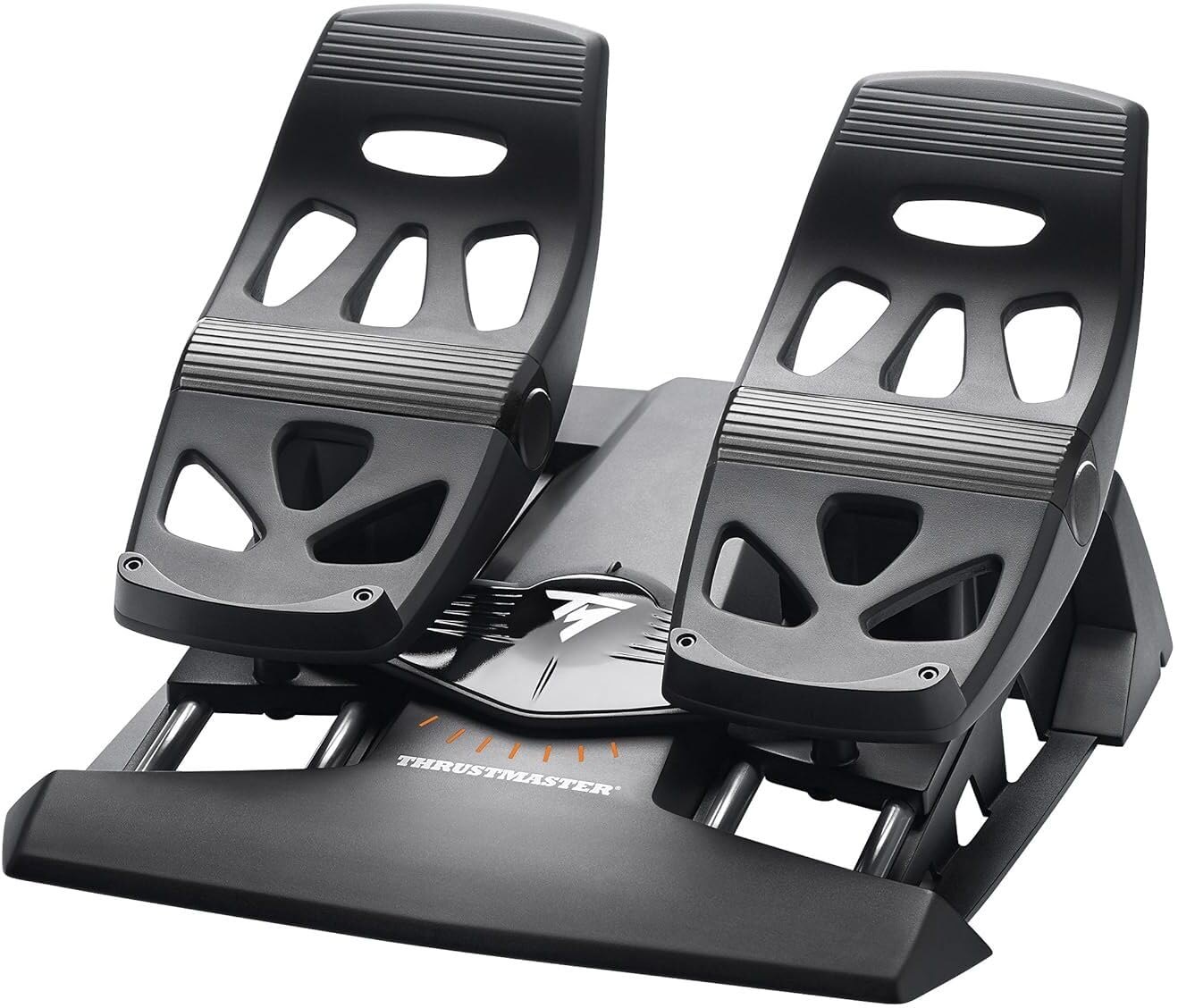
Rudder pedals are the third purchase in a flight sim setup, not the first. If you already own a stick or a yoke and a throttle, and you have reached the point where twisting a grip to hold a sideslip feels wrong, this is the category you graduate into. The Thrustmaster TFRP sits at the entry to that category: a self-centering pedal set with an aluminum rail mechanism, priced at $129.99 at the time of writing.
The target buyer is a hobbyist flying Microsoft Flight Simulator, DCS or a helicopter title on PC, or someone building a console cockpit on PS5 or Xbox Series X|S. It also makes sense for anyone learning crosswind landings, where the ability to hold rudder independently of aileron is the whole exercise. Buyers rate the set 4.4 out of 5 across more than 3,000 ratings, which for a mechanical peripheral in this bracket is a solid signal of consistency rather than excellence.
It is not for the pilot chasing competitive precision. If you are comparing load-cell brake pedals and metal-bodied sets, this is a step below that tier, and the listing does not claim otherwise.
Design and build
The headline mechanical feature is the sliding rail system: four aluminum rails that the pedals travel on, which Thrustmaster markets as S.M.A.R.T. The claim is friction-free motion and added rigidity. On paper that is the right approach, because the common failure of budget pedals is a gritty, uneven sweep that makes fine corrections guesswork. Metal rails are a meaningful upgrade over plastic guides, and owners generally report the motion holds up.
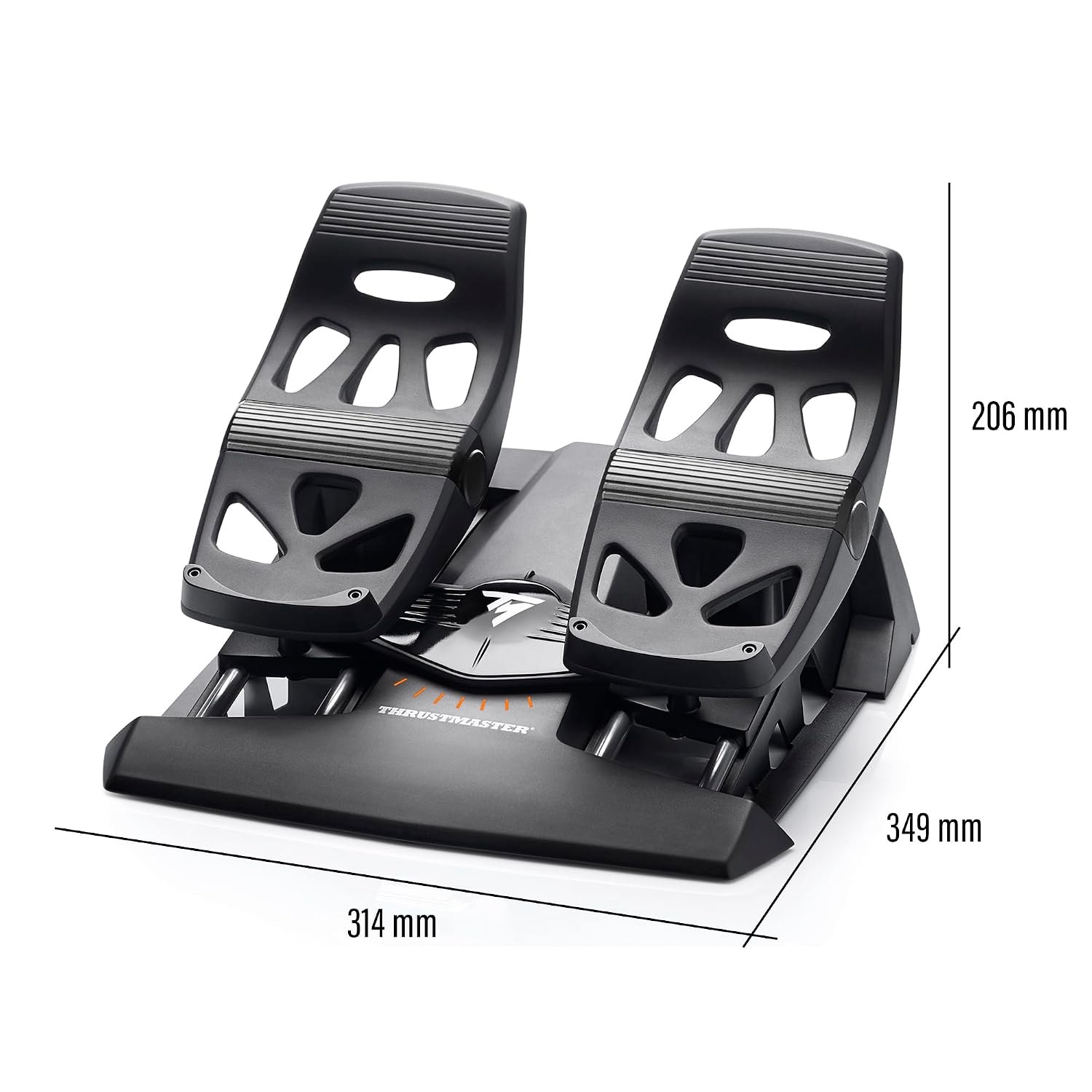
The rest of the chassis is where the price shows. At 4.9 pounds across a 14 by 12 inch footprint, this is a lightweight unit by sim pedal standards, and lighter pedals have a habit of walking across hard flooring under load. The listing emphasizes secure mounting and stable construction, which suggests Thrustmaster expects you to anchor the set to a cockpit frame or at least park it against a wall or rug.
One oddity worth flagging: the specification table lists a battery power source while also listing USB connectivity. Passive rudder pedals of this type draw what they need over USB, so treat the battery line as a listing artifact rather than a requirement. Warranty is one year.
What the specs tell us
Three things matter in a rudder pedal: travel, centering and resistance. The listing addresses all three. A long range of travel on the rudder axis means a given degree of yaw maps to more physical pedal movement, which is what makes small, deliberate corrections possible instead of twitchy ones. Short-throw pedals are the single most common complaint in the budget tier, so this is the right priority.
Self-centering matters because an axis that does not return cleanly to neutral leaves you holding a small permanent yaw input you cannot feel. The listing describes a mix of smoothness and resistance intended to deliver precise re-centering. Adjustable resistance appears in the item highlights, letting you set how heavy the rudder feels, which is useful since helicopter pilots usually want a lighter action than fixed-wing pilots do.
The gap is braking. The highlights mention differential braking, but the specification table never confirms dedicated toe-brake axes, and the listing does not describe a sensor type. Anyone who relies on independent wheel braking for tight taxiing should verify that before ordering rather than assume it.
Living with it
Setup is straightforward on PC: USB in, calibrate, assign the axis. On PS5 and Xbox Series X|S, pedals usually operate as part of a Thrustmaster ecosystem alongside a compatible stick or throttle, and in-game support varies by title, so confirm your sim recognizes rudder hardware on your platform.
The practical consideration is placement. A 4.9 pound set with a self-centering spring will push back against your feet, and that force has to go somewhere. Owners who mount the pedals to a cockpit rig or place them on a textured mat report a stable experience; those using them loose on laminate generally do not. Factor that into your setup plan before you judge the hardware.
Long sessions are where the long travel pays off, because you spend less energy fighting an over-sensitive axis and more time flying. Expect a mechanical peripheral that is quiet, uncomplicated and does one job.
Value for money
At $129.99 at the time of writing, the TFRP sits between the toy tier and the enthusiast tier. You are paying for metal rails, a long axis and multi-platform support, not for load cells or an all-metal frame. Judged against that, the price is fair rather than generous, and sets like this tend to see meaningful seasonal discounts rather than holding a fixed figure, so patience can be rewarded.
The alternative use of $130 is worth considering honestly. If you do not yet own a dedicated throttle, that purchase will change your flying more than pedals will. If you do, pedals are the next logical step and this is the cheapest credible way to take it.
Alternatives
Logitech G Pro Flight Rudder Pedals are the long-standing direct competitor, with damping adjustment and toe brakes, and are worth picking if independent wheel braking is non-negotiable for you.
Thrustmaster T-Pendular-Rudder (TPR) is the step up within the same family, using a pendular hanging design and metal construction, and makes sense if you fly heavily enough to justify roughly triple the outlay.
MFG Crosswind or similar enthusiast pedals are the end point of this upgrade path, built for pilots who want adjustable geometry and high-resolution sensors, and are the right choice only once you know pedals are central to how you fly.
The bottom line
The TFRP is the sensible first set of rudder pedals for someone who has outgrown a twist axis and is not ready to spend three figures more. Its aluminum rail system and long travel address the two things budget pedals usually get wrong, and the strong buyer rating suggests the execution is consistent. Verify the braking arrangement against your own requirements, plan how you will keep it anchored, and it earns its place in a mid-tier cockpit.
.gap-review{margin:2.5rem 0 0}.gap-review h2{font-size:1.5rem;margin:0 0 1.25rem}.gap-verdict{background:#0E1A2B;color:#fff;border-radius:16px;padding:1.5rem 1.75rem}.gap-verdict__head{display:flex;gap:1.25rem;align-items:center}.gap-score{margin:0;width:84px;height:84px;border-radius:50%;background:#FF5A1F;color:#fff;display:flex;flex-direction:column;align-items:center;justify-content:center;font-weight:800;font-size:1.9rem;line-height:1}.gap-score small{font-size:.7rem;font-weight:600;opacity:.85}.gap-eyebrow{margin:0 0 .35rem;text-transform:uppercase;letter-spacing:.08em;font-size:.75rem;font-weight:700;color:#FF5A1F}.gap-verdict__line{margin:0;font-size:1.125rem;line-height:1.45}.gap-proscons{display:grid;grid-template-columns:1fr 1fr;gap:1.25rem 2rem;margin-top:1.5rem;padding-top:1.25rem;border-top:1px solid rgba(255,255,255,.15)}.gap-proscons h3{margin:0 0 .6rem;font-size:.9rem;text-transform:uppercase;letter-spacing:.05em;color:inherit}.gap-proscons ul{list-style:none;margin:0;padding:0}.gap-proscons li{position:relative;padding-left:1.6em;margin:0 0 .45em}.gap-proscons li::before{position:absolute;left:0;top:0;font-weight:800}.gap-pros li::before{content:’+’;color:#4ADE80}.gap-cons li::before{content:’2013′;color:#F87171}.gap-specs,.gap-faq{margin-top:2rem}.gap-specs h3,.gap-faq h3{font-size:1.2rem;margin:0 0 .75rem}.gap-specs table{width:100%;border-collapse:collapse;font-size:.95rem}.gap-specs th,.gap-specs td{text-align:left;padding:.65rem .9rem;border-bottom:1px solid #E2E8F0;vertical-align:top}.gap-specs th{width:38%;background:#F4F6F9}.gap-faq details{border:1px solid #E2E8F0;border-radius:10px;padding:0 1rem;margin:0 0 .6rem}.gap-faq summary{cursor:pointer;padding:.85rem 0;font-weight:600}.gap-cta{margin-top:2rem;padding:1.25rem 1.5rem;background:#F4F6F9;border-radius:16px;display:flex;flex-wrap:wrap;gap:.75rem;align-items:center}.gap-btn{display:inline-block;padding:.85em 1.5em;border-radius:10px;font-weight:600;text-decoration:none!important;background:#FF5A1F;color:#fff!important}.gap-btn–secondary{background:transparent;color:#0E1A2B!important;border:2px solid #E2E8F0}.gap-disclosure,.gap-note{font-size:.875rem;color:#4A5568;margin:.75rem 0 0}@media(max-width:640px){.gap-proscons{grid-template-columns:1fr}}
Thrustmaster TFRP Flight Sim Rudder Pedals review
7.8/10
madagear.com verdict
Buy it if you fly with a HOTAS or yoke and want real rudder input without spending several hundred dollars; skip it if you need load-cell toe brakes or a metal-bodied pedal set for competitive use.
What we like
- Self-centering rudder axis returns to neutral without manual trimming
- Long travel on the rudder axis makes small heading corrections easier
- Four aluminum rails give the sliding motion a smoother, more rigid feel
- Adjustable resistance lets you tune how heavy the rudder feels
- Works with PC plus PS4, PS5 and Xbox Series X|S over USB
- Buyers rate it 4.4 out of 5 across more than 3,000 ratings
What we don’t
- Listing does not confirm dedicated load-cell toe brake axes
- Mostly polymer construction outside the rails at this price
- At 4.9 lb it can slide on hard floors without a mount or mat
- Listing spec table lists a battery power source despite USB connectivity
Specs at a glance
| Brand | Thrustmaster |
|---|---|
| Model | T.Flight Rudder Pedals (TFRP) |
| Controller type | Flight pedals |
| Connectivity | USB |
| Compatible platforms | PC, PS4, PS5, Xbox Series X|S |
| Rail system | Four aluminum rails (S.M.A.R.T. sliding system) |
| Key features | Self-centering rudder axis, long travel, adjustable resistance |
| Item weight | 4.9 pounds |
| Dimensions (D x W x H) | 14 x 12 x 8 inches |
| Color | Black |
| Warranty | One year |
| UPC | 663296420367 |
Frequently asked questions
Do I need rudder pedals if I already have a joystick with twist rudder?
You do not strictly need them, since a twist axis will keep an aircraft coordinated well enough for casual flying. Pedals separate yaw from roll and pitch, which makes crosswind landings, taxiing and helicopter work noticeably more manageable. If you fly mostly airliners on autopilot, the gain is smaller.
Will these work on PS5 and Xbox Series X|S?
The listing states compatibility with PS4, PS5, Xbox Series X|S and PC over USB. On console you generally pair pedals with a supported Thrustmaster stick or throttle rather than using them standalone, and in-game support depends on the title. Check that your specific sim recognizes rudder hardware on your platform before buying.
Does the set include toe brakes?
The listing mentions differential braking among its highlights but does not spell out dedicated toe-brake axes in the specification table. If independent left and right wheel braking is essential to your flying, confirm that detail with the manufacturer documentation first. Many pilots at this price map braking to a stick button instead.
Can the resistance be adjusted?
The listing lists adjustable resistance among the item highlights, alongside the self-centering rudder axis. That lets you set how much force is needed to hold a yaw input, which matters because preferences vary between fixed-wing and rotorcraft flying. Expect a mechanical adjustment rather than a software setting.
At the time of writing the price seen was $129.99, which covers the pedal set, the rail system and a one-year warranty, and sim pedals in this bracket tend to drift down during seasonal sales rather than hold a fixed figure. Price and availability checked on 2026-11-14.
madagear.com is reader-supported. When you buy through links on our site we may earn an affiliate commission, at no extra cost to you. This never affects what we recommend.


Reviews
There are no reviews yet.