

Description
Who it’s for
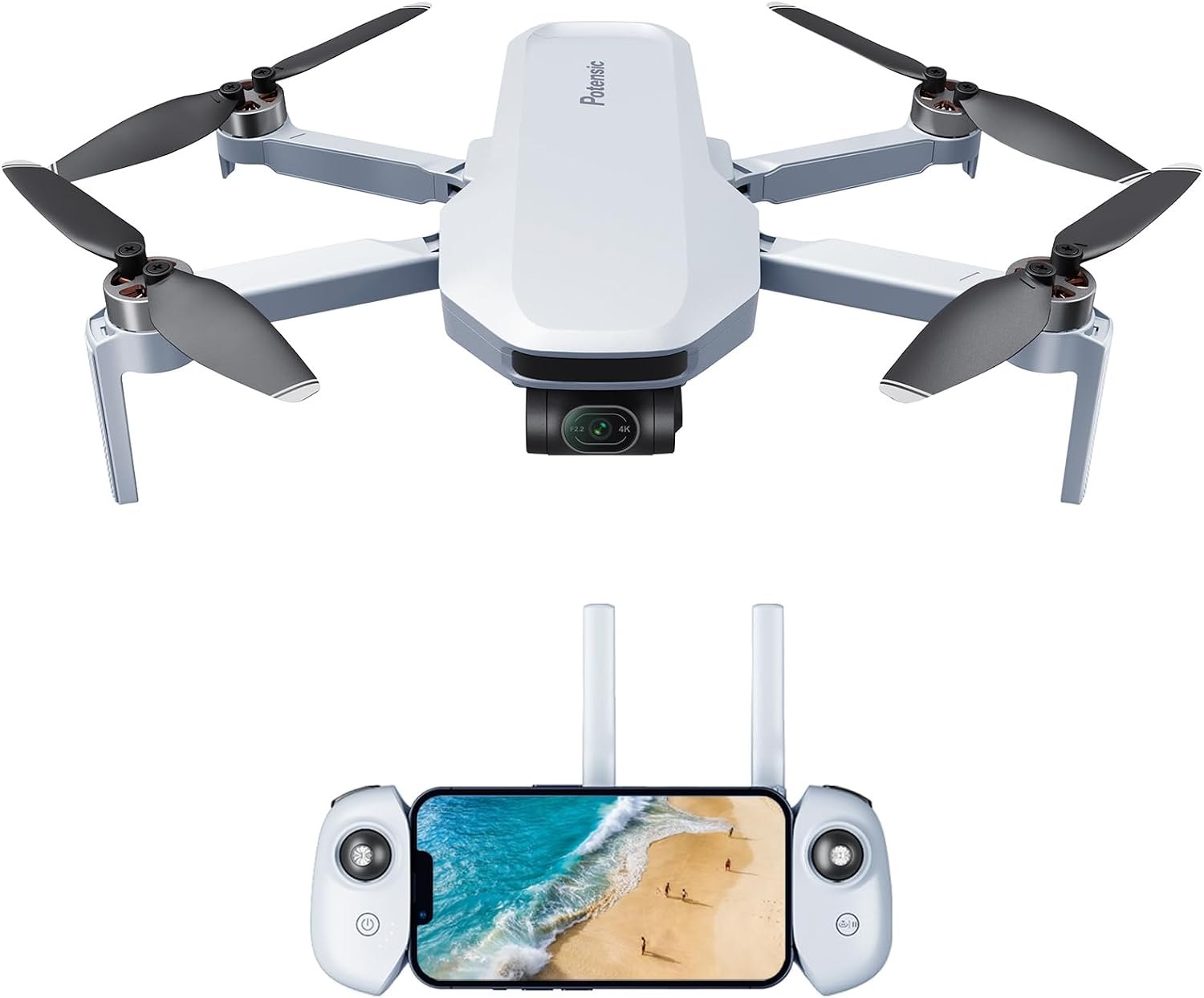
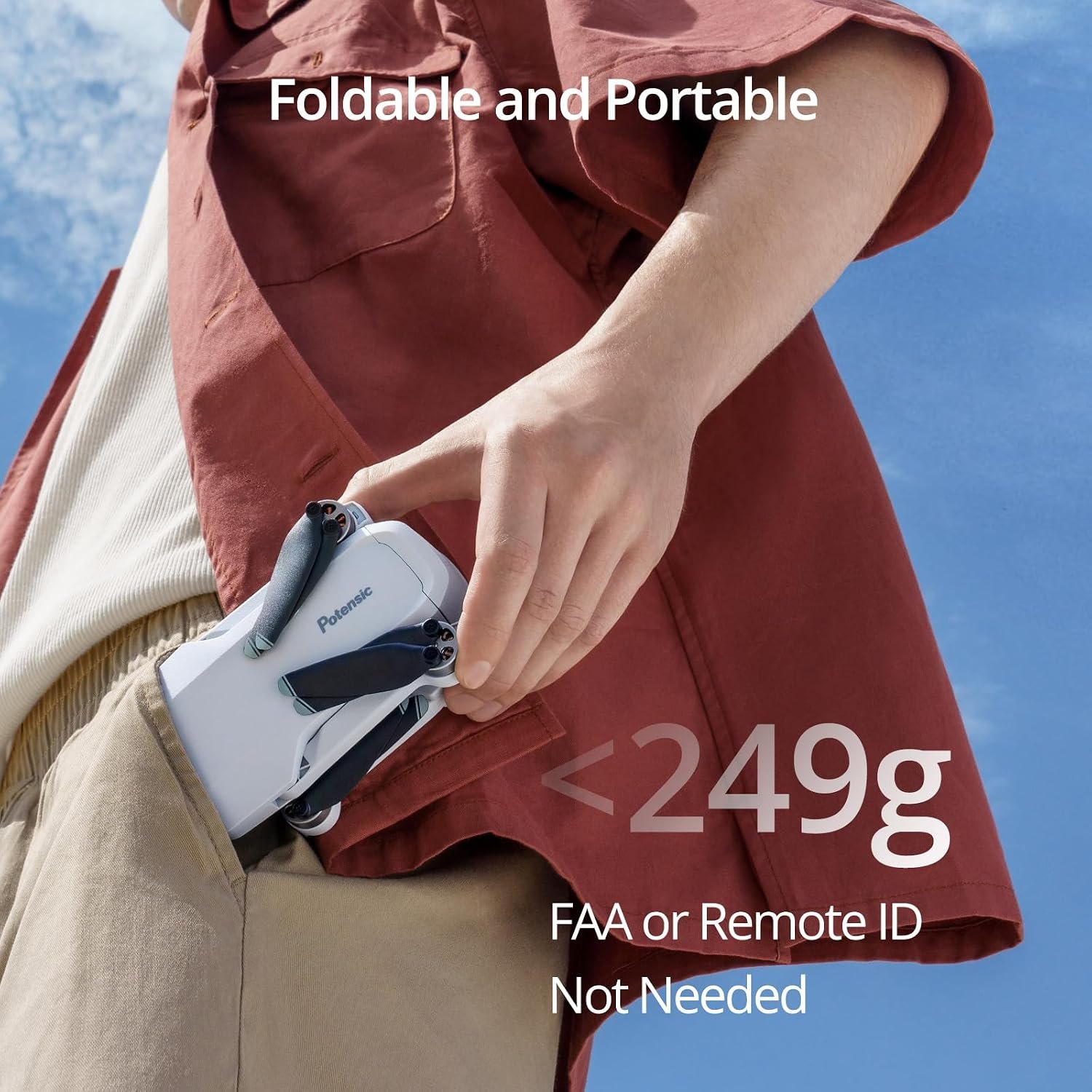
The original Atom is for the beginner who has decided that smooth footage matters, but whose budget stops around $250. It is the cheapest drone in Potensic’s range with a real three-axis gimbal, and it stays under 249 g, so you can fly it recreationally in the US without registering. It suits first-time buyers, parents buying for a teenager with a creative streak, and DJI Mini owners looking for a cheaper second drone. It does not suit anyone who needs obstacle sensing or wants landscape shots with a wide, sweeping field of view.
Design and build
The Atom is a small folding quadcopter in the shape every DJI Mini owner will recognize. Tom’s Guide called the build quality lackluster, and that is fair: the plastics are light and thin, which is partly how Potensic hits the weight limit. Treat it with care and it will be fine; treat it like a toy and it will show.
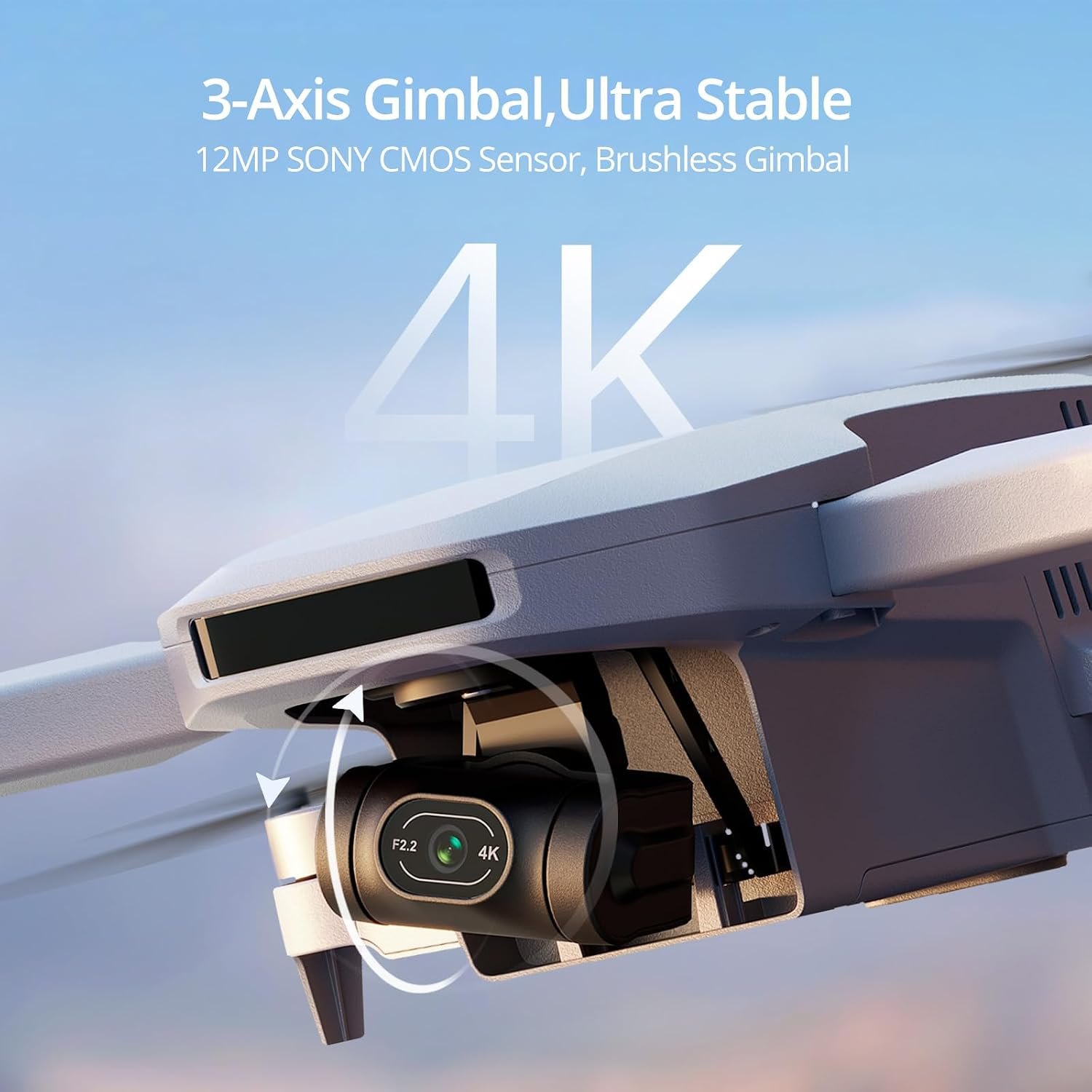
The important part hangs under the nose. The brushless three-axis gimbal tilts from straight down to 20 degrees up and stabilizes pitch, roll and yaw mechanically. That is the main reason to choose the Atom over the cheaper Atom SE, which tilts on one axis and relies on electronic stabilization for the rest. A downward vision system holds the drone steady between 0.3 and 5 m.
Camera and flight
The camera uses a 12 MP Sony sensor, which reviewers identify as 1/3-inch, behind a lens with a 78 degree field of view. It records 4K at up to 30 fps, 2.7K and 1080p at up to 60 fps. The gimbal is what lifts the result: pans are smooth and horizons stay level even when the drone is working against a breeze, which gives the footage a much more finished look than EIS drones at the same price.
The limits are the sensor and the lens. A 1/3-inch chip clips highlights early and gets noisy as light drops, so plan flights for good light. The 78 degree view is noticeably tighter than most drone cameras; Tom’s Guide flagged the narrow field of view as a drawback, and it means you fly higher or further back to fit a scene in. Digital zoom reaches 2x in 4K and 3x in lower resolutions.
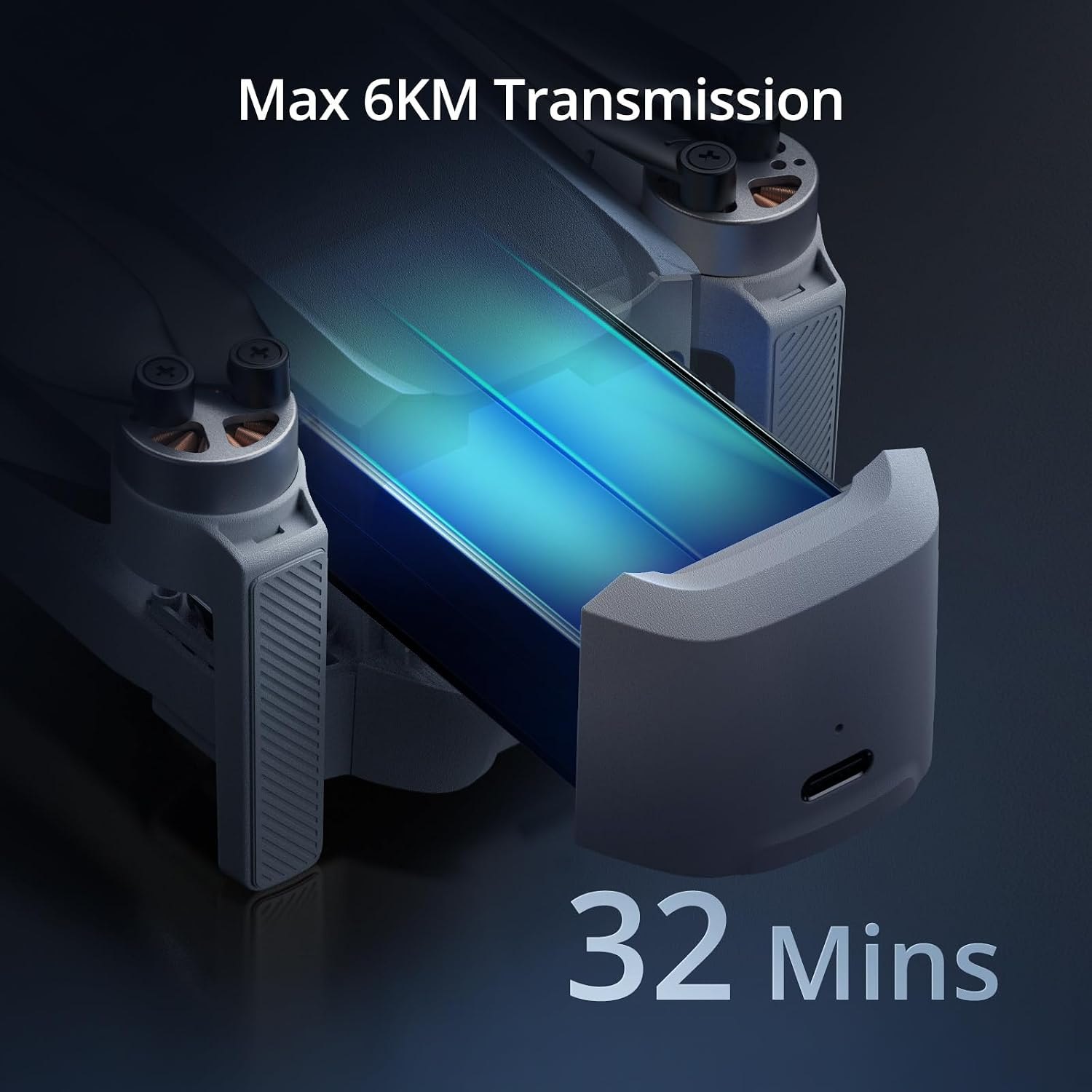
Flight features are generous for the price. Visual tracking can follow or orbit a subject, QuickShots offers Pull-away, Rocket, Circle, Spiral and Boomerang, and waypoint flight lets you plan a route. Potensic rates the Atom for Level 5 wind at 10.7 m/s, quotes 32 minutes per battery, and the PixSync 3.0 link is rated to 6 km. Tom’s Guide and TechRadar both rate it among the best beginner drones, with no obstacle avoidance the main caveat.
Living with it
The Atom flies through the Potensic app on iOS and Android with a phone clipped into the controller. Video, Normal and Sport modes let new pilots start slowly. The single-battery kit is the cheapest way in, but a 32-minute pack goes quickly, so budget for a spare or buy a multi-battery kit.
In the US the Atom is straightforward legally: no FAA registration or Remote ID for recreational flying under 249 g, and its FCC authorization predates the December 2025 Covered List action.
Value for money
At the time of writing Potensic’s store lists the Atom from $249.99, down from $299.99, with two- and three-battery kits available on Amazon. At that price nothing else from a recognizable brand gives you a three-axis gimbal, tracking and a 6 km link under 250 g. The Atom 2 costs roughly $70 to $80 more and brings a much better sensor; if you can stretch, that is the smarter long-term buy.
Alternatives
- Potensic Atom 2: pick it if you can spend about $80 more for a 1/2-inch sensor, HDR video and a 10 km link.
- DJI Mini 2 SE: pick it if you prefer DJI’s app and wider lens and do not need tracking modes.
- Potensic Atom SE: pick it if flight time and two batteries matter more than gimbal footage.
The bottom line
The Potensic Atom delivers what most budget drones only promise: properly stabilized footage from a drone you do not have to register. The sensor is small and the lens narrow, so do not expect miracles in poor light. At around $250 it remains one of the best-value gimbal drones in the US.
.gap-review{margin:2.5rem 0 0}.gap-review h2{font-size:1.5rem;margin:0 0 1.25rem}.gap-verdict{background:#0E1A2B;color:#fff;border-radius:16px;padding:1.5rem 1.75rem}.gap-verdict__head{display:flex;gap:1.25rem;align-items:center}.gap-score{margin:0;width:84px;height:84px;border-radius:50%;background:#FF5A1F;color:#fff;display:flex;flex-direction:column;align-items:center;justify-content:center;font-weight:800;font-size:1.9rem;line-height:1}.gap-score small{font-size:.7rem;font-weight:600;opacity:.85}.gap-eyebrow{margin:0 0 .35rem;text-transform:uppercase;letter-spacing:.08em;font-size:.75rem;font-weight:700;color:#FF5A1F}.gap-verdict__line{margin:0;font-size:1.125rem;line-height:1.45}.gap-proscons{display:grid;grid-template-columns:1fr 1fr;gap:1.25rem 2rem;margin-top:1.5rem;padding-top:1.25rem;border-top:1px solid rgba(255,255,255,.15)}.gap-proscons h3{margin:0 0 .6rem;font-size:.9rem;text-transform:uppercase;letter-spacing:.05em;color:inherit}.gap-proscons ul{list-style:none;margin:0;padding:0}.gap-proscons li{position:relative;padding-left:1.6em;margin:0 0 .45em}.gap-proscons li::before{position:absolute;left:0;top:0;font-weight:800}.gap-pros li::before{content:’+’;color:#4ADE80}.gap-cons li::before{content:’2013′;color:#F87171}.gap-specs,.gap-faq{margin-top:2rem}.gap-specs h3,.gap-faq h3{font-size:1.2rem;margin:0 0 .75rem}.gap-specs table{width:100%;border-collapse:collapse;font-size:.95rem}.gap-specs th,.gap-specs td{text-align:left;padding:.65rem .9rem;border-bottom:1px solid #E2E8F0;vertical-align:top}.gap-specs th{width:38%;background:#F4F6F9}.gap-faq details{border:1px solid #E2E8F0;border-radius:10px;padding:0 1rem;margin:0 0 .6rem}.gap-faq summary{cursor:pointer;padding:.85rem 0;font-weight:600}.gap-cta{margin-top:2rem;padding:1.25rem 1.5rem;background:#F4F6F9;border-radius:16px;display:flex;flex-wrap:wrap;gap:.75rem;align-items:center}.gap-btn{display:inline-block;padding:.85em 1.5em;border-radius:10px;font-weight:600;text-decoration:none!important;background:#FF5A1F;color:#fff!important}.gap-btn–secondary{background:transparent;color:#0E1A2B!important;border:2px solid #E2E8F0}.gap-disclosure,.gap-note{font-size:.875rem;color:#4A5568;margin:.75rem 0 0}@media(max-width:640px){.gap-proscons{grid-template-columns:1fr}}
Potensic Atom review
7.5/10
madagear.com verdict
Buy it if you want smooth gimbal footage and tracking without registration on a tight budget; skip it if you need wide-angle shots, obstacle avoidance or better low-light video.
What we like
- Brushless three-axis gimbal at a price where most rivals use EIS
- Under 249 g, so no FAA registration for recreational flying
- Visual tracking, QuickShots and waypoint flight
- PixSync 3.0 link rated to 6 km
- Level 5 wind rating and around 32 minutes per battery
What we don’t
- Narrow 78 degree field of view for a drone camera
- Small 1/3-inch 12 MP sensor limits dynamic range and low light
- No obstacle avoidance
- Build feels light and plasticky
Specs at a glance
| Takeoff weight | Under 249 g |
|---|---|
| Camera | 12 MP Sony CMOS (1/3-inch), 78 degree field of view |
| Video | 4K at 24/25/30fps, 2.7K at 30fps, 1080p up to 60fps |
| Gimbal | Brushless 3-axis, tilt -90 to +20 degrees |
| Flight time | Up to 32 min per battery (manufacturer figure) |
| Transmission | PixSync 3.0, up to 6 km |
| Max speed | 16 m/s in Sport mode |
| Wind resistance | Level 5, 10.7 m/s |
| Zoom | 2x digital in 4K, 3x in 2.7K and 1080p |
Frequently asked questions
Do I need to register the Potensic Atom?
Not for recreational flying in the US. At under 249 g it is below the FAA’s 250 g threshold, so registration and Remote ID are not required unless you fly commercially under Part 107.
What is the difference between the Atom and the Atom 2?
The Atom 2 moves to a larger 1/2-inch sensor with 48 MP stills and 4K HDR, extends the link to 10 km, adds vertical shooting and AI tracking, and offers a screen controller. The original Atom is roughly $70 to $80 cheaper.
Does the Potensic Atom have obstacle avoidance?
No. It has downward vision for hovering between 0.3 and 5 m, but no forward or side sensors, so tracking near trees and buildings needs care.
Is the Atom still sold in the US after the FCC changes?
Yes. The December 2025 Covered List action only blocks new foreign-made models from being authorized. The Atom was authorized before then, so it remains legal to sell and fly.
Potensic’s store lists the single-battery kit from $249.99 (list $299.99). Expansion and Fly More kits with two or three batteries cost more on Amazon. Price and availability checked on 2026-11-10.
madagear.com is reader-supported. When you buy through links on our site we may earn an affiliate commission, at no extra cost to you. This never affects what we recommend.


Reviews
There are no reviews yet.