




Description
Who it’s for
This is a storage card for people who want to stop thinking about storage cards. If you fly a consumer drone, run an action camera on the helmet or quad, or want a capacity bump for a phone or tablet that still takes microSD, a 128GB U3-rated card is the default answer. Amazon Basics is aiming squarely at that buyer: one card, one adapter, a short setup leaflet, done.
It also suits the pilot who has been burned by a counterfeit card. Memory cards are one of the most heavily faked product categories out there, and buying from a first-party line removes one of the bigger variables. That is a quieter benefit than raw speed numbers, but for anyone who has lost a flight’s footage to a card that reported a capacity it did not have, it carries weight.
Who it is not for: videographers chasing high-bitrate or long-form capture, and anyone who treats price per gigabyte as the deciding factor. Both of those buyers are better served elsewhere, for reasons covered further down.
Design and build
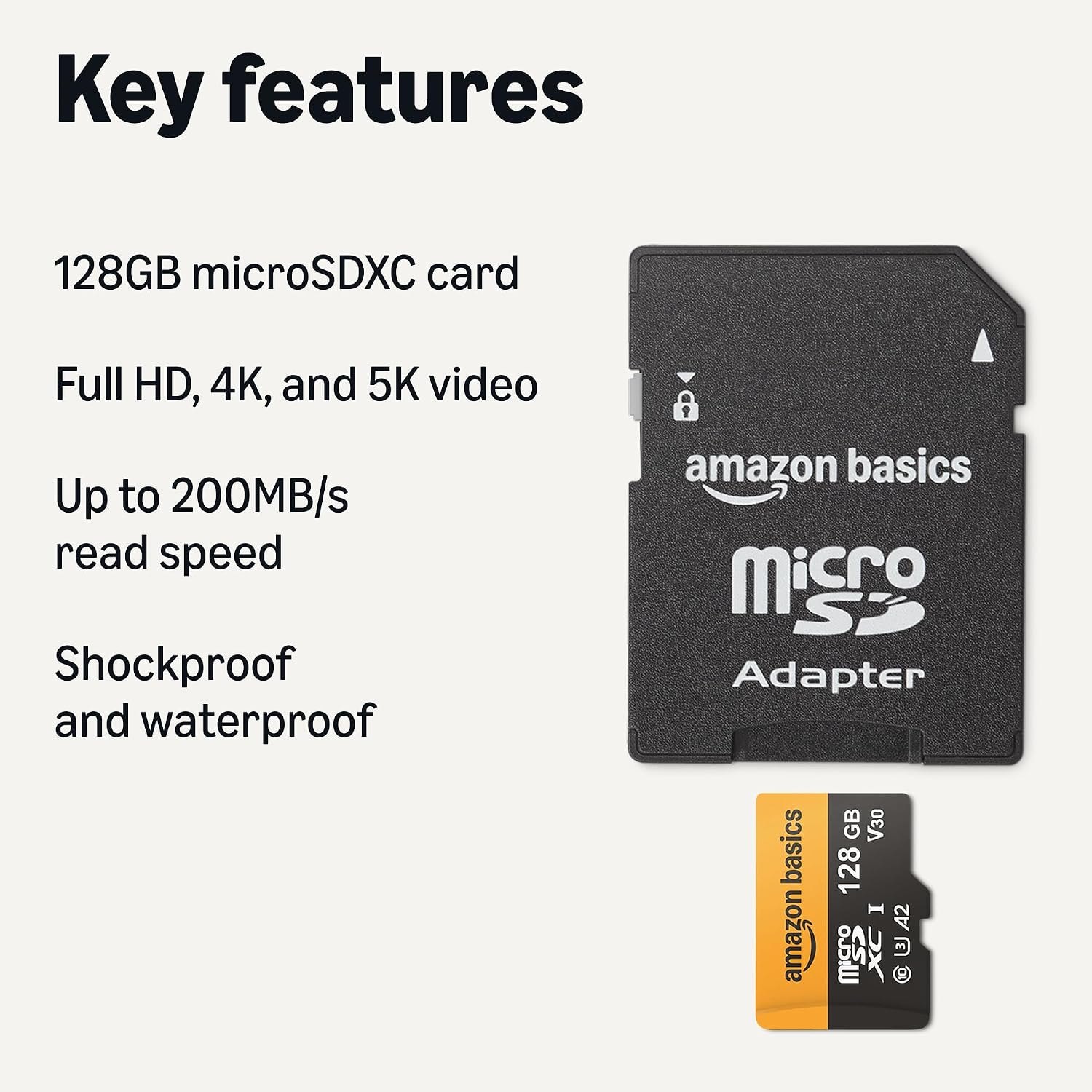
There is not much to describe physically. It is a black microSDXC card weighing 0.02 kg, supplied with a full-size SD adapter so it drops into a laptop slot or a camera that takes standard SD. The adapter matters more than it sounds: plenty of drone pilots offload through a laptop reader rather than a dedicated USB stick, and having the sleeve in the box saves a separate purchase.
The durability claims are the usual list for this class. The maker states the card is drop proof, shockproof, IPX6 waterproof, temperature rated from -10 to 80 degrees Celsius, X-ray proof and magnet proof. Those are standard protections across mainstream microSD lines rather than a differentiator, but they are the right ones for gear that lives in a flight bag, gets swapped with cold fingers, and goes through airport scanners.
Worth noting what is absent. There is no video speed class rating quoted, no V30 or V60 badge, only the UHS-I bus with U3, Class 10 and A2 classifications. In practice U3 and V30 both promise a 30MB/s sustained write floor, so the gap is more about labeling than capability, but buyers whose camera manual explicitly asks for a V-rated card will notice.
What the specs tell us
The headline figures are up to 200MB/s read and up to 150MB/s write. Read speed is the one with an asterisk: the listing is explicit that hitting 200MB/s requires the Amazon Basics USB-C 3.0 card reader, sold separately. That is an honest disclosure, and it is also a reminder that read speed only governs how fast you pull footage onto a computer, not whether your drone can record cleanly.
Write speed is the number that actually matters in the air, and here the card is comfortably specified. Consumer drones recording 4K typically need a sustained write in the region of 30MB/s, which the U3 rating guarantees as a floor. The 150MB/s peak is a burst figure you will rarely see sustained, but the gap between the guaranteed minimum and what a drone demands is wide enough that dropped frames should not be a concern on mainstream hardware.
The A2 rating is the other useful marker. It covers random read and write performance, which is what makes a card feel responsive when an operating system is loading apps from it rather than streaming a single large video file. If this card is going into a tablet or a handheld rather than a drone, A2 is the spec to care about.
Living with it
Buyer sentiment is strong: 4.7 out of 5 across more than 3,400 ratings, and it currently sits at number 29 in the micro SD card category. That is the profile of a card that does the unremarkable thing reliably, which is exactly the goal. Owners of cards in this class generally report that the pain points are offload speed and capacity management rather than recording failures.
On capacity, 128GB is the sensible middle. It holds more consumer 4K drone footage than a full set of batteries will produce in one session, which means the card is not the thing that ends your flying day. Many pilots prefer two 128GB cards to one 256GB card anyway, since a single card failure then costs half the footage rather than all of it.
The compatibility note deserves a flag. The listing states plainly that this card does not work with the Nintendo Switch 2, which moved to the faster microSD Express standard. If you were planning to buy one card and shuttle it between a drone and a new console, that plan does not work here.
Value for money
This is where the product gets harder to defend. At the time of writing it lists at $44.93 for 128GB, and that is high for a UHS-I card against the broader market, where 128GB U3 cards from established memory brands frequently sit well below that. You are paying something for the first-party supply chain and the bundled adapter, but the premium is real rather than nominal.
MicroSD pricing also moves sharply around sale events. A card at this capacity and speed grade is the kind of thing worth adding to a watchlist rather than buying at full list. If it lands meaningfully lower than the current figure, the value case flips from questionable to solid, because the underlying specification is perfectly sound.
There is also the hidden cost of the reader. Getting the advertised 200MB/s read means buying the matching USB-C 3.0 reader separately, so budget for that if fast offloads are part of why you are considering this card.
Alternatives
The SanDisk Extreme microSDXC is the obvious comparison, carrying both U3 and V30 ratings along with A2, and it is the card most drone manufacturers list by name in their compatibility notes. Pick it if your camera manual asks for a V30 badge specifically, or if it is cheaper on the day you shop.
The Samsung EVO Select is the value play in this bracket, generally landing lower per gigabyte with the same U3 and A2 grades. Pick it if cost per gigabyte is the thing driving the decision and you do not need the fastest possible offload.
The Lexar Professional Silver Plus is the step-up option for anyone recording at higher bitrates or shooting long takes, since it targets sustained-write performance more aggressively. Pick it if your workflow punishes a card that only just clears the 30MB/s floor.
The bottom line
The specification here is sound and well matched to what a consumer drone or action camera actually asks of a card, and buyer sentiment backs that up. The sticking point is the asking price at the time of writing, which sits above comparable UHS-I cards from brands with longer track records in flash memory. Watch it for a discount, and it becomes an easy recommendation rather than a conditional one.
.gap-review{margin:2.5rem 0 0}.gap-review h2{font-size:1.5rem;margin:0 0 1.25rem}.gap-verdict{background:#0E1A2B;color:#fff;border-radius:16px;padding:1.5rem 1.75rem}.gap-verdict__head{display:flex;gap:1.25rem;align-items:center}.gap-score{margin:0;width:84px;height:84px;border-radius:50%;background:#FF5A1F;color:#fff;display:flex;flex-direction:column;align-items:center;justify-content:center;font-weight:800;font-size:1.9rem;line-height:1}.gap-score small{font-size:.7rem;font-weight:600;opacity:.85}.gap-eyebrow{margin:0 0 .35rem;text-transform:uppercase;letter-spacing:.08em;font-size:.75rem;font-weight:700;color:#FF5A1F}.gap-verdict__line{margin:0;font-size:1.125rem;line-height:1.45}.gap-proscons{display:grid;grid-template-columns:1fr 1fr;gap:1.25rem 2rem;margin-top:1.5rem;padding-top:1.25rem;border-top:1px solid rgba(255,255,255,.15)}.gap-proscons h3{margin:0 0 .6rem;font-size:.9rem;text-transform:uppercase;letter-spacing:.05em;color:inherit}.gap-proscons ul{list-style:none;margin:0;padding:0}.gap-proscons li{position:relative;padding-left:1.6em;margin:0 0 .45em}.gap-proscons li::before{position:absolute;left:0;top:0;font-weight:800}.gap-pros li::before{content:’+’;color:#4ADE80}.gap-cons li::before{content:’2013′;color:#F87171}.gap-specs,.gap-faq{margin-top:2rem}.gap-specs h3,.gap-faq h3{font-size:1.2rem;margin:0 0 .75rem}.gap-specs table{width:100%;border-collapse:collapse;font-size:.95rem}.gap-specs th,.gap-specs td{text-align:left;padding:.65rem .9rem;border-bottom:1px solid #E2E8F0;vertical-align:top}.gap-specs th{width:38%;background:#F4F6F9}.gap-faq details{border:1px solid #E2E8F0;border-radius:10px;padding:0 1rem;margin:0 0 .6rem}.gap-faq summary{cursor:pointer;padding:.85rem 0;font-weight:600}.gap-cta{margin-top:2rem;padding:1.25rem 1.5rem;background:#F4F6F9;border-radius:16px;display:flex;flex-wrap:wrap;gap:.75rem;align-items:center}.gap-btn{display:inline-block;padding:.85em 1.5em;border-radius:10px;font-weight:600;text-decoration:none!important;background:#FF5A1F;color:#fff!important}.gap-btn–secondary{background:transparent;color:#0E1A2B!important;border:2px solid #E2E8F0}.gap-disclosure,.gap-note{font-size:.875rem;color:#4A5568;margin:.75rem 0 0}@media(max-width:640px){.gap-proscons{grid-template-columns:1fr}}
Amazon Basics 128GB microSDXC Memory Card review
7.2/10
madagear.com verdict
Worth buying if you want a straightforward U3-rated card from a known seller for a drone or action camera, but skip it if you shop on price per gigabyte or need certified V30 sustained-write numbers.
What we like
- U3, Class 10 and A2 ratings cover 4K drone and action-cam recording
- Full-size SD adapter included, so laptop and camera card readers work too
- Quoted write speed up to 150MB/s is well above what most drones demand
- Drop, shock, IPX6, temperature and X-ray protection claimed by the maker
- Buyers rate it 4.7 out of 5 across more than 3,400 ratings
- Broad device support across cameras, consoles, phones, tablets and PCs
What we don’t
- Price per gigabyte is high next to rival 128GB U3 cards at the time of writing
- The 200MB/s read figure needs a separate Amazon Basics USB-C reader
- No V30 or V60 video speed class listed, only UHS-I U3
- Explicitly not compatible with the Nintendo Switch 2
Specs at a glance
| Capacity | 128 GB |
|---|---|
| Format | microSDXC |
| Speed classes | UHS-I, U3, Class 10, A2 |
| Read speed | Up to 200 MB/s |
| Write speed | Up to 150 MB/s |
| In the box | Card, microSD-to-SD adapter, setup guide |
| Durability | Drop, shock, IPX6, -10 to 80 C, X-ray, magnet |
| Weight | 0.02 kg |
| Model number | LSMICRO128GU3-H |
| Warranty | Limited |
Frequently asked questions
Is this card fast enough for 4K drone footage?
On paper, yes. U3 and Class 10 guarantee a minimum sustained write of 30MB/s, which is the bar most consumer drones and action cameras ask for when recording 4K. The listing’s 150MB/s write ceiling leaves plenty of headroom, though that peak figure is a best case rather than a sustained rate.
Why am I not getting 200MB/s read speeds?
The listing states that the 200MB/s figure requires the Amazon Basics USB-C 3.0 card reader, sold separately. Plugged into an older USB 2.0 reader or a slow laptop slot, transfers will be capped by the reader rather than the card. For in-drone recording this does not matter, since write speed is what governs capture.
Does it work with the Nintendo Switch 2?
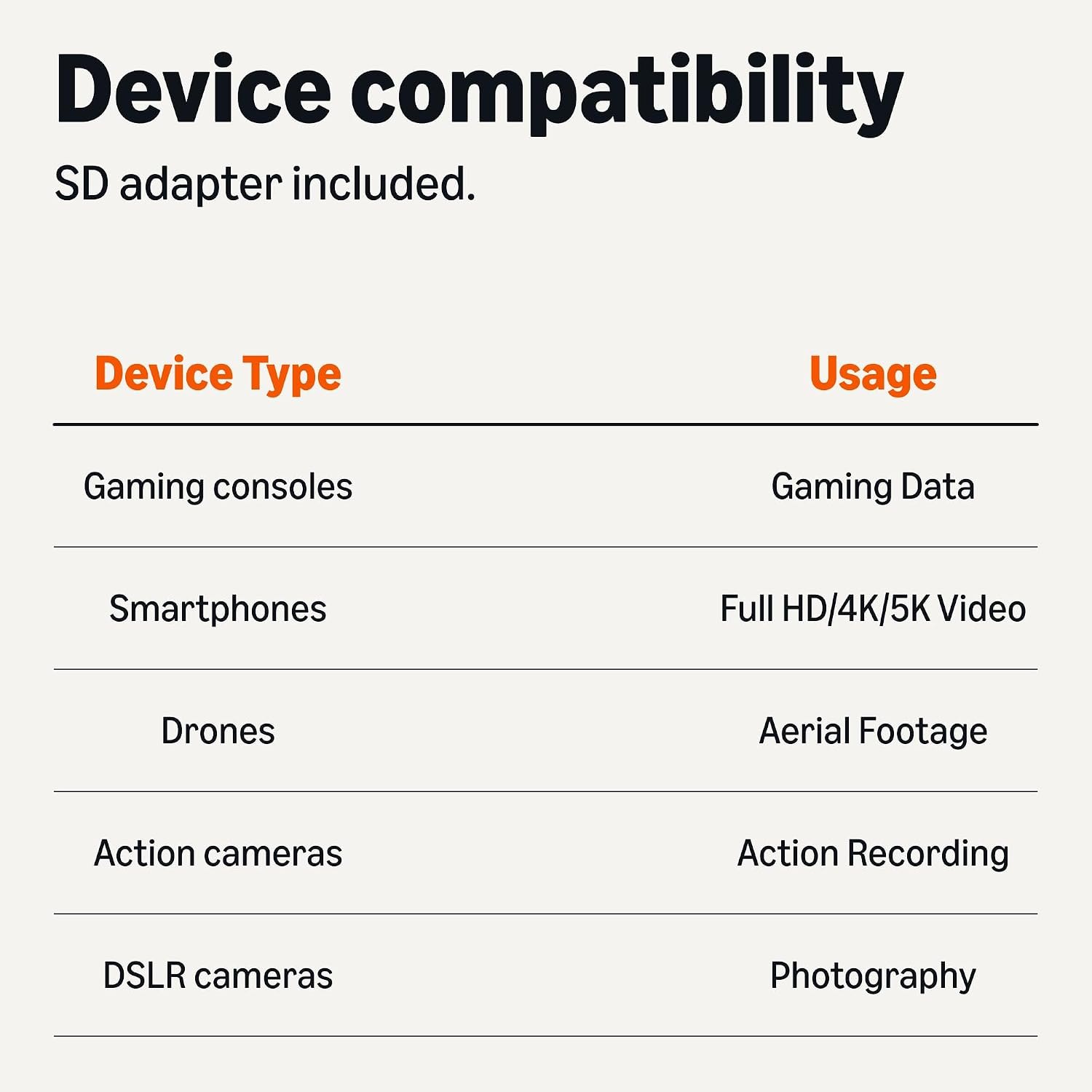
No. The listing specifically calls out that this card is not compatible with the Switch 2, which uses the newer microSD Express standard. It is listed as compatible with cameras, older gaming consoles, smartphones, tablets and PCs.
Is 128GB enough for a day of flying?
For most pilots, comfortably so. A 128GB card holds a few hours of typical consumer 4K drone footage, which is far more than the battery stack on a normal session allows. Heavy shooters recording at high bitrates for a full day may prefer to carry a second card rather than a larger single one.
At the time of writing it lists at $44.93 for the single card plus the full-size SD adapter, and microSD pricing swings hard around sales events, so the figure you see today may not be the figure next week. Price and availability checked on 2026-11-14.
madagear.com is reader-supported. When you buy through links on our site we may earn an affiliate commission, at no extra cost to you. This never affects what we recommend.


Reviews
There are no reviews yet.