


Description
Who it’s for
The Goggles 3 is for pilots who have committed to DJI’s digital system and want the best view it can deliver. That includes DJI Avata 2 owners who want more than the bundled experience, custom-build pilots flying O3 or O4 air units, and camera-drone owners who want to fly a Mini 4 Pro or Air 3 through goggles. It is the only current DJI headset that covers all of those at once. If you only fly a DJI Neo, wear glasses, or are still deciding whether FPV is for you, the much cheaper Goggles N3 makes more sense.
Design and build
DJI moved the battery into the back of the headband, so there is no separate pack and no cable running down to your pocket. The whole unit weighs about 470 g, heavier than the old Goggles 2, but owners and reviewers consistently describe it as more comfortable because the weight is balanced front to back and a forehead pad takes pressure off your nose and cheeks. A dial behind the battery tightens the strap. Inside are two 0.49-inch micro-OLED panels at 1920 × 1080 each, with a 56 to 72 mm IPD range and built-in diopter adjustment from -6.0 to +2.0; DJI includes a pair of -2.0 lenses for stronger prescriptions. A joystick and button replace the old touchpad, a cooling fan runs automatically with an anti-fog boost, and the microSD slot records MOV files. Two forward-facing cameras provide Real View PiP, a 720p look at the world around you. The antennas are fixed, so there is no upgrade path there.
Image and transmission
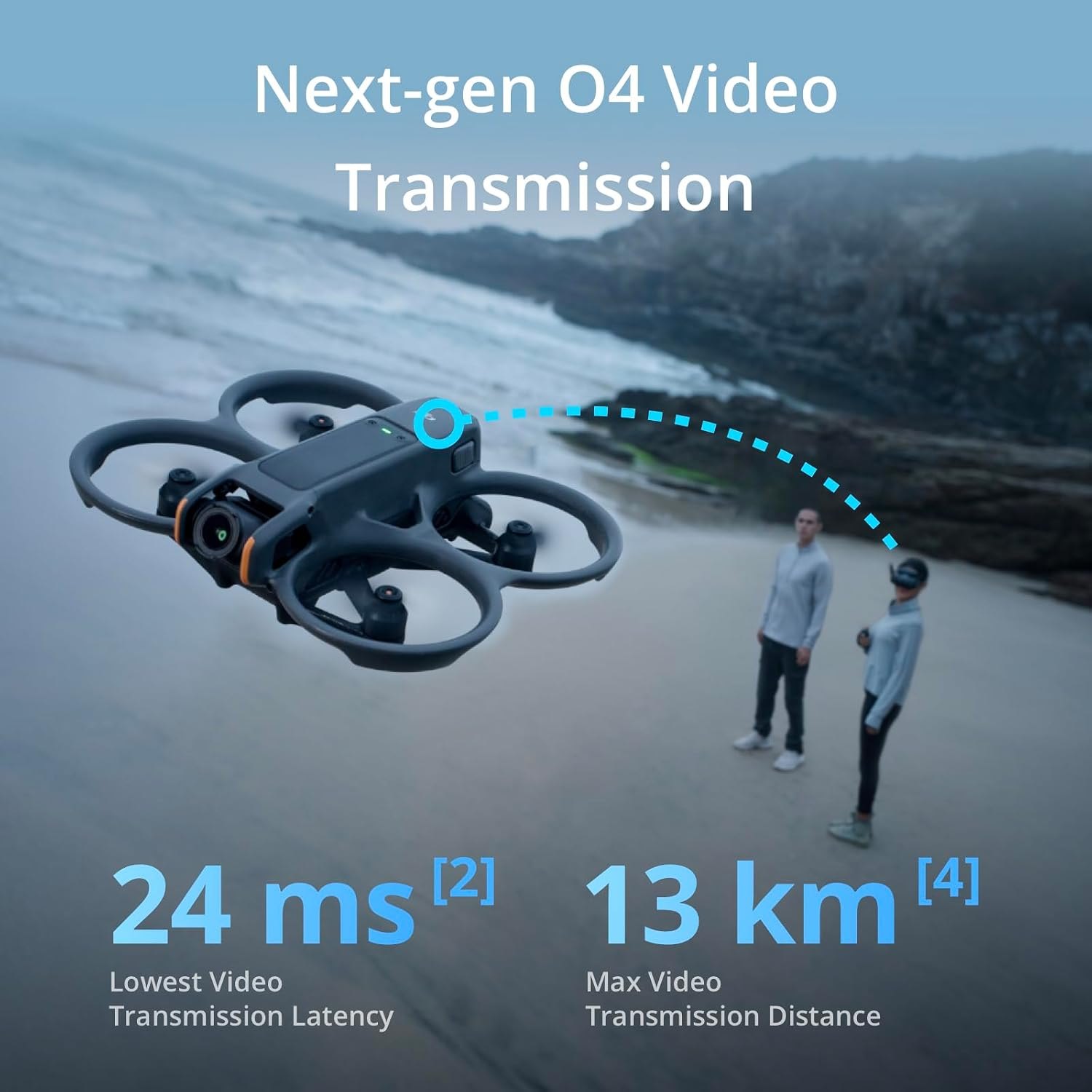
This is where the price goes. The micro-OLED panels run at up to 100 Hz with deep blacks, and the 44° field of view is narrower than the Goggles 2’s 51°, which reviewers found sharper at the edges in practice. With the Avata 2, DJI quotes 24 ms latency at 1080p/100fps and a 13 km FCC range at up to 60 Mbps. Pair it with an O4 Air Unit in Racing mode and DJI quotes 20 ms; with an O4 Air Unit Pro it drops to 15 ms, the lowest figure in the DJI lineup. Head tracking works with the Avata 2 and Neo for a more natural camera feel. Real View PiP is useful for finding a dropped battery or talking to a spotter, but the passthrough image is low resolution, and reviewers found the double-tap gesture that activates it fussy.
Living with it
Battery life is about three hours per charge under DJI’s test conditions, and it charges over USB-C at up to 20 W, or runs from a power bank in the field. Compatibility is the Goggles 3’s strongest argument: Avata 2, Neo, Neo 2 (with its optional transceiver), Air 3, Mini 4 Pro, the O3 Air Unit after a firmware update, and the full O4 air unit range. It does not work with the older RC Motion 2 or FPV Remote Controller 2, and it has no analog, Walksnail or HDZero support at all. The FCC’s December 2025 Covered List decision blocks new DJI authorizations, but the Goggles 3 was approved long before that and remains on sale in the US at the time of writing.
Value for money
At the time of writing, US FPV retailers list the Goggles 3 at around $689, well above its $499 launch price. That is a lot of money for goggles that only work with one ecosystem. The Goggles N3 costs roughly a third as much and covers the Avata 2, Neo and O4 builds, but with a 60 Hz LCD, higher latency and no Air 3 or Mini 4 Pro support. Against non-DJI flagships, the Goggles 3 is priced similarly and wins on comfort and integration while losing on flexibility.
Alternatives
- DJI Goggles N3: pick it if you fly an Avata 2, Neo or O4 build, wear glasses, or want DJI digital FPV for a fraction of the price.
- Walksnail Avatar HD Goggles X: pick it if you want removable antennas, HDMI and AV inputs, and a system that is not tied to DJI.
- DJI Avata 2: pick it if you do not own a drone yet; its Fly More Combo bundles the Goggles 3 with the aircraft.
The bottom line
The DJI Goggles 3 is the best way to see DJI’s O4 video: sharp, fast, comfortable and compatible with almost everything DJI makes. The price and the closed ecosystem are the trade-offs. If you are staying with DJI for the long run, these are the goggles to own.
.gap-review{margin:2.5rem 0 0}.gap-review h2{font-size:1.5rem;margin:0 0 1.25rem}.gap-verdict{background:#0E1A2B;color:#fff;border-radius:16px;padding:1.5rem 1.75rem}.gap-verdict__head{display:flex;gap:1.25rem;align-items:center}.gap-score{margin:0;width:84px;height:84px;border-radius:50%;background:#FF5A1F;color:#fff;display:flex;flex-direction:column;align-items:center;justify-content:center;font-weight:800;font-size:1.9rem;line-height:1}.gap-score small{font-size:.7rem;font-weight:600;opacity:.85}.gap-eyebrow{margin:0 0 .35rem;text-transform:uppercase;letter-spacing:.08em;font-size:.75rem;font-weight:700;color:#FF5A1F}.gap-verdict__line{margin:0;font-size:1.125rem;line-height:1.45}.gap-proscons{display:grid;grid-template-columns:1fr 1fr;gap:1.25rem 2rem;margin-top:1.5rem;padding-top:1.25rem;border-top:1px solid rgba(255,255,255,.15)}.gap-proscons h3{margin:0 0 .6rem;font-size:.9rem;text-transform:uppercase;letter-spacing:.05em;color:inherit}.gap-proscons ul{list-style:none;margin:0;padding:0}.gap-proscons li{position:relative;padding-left:1.6em;margin:0 0 .45em}.gap-proscons li::before{position:absolute;left:0;top:0;font-weight:800}.gap-pros li::before{content:’+’;color:#4ADE80}.gap-cons li::before{content:’2013′;color:#F87171}.gap-specs,.gap-faq{margin-top:2rem}.gap-specs h3,.gap-faq h3{font-size:1.2rem;margin:0 0 .75rem}.gap-specs table{width:100%;border-collapse:collapse;font-size:.95rem}.gap-specs th,.gap-specs td{text-align:left;padding:.65rem .9rem;border-bottom:1px solid #E2E8F0;vertical-align:top}.gap-specs th{width:38%;background:#F4F6F9}.gap-faq details{border:1px solid #E2E8F0;border-radius:10px;padding:0 1rem;margin:0 0 .6rem}.gap-faq summary{cursor:pointer;padding:.85rem 0;font-weight:600}.gap-cta{margin-top:2rem;padding:1.25rem 1.5rem;background:#F4F6F9;border-radius:16px;display:flex;flex-wrap:wrap;gap:.75rem;align-items:center}.gap-btn{display:inline-block;padding:.85em 1.5em;border-radius:10px;font-weight:600;text-decoration:none!important;background:#FF5A1F;color:#fff!important}.gap-btn–secondary{background:transparent;color:#0E1A2B!important;border:2px solid #E2E8F0}.gap-disclosure,.gap-note{font-size:.875rem;color:#4A5568;margin:.75rem 0 0}@media(max-width:640px){.gap-proscons{grid-template-columns:1fr}}
DJI Goggles 3 review
9.0/10
madagear.com verdict
Buy it if you fly DJI digital FPV and want the sharpest, lowest-latency view DJI makes; skip it if you wear glasses, fly analog, or only need goggles for a DJI Neo.
What we like
- Dual 1080p micro-OLED screens at up to 100 Hz give a sharp, high-contrast image
- Works with Avata 2, Neo, Air 3, Mini 4 Pro, O3 and all O4 air units
- Lowest latency in the DJI range: 15 ms with an O4 Air Unit Pro in Racing mode
- Battery built into the headband, about 3 hours per charge, no dangling cable
- Built-in diopter adjustment from -6.0 to +2.0 and a 56 to 72 mm IPD range
- Real View PiP lets you check your surroundings without taking the goggles off
What we don’t
- Expensive, and US prices have climbed well above the $499 launch price
- Antennas are not removable and the battery cannot be swapped
- DJI only: no analog, Walksnail or HDZero support
- Not designed to be worn over glasses
Specs at a glance
| Display | Dual 0.49-inch micro-OLED, 1920 × 1080 per eye, up to 100 Hz |
|---|---|
| Field of view | 44° |
| IPD and diopter | 56–72 mm IPD; -6.0 D to +2.0 D diopter |
| Video system | DJI O4, up to 60 Mbps, 13 km max range (FCC) |
| Latency | 24 ms with DJI Avata 2 at 1080p/100fps; as low as 15 ms with O4 Air Unit Pro in Racing mode |
| Recording | MOV to microSD, cards up to 512 GB |
| Battery | Integrated 3000 mAh (21.6 Wh), about 3 hours, 20 W charging |
| Weight | About 470 g including battery |
| Compatibility | Avata 2, Neo, Neo 2, Air 3, Mini 4 Pro, O3 Air Unit, O4 Air Unit, O4 Air Unit Pro |
Frequently asked questions
Does the DJI Goggles 3 work with the O3 Air Unit?
Yes. DJI added O3 Air Unit support in a mid-2024 firmware update. Update both the goggles and the air unit to the latest firmware before binding. The RC Motion 3 cannot be used with an O3 build, but the FPV Remote Controller 3 can.
Can I use DJI Goggles 3 with the DJI Mini 4 Pro or Air 3?
Yes. Those camera drones pair with the Goggles 3 and their regular controller, and the live view moves from the controller screen to the goggles. The Goggles N3 does not support them, which is one of the main reasons to buy the Goggles 3 instead.
Can I wear glasses under the DJI Goggles 3?
Not comfortably. The goggles have a built-in diopter range of -6.0 to +2.0, and DJI includes extra -2.0 lenses that extend it further. If your prescription is outside that range or you have astigmatism, the Goggles N3 is designed to fit over glasses.
Is the DJI Goggles 3 still sold in the US after the FCC Covered List decision?
At the time of writing, yes. The Covered List blocks new FCC authorizations for DJI hardware, but the Goggles 3 was authorized years earlier and is still stocked by US retailers and listed on Amazon.
Typical US FPV-retailer price at the time of writing; DJI launched the Goggles 3 at $499 and tariffs have pushed US prices up since. Remote controllers are sold separately. Price and availability checked on 2026-11-10.
madagear.com is reader-supported. When you buy through links on our site we may earn an affiliate commission, at no extra cost to you. This never affects what we recommend.


Reviews
There are no reviews yet.