


Description
Who it’s for
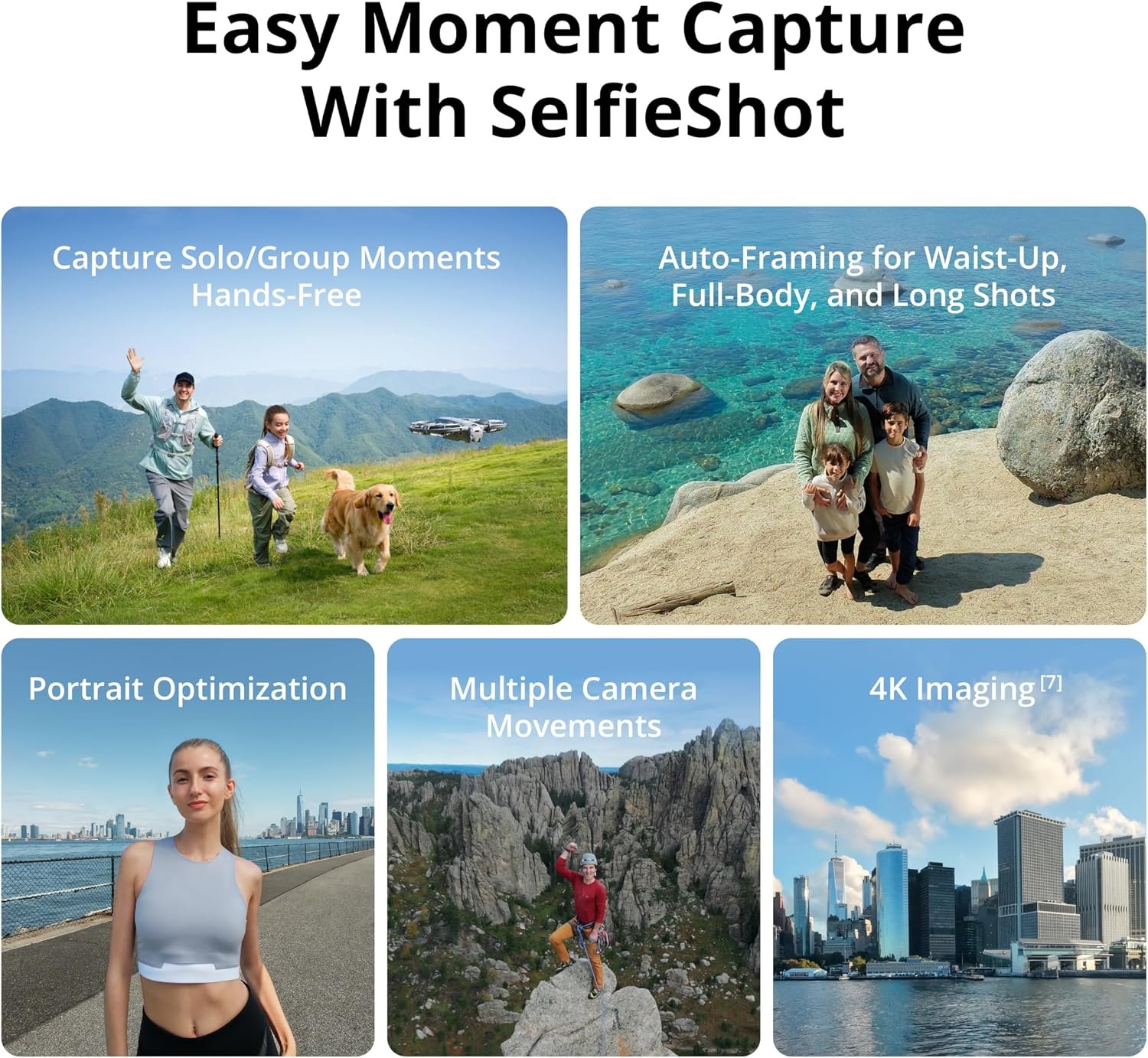
The Neo 2 is for people who want aerial clips of themselves without learning to fly. You hold it on your palm, press a button or show it a gesture, and it lifts off, frames you and follows. Cyclists, hikers, skaters and solo travelers are the obvious buyers, along with parents who want footage of the family that does not involve one person always holding the phone.
It is also a sensible first drone for someone who suspects they will want manual control later. Add the RC-N3 controller and the Digital Transceiver and it becomes a conventional long-range drone, and add the RC Motion 3 and goggles and it becomes a beginner FPV rig. What it is not is a landscape or real estate camera; the sensor and the flight time are both too small for that job.
Design and build
At 151 g, the Neo 2 sits well under the 250 g line, and the arms now fold, which the original DJI Neo did not offer. The propellers live inside guards, so a palm launch or a close pass feels safe in a way that an open-prop drone never does. DJI’s own spec sheet lists the drone at 147 by 171 by 41 mm with the guards fitted.
The biggest hardware change is sensing. DJI combines omnidirectional monocular vision with a forward-facing LiDAR and a downward infrared sensor, rated to detect obstacles from 0.5 to 15 m. For a selfie drone that will spend its life following you past trees and lampposts, that matters more than any camera upgrade.
Storage is internal: 49 GB according to DJI, with no microSD slot. That is plenty for a day of short clips, but you will be offloading to your phone more often than with a card-based drone.
Camera and tracking
The camera pairs a 1/2-inch 12 MP sensor with a wide 119.8-degree, f/2.2 lens. Video goes to 4K at 60 fps, or 100 fps for slow motion when you fly with a controller, and vertical 2.7K at up to 60 fps for social clips. The bit rate tops out at 80 Mbps and there is only a Normal color profile, so treat the footage as finished output rather than material to grade.
The upgrade from the original Neo is the 2-axis mechanical gimbal, backed by electronic stabilization. On paper that should mean steadier horizons when the drone banks to follow you, which was the weakest point of the first model. Tracking speed is rated at 12 m/s, fast enough for running and most casual cycling, and the 10.7 m/s wind rating is respectable for something this light.
Reviewers have consistently ranked it at or near the top of the compact follow-me category. DroneTrader calls it better than the original Neo in every measurable way, while noting real-world flights of 15 to 16 minutes rather than the rated 19.
Living with it
Out of the box, the Neo 2 talks to your phone over Wi-Fi, which DJI rates at about 500 m in open space. Most owners will fly it far closer than that. If you want proper range, the Fly More Combo with the RC-N3 and the Digital Transceiver uses DJI’s O4 link, rated up to 10 km under FCC rules.
The US situation needs explaining. DJI decided not to sell the Neo 2 through its own US store, so it reaches US buyers through authorized resellers and Amazon sellers. The drone itself received FCC authorization in July 2025, before the FCC added foreign-made drones to its Covered List in December 2025. That listing blocks new models, but previously authorized ones remain legal to import, sell and fly. The practical catch is warranty: a reseller purchase can make claims slower, so check who is selling before you buy.
Value for money
At the time of writing the drone-only kit sells for about $259 from US resellers. We would spend the extra $90 on the Fly More Combo (drone only), because three batteries turn a 15-minute outing into a proper session. The $429 combo with the controller is the one to get if you plan to fly it like a normal drone.
Alternatives
- DJI Neo is the cheaper original if all you need are short palm-launch clips and you can live without the gimbal and obstacle sensing.
- HoverAir X1 PRO costs more but has stronger sports tracking and the OmniTerrain modes for water and snow.
- DJI Flip is the step up for vloggers who want a more capable camera drone that still keeps its propellers fully guarded.
The bottom line
The Neo 2 fixes nearly everything that held the original back: it has a gimbal, it sees obstacles, and it folds. Flight time and storage are still tight, and US buyers have to go through resellers. For hands-free selfie footage at this price, it is the one to beat.
.gap-review{margin:2.5rem 0 0}.gap-review h2{font-size:1.5rem;margin:0 0 1.25rem}.gap-verdict{background:#0E1A2B;color:#fff;border-radius:16px;padding:1.5rem 1.75rem}.gap-verdict__head{display:flex;gap:1.25rem;align-items:center}.gap-score{margin:0;width:84px;height:84px;border-radius:50%;background:#FF5A1F;color:#fff;display:flex;flex-direction:column;align-items:center;justify-content:center;font-weight:800;font-size:1.9rem;line-height:1}.gap-score small{font-size:.7rem;font-weight:600;opacity:.85}.gap-eyebrow{margin:0 0 .35rem;text-transform:uppercase;letter-spacing:.08em;font-size:.75rem;font-weight:700;color:#FF5A1F}.gap-verdict__line{margin:0;font-size:1.125rem;line-height:1.45}.gap-proscons{display:grid;grid-template-columns:1fr 1fr;gap:1.25rem 2rem;margin-top:1.5rem;padding-top:1.25rem;border-top:1px solid rgba(255,255,255,.15)}.gap-proscons h3{margin:0 0 .6rem;font-size:.9rem;text-transform:uppercase;letter-spacing:.05em;color:inherit}.gap-proscons ul{list-style:none;margin:0;padding:0}.gap-proscons li{position:relative;padding-left:1.6em;margin:0 0 .45em}.gap-proscons li::before{position:absolute;left:0;top:0;font-weight:800}.gap-pros li::before{content:’+’;color:#4ADE80}.gap-cons li::before{content:’2013′;color:#F87171}.gap-specs,.gap-faq{margin-top:2rem}.gap-specs h3,.gap-faq h3{font-size:1.2rem;margin:0 0 .75rem}.gap-specs table{width:100%;border-collapse:collapse;font-size:.95rem}.gap-specs th,.gap-specs td{text-align:left;padding:.65rem .9rem;border-bottom:1px solid #E2E8F0;vertical-align:top}.gap-specs th{width:38%;background:#F4F6F9}.gap-faq details{border:1px solid #E2E8F0;border-radius:10px;padding:0 1rem;margin:0 0 .6rem}.gap-faq summary{cursor:pointer;padding:.85rem 0;font-weight:600}.gap-cta{margin-top:2rem;padding:1.25rem 1.5rem;background:#F4F6F9;border-radius:16px;display:flex;flex-wrap:wrap;gap:.75rem;align-items:center}.gap-btn{display:inline-block;padding:.85em 1.5em;border-radius:10px;font-weight:600;text-decoration:none!important;background:#FF5A1F;color:#fff!important}.gap-btn–secondary{background:transparent;color:#0E1A2B!important;border:2px solid #E2E8F0}.gap-disclosure,.gap-note{font-size:.875rem;color:#4A5568;margin:.75rem 0 0}@media(max-width:640px){.gap-proscons{grid-template-columns:1fr}}
DJI Neo 2 review
8.4/10
madagear.com verdict
Buy it if you want a follow-me drone that launches from your hand and dodges obstacles on its own; skip it if you need long flights, a microSD slot or a simple US warranty path.
What we like
- 151 g, so no FAA registration for recreational flying
- Omnidirectional vision plus forward LiDAR for obstacle sensing
- 2-axis mechanical gimbal and 4K up to 100 fps
- Palm launch, gesture control and phone control without a remote
- Optional Digital Transceiver adds O4 range up to 10 km (FCC)
What we don’t
- About 19 minutes per battery, 17 with the prop guards on
- No microSD slot; you rely on internal storage
- Not sold on DJI’s US store, so warranty runs through resellers
- Small 1/2-inch sensor and no log profile
Specs at a glance
| Takeoff weight | 151 g (160 g with the Digital Transceiver) |
|---|---|
| Camera | 1/2-inch sensor, 12 MP, f/2.2, 119.8 degree FOV |
| Video | 4K at up to 100 fps (100 fps needs a controller), vertical 2.7K at 60 fps |
| Bit rate | Up to 80 Mbps |
| Gimbal | 2-axis mechanical (tilt and roll) with electronic stabilization |
| Flight time | About 19 min (about 17 min with prop guards) |
| Obstacle sensing | Omnidirectional monocular vision, forward LiDAR, downward infrared |
| Wind resistance | 10.7 m/s (level 5) |
| Transmission | Wi-Fi to phone about 500 m; up to 10 km (FCC) with RC-N3 and Digital Transceiver |
| Internal storage | 49 GB, no microSD slot |
Frequently asked questions
Can I buy the DJI Neo 2 in the US?
Yes, through Amazon sellers and authorized US resellers, but not from DJI’s own US store. The Neo 2 received FCC authorization in July 2025, before foreign drones were added to the FCC Covered List, so it is legal to sell, own and fly.
Do I need to register the DJI Neo 2 with the FAA?
Not for recreational flying. At 151 g it is under the 250 g threshold. If you fly under Part 107 for commercial work, registration is required at any weight.
Do I need a controller?
No. You can launch it from your palm and use gestures or the DJI Fly app over Wi-Fi. A controller plus the Digital Transceiver is needed for long range and for 4K at 100 fps.
How is it different from the original DJI Neo?
The Neo 2 adds a 2-axis mechanical gimbal, omnidirectional obstacle sensing with LiDAR, foldable arms, a larger 1606 mAh battery and 4K up to 100 fps.
US reseller price for the drone only. The Fly More Combo (drone only) is about $349, the Fly More Combo with RC-N3 and Digital Transceiver about $429, and the Motion Fly More Combo about $599. DJI does not sell it through its own US store. Price and availability checked on 2026-11-10.
madagear.com is reader-supported. When you buy through links on our site we may earn an affiliate commission, at no extra cost to you. This never affects what we recommend.



Reviews
There are no reviews yet.