


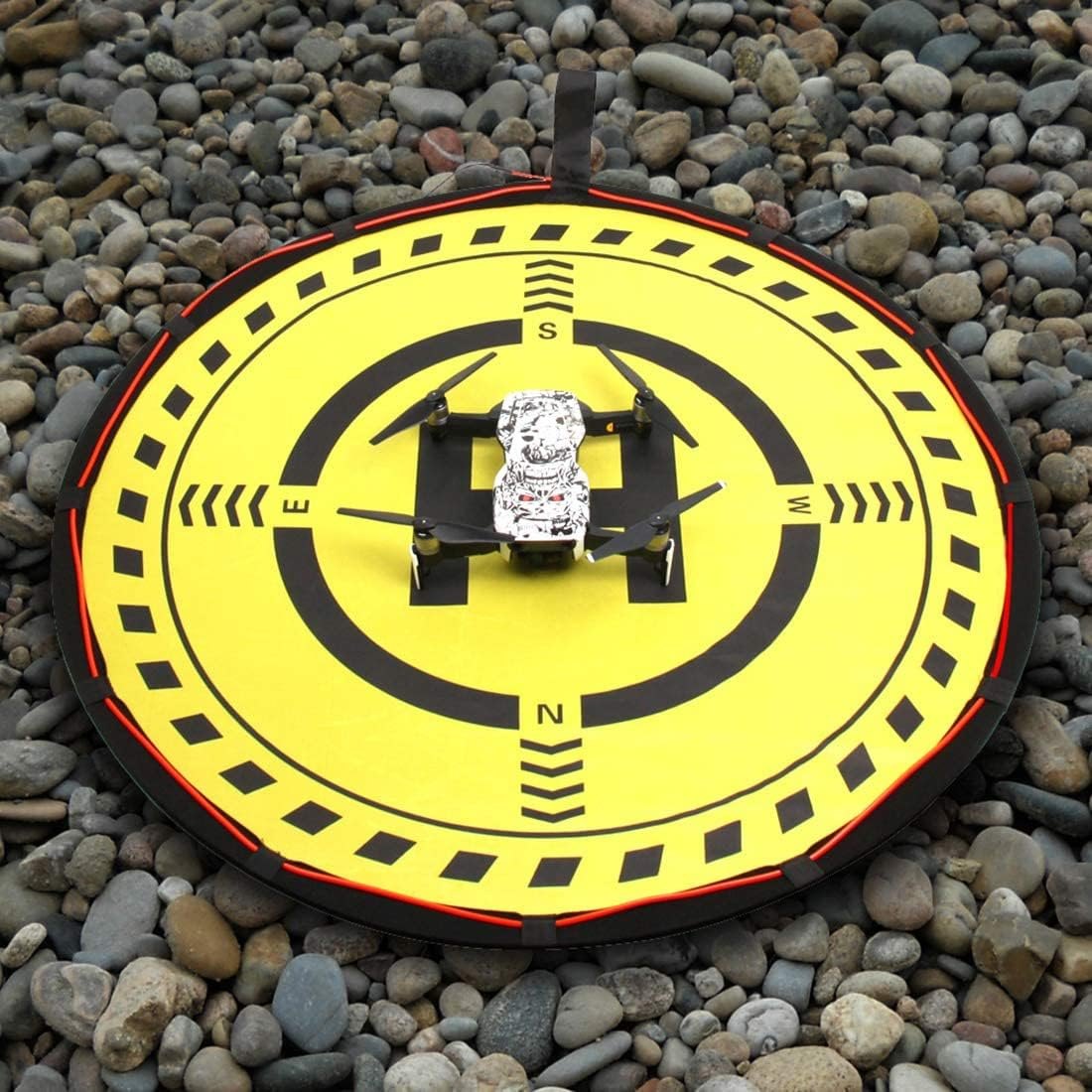


Description
Who it’s for
This is a landing pad for people who fly small drones in places that were not designed for drones. If your usual takeoff spot is a patch of grass, a gravel turnout, a beach, a muddy trail head or a dusty car park, a pad is the cheapest insurance you can buy for your gimbal and your motors. Grit kicked up on takeoff is the single most common way a small drone picks up damage that never shows on a crash log.
The 27.6-inch (70cm) size points clearly at the sub-250g and small folding crowd. DJI Mini-series, Neo, Flip, Mini 4K and Air-class machines all sit well inside that circle, and the listing names a long run of them explicitly. Pilots flying larger cinema rigs, or anyone who wants a comfortable manual landing target in wind, should be looking at a 32-inch or 43-inch pad instead.
The second audience is anyone who flies into dusk. The removable LED strip is the feature that separates this from the dozens of plain nylon circles at the same price, and it answers a real problem: once the light goes, a dark pad in a dark field is genuinely hard to find on the way home.
Design and build
The construction is the standard one for this category, and that is not a criticism. A coated nylon disc over a sprung wire rim folds into a figure-eight and drops to a fraction of its open size. The listed folded dimensions of 11 x 8 x 2 inches and the 12.3 ounce weight describe the packed state, not the open pad, which is worth knowing if you are comparing listings that quote the two differently.
The surface is double-sided in two colors, so you can flip to whichever contrasts better against the ground you are standing on. On paper that matters more than it sounds. Vision positioning systems want texture and contrast underneath them, and a flat high-contrast target is also what you are squinting at when you bring the aircraft back manually.
Nylon with a waterproof and dustproof coating is the right material choice here. The listing says you can rinse mud off and shake it dry, which is what you want from something that will spend its life on wet grass. The one thing to watch with every sprung pad is the rim: the wire is the part that eventually takes a set if you force the fold, so learn the twist rather than fighting it.
What the specs tell us
The numbers are modest and mostly honest. A 70cm working surface, under 13 ounces packed, and a waterproof bag thrown in is a sensible package. The model number TJP07 and the ranking at #10 in RC Aircraft Landing Gear suggest this is a known quantity in its niche rather than a listing that appeared last week.
Buyers report 4.5 out of 5 across 1,103 ratings, which for a simple accessory is about as strong a signal as the category produces. Pads fail in boring, visible ways, so a score that high usually means the stitching and the rim are holding up.
What the specs do not tell us is also informative. There is no mention of stakes, no mention of LED runtime, and no mention of battery type for the light strip. The pad is described as weighted, but weighted in this class generally means a heavier hem rather than anything that will hold against a stiff breeze on its own.
Living with it
In practice a pad like this becomes part of the pre-flight routine rather than an accessory you think about. Open, drop, flip to the contrasting side, launch. The payoff is that your props stop sandblasting the lens and your motors stop ingesting grit, and neither of those problems announces itself until it is expensive.
Night use is where the LED strip earns its place. A lit perimeter gives you something to steer toward when the drone is a set of position lights against a black field, and it also marks your own position for anyone else sharing the space. The tradeoff is one more item to charge, and a removable strip is one more item to lose, so it belongs in the storage bag rather than loose in the case.
Wind is the honest limitation. Any pad of this size will lift at the edge in gusts, and a lifting pad under a hovering drone is worse than no pad at all. A set of cheap tent pegs, or simply parking your case on the upwind edge, solves it. Plan for that rather than assuming the weighting does all the work.
Value for money
At the time of writing it sits at $19.99, which is squarely mid-pack for a 70cm pad and slightly above the plainest unlit options. The LED strip and the included waterproof bag are what you are paying the difference for, and both are things you would otherwise buy separately for more than the gap.
Compared with the cost of a gimbal repair or a motor service on a Mini-class drone, the math is not close. This is one of the few drone accessories that pays for itself the first time it prevents a problem, and it does not depend on firmware, pairing or compatibility to keep doing so.
Alternatives
The PGYTECH landing pad is the premium pick: better materials and finishing for roughly double the money, worth it if you want something that will outlast several drones. Hoodman’s rigid launch pads are the choice for serious field work, since the stiffer structure handles wind far better, though they cost considerably more and pack bulkier. If you simply want the largest surface for the least money and do not care about lighting, a plain 32-inch unlit nylon pad from any of the generic sellers will cover a bigger drone for about the same outlay.
The bottom line
For under twenty dollars at the time of writing, this covers the two things a small-drone pilot actually needs from a pad: a clean surface in dirty places and visibility once the light fades. The strong buyer rating across a large sample suggests it holds together in normal field use. Judge it as sensible insurance for a Mini or Air-class drone rather than as a piece of equipment you will think about twice.
.gap-review{margin:2.5rem 0 0}.gap-review h2{font-size:1.5rem;margin:0 0 1.25rem}.gap-verdict{background:#0E1A2B;color:#fff;border-radius:16px;padding:1.5rem 1.75rem}.gap-verdict__head{display:flex;gap:1.25rem;align-items:center}.gap-score{margin:0;width:84px;height:84px;border-radius:50%;background:#FF5A1F;color:#fff;display:flex;flex-direction:column;align-items:center;justify-content:center;font-weight:800;font-size:1.9rem;line-height:1}.gap-score small{font-size:.7rem;font-weight:600;opacity:.85}.gap-eyebrow{margin:0 0 .35rem;text-transform:uppercase;letter-spacing:.08em;font-size:.75rem;font-weight:700;color:#FF5A1F}.gap-verdict__line{margin:0;font-size:1.125rem;line-height:1.45}.gap-proscons{display:grid;grid-template-columns:1fr 1fr;gap:1.25rem 2rem;margin-top:1.5rem;padding-top:1.25rem;border-top:1px solid rgba(255,255,255,.15)}.gap-proscons h3{margin:0 0 .6rem;font-size:.9rem;text-transform:uppercase;letter-spacing:.05em;color:inherit}.gap-proscons ul{list-style:none;margin:0;padding:0}.gap-proscons li{position:relative;padding-left:1.6em;margin:0 0 .45em}.gap-proscons li::before{position:absolute;left:0;top:0;font-weight:800}.gap-pros li::before{content:’+’;color:#4ADE80}.gap-cons li::before{content:’2013′;color:#F87171}.gap-specs,.gap-faq{margin-top:2rem}.gap-specs h3,.gap-faq h3{font-size:1.2rem;margin:0 0 .75rem}.gap-specs table{width:100%;border-collapse:collapse;font-size:.95rem}.gap-specs th,.gap-specs td{text-align:left;padding:.65rem .9rem;border-bottom:1px solid #E2E8F0;vertical-align:top}.gap-specs th{width:38%;background:#F4F6F9}.gap-faq details{border:1px solid #E2E8F0;border-radius:10px;padding:0 1rem;margin:0 0 .6rem}.gap-faq summary{cursor:pointer;padding:.85rem 0;font-weight:600}.gap-cta{margin-top:2rem;padding:1.25rem 1.5rem;background:#F4F6F9;border-radius:16px;display:flex;flex-wrap:wrap;gap:.75rem;align-items:center}.gap-btn{display:inline-block;padding:.85em 1.5em;border-radius:10px;font-weight:600;text-decoration:none!important;background:#FF5A1F;color:#fff!important}.gap-btn–secondary{background:transparent;color:#0E1A2B!important;border:2px solid #E2E8F0}.gap-disclosure,.gap-note{font-size:.875rem;color:#4A5568;margin:.75rem 0 0}@media(max-width:640px){.gap-proscons{grid-template-columns:1fr}}
Thriverline 27.6" LED Drone Landing Pad review
7.6/10
madagear.com verdict
Buy it if you launch a DJI Mini, Neo, Flip or Air-class drone from grass, gravel or dirt and sometimes fly at dusk; skip it if you fly a larger cinema rig that needs a 32-inch or wider pad.
What we like
- 27.6-inch (70cm) surface suits most sub-250g and small folding drones
- Removable LED strip makes the pad visible for dusk and night landings
- Two-tone reversible surface gives the drone a clear contrast target
- Nylon construction is waterproof and rinses clean after muddy sessions
- Spring-folds down small enough to drop into most drone cases
- Waterproof storage bag included rather than sold separately
What we don’t
- Weighted edges still need stakes in real wind; no stakes listed
- Too small for larger cinema drones that want a 32-inch pad or more
- LED strip adds a battery to charge or replace before night flights
- Listing dimensions describe the folded size, not the open diameter
Specs at a glance
| Brand | Thriverline |
|---|---|
| Model number | TJP07 |
| Open size | 27.6 in (70 cm) |
| Folded dimensions | 11 x 8 x 2 in |
| Weight | 12.3 oz |
| Material | Nylon, waterproof and dustproof |
| Lighting | Removable LED light strip |
| Surface | Double-sided, two-color |
| Included | Pad, LED strip, waterproof storage bag |
| Age guidance | 15 years and up |
| Buyer rating | 4.5 out of 5 from 1,103 ratings |
Frequently asked questions
Will a 27.6-inch pad be big enough for a DJI Mini 5 Pro or Air 3S?
Yes for normal use. A 70cm circle gives a sub-250g Mini or a Neo a generous margin, and an Air-class drone still lands comfortably inside it. The pad is only tight if you are landing manually in gusts or flying something considerably larger than an Air.
Does the LED strip need its own power source?
The listing describes it as a removable light-up strip, which means it carries its own power rather than drawing from the drone. Treat it as one more thing to charge or fit batteries into before a night session. If you only ever fly in daylight you can leave it off entirely and save the weight.
Will it stay put in wind without stakes?
The pad is described as weighted, which is enough for light breeze on grass. Anything above that and you should expect to pin it down, and no stakes are listed as included, so budget for a set of tent pegs if you fly in open fields. Many owners of pads in this class simply drop a bag or a drone case on one edge.
Can it be washed after muddy flights?
The nylon surface is described as waterproof and dustproof, and the listing says you can rinse it and shake it dry. That is normal for coated nylon pads. Let it dry fully before folding it away, since trapping moisture in the storage bag is how these pads pick up a smell.
At the time of writing it is $19.99, which covers the pad, the removable LED light strip and a waterproof carry bag; landing pad pricing in this size class drifts a few dollars either way and tends to dip during seasonal sales. Price and availability checked on 2026-11-14.
madagear.com is reader-supported. When you buy through links on our site we may earn an affiliate commission, at no extra cost to you. This never affects what we recommend.

Reviews
There are no reviews yet.