


Description
Who it’s for
The HS900 Pro is Holy Stone’s answer to a familiar question: what is the best camera drone you can get under 250 g without paying DJI money? It is aimed at first-time and returning pilots who want proper gimbal-stabilized 4K footage, GPS hold and long sessions in the air, and who care more about the price than about obstacle sensing.
It suits travelers, hobbyists filming local landscapes, and anyone moving up from a toy-grade drone with electronic stabilization only. It does not suit pilots who fly near trees and buildings without much experience, or anyone whose main subject is sunsets and city lights.
Design and build
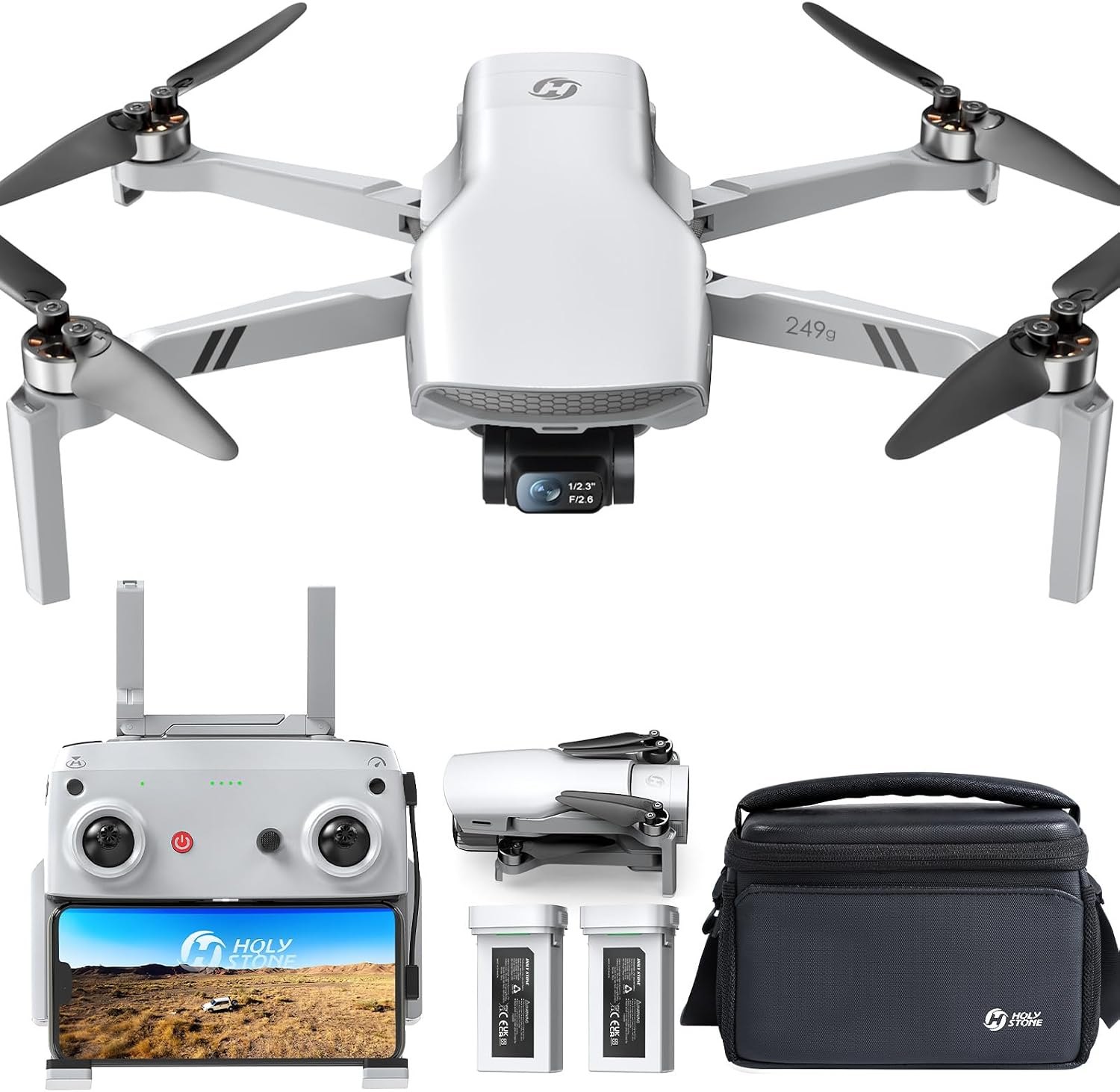
At 249 g, the HS900 Pro sits just under the registration threshold. It folds to 143 by 82.8 by 62 mm, which fits in a jacket pocket or the small backpack that comes in the box. The kit includes the drone, a phone-holder controller, two batteries, spare propellers, a gimbal cover and cables for iPhone and USB-C phones.
Positioning comes from GPS backed by optical flow and a downward time-of-flight sensor, which Holy Stone rates for precise hovering from 0.25 to 5 m. That helps with stable takeoffs and landings, but it is not obstacle avoidance, and Holy Stone’s spec sheet says so plainly.
Camera and flight
The camera uses a 1/2.3-inch sensor rated at 48 MP effective, behind an 83-degree lens. Video tops out at 4K/30, with 1080p available at 60 fps, and you can choose a 50 or 100 Mbps bit rate. Photos can be saved as RAW as well as JPEG, which gives you room to recover highlights in editing.
The key hardware feature is the 3-axis mechanical gimbal. Many drones near this price rely on a 2-axis gimbal or electronic stabilization; a true 3-axis gimbal keeps the horizon level and the footage smooth when the drone yaws or is buffeted. On paper, that puts the HS900 Pro’s daylight footage in a class above most budget GPS drones. The small sensor still limits it in low light and in high-contrast scenes, where larger-sensor drones hold more detail.
Flight performance is solid for the class. Holy Stone quotes a top speed of 14 m/s, force 5 wind resistance and up to 30 minutes per battery when hovering in calm conditions. With two batteries in the kit, that is up to an hour of total flight time. The 5.8 GHz link is rated at up to 10 km in open areas, far more than you can legally use while keeping the drone in sight.
Living with it
Everything runs through the HS Sirius app on your phone, which handles live view, camera settings and the automated shots. The list is generous: AI Follow and Parallel tracking, Dolly Zoom, Rotation, Ascension, Catapult, Circle, waypoints, panoramas, time-lapse and slow motion. Firmware updates arrive through the app.
Return-to-home relies on GPS and does not avoid obstacles, so set a return altitude that clears the tallest trees around you. Storage is microSD up to 128 GB; use a U3 or V30 card for 100 Mbps recording.
Like nearly every consumer drone, the HS900 Pro is foreign-made. The FCC’s December 2025 Covered List decision blocks authorization for new foreign models but leaves previously authorized models on sale, and the HS900 Pro is listed on Amazon US through Holy Stone’s own store links.
Value for money
At the time of writing, Holy Stone lists the HS900 Pro at $389.99, with Amazon pricing moving with coupons. For that you get a 3-axis gimbal, two batteries and a backpack. You give up obstacle sensing and the larger sensors found on more expensive sub-250 g drones, but you also keep about a hundred dollars or more in your pocket.
Alternatives
- Holy Stone HS900 is the cheaper sibling; its standard edition has one battery and a shorter 6 km link.
- Potensic Atom 2 is the closest non-DJI rival in the sub-250 g gimbal drone class.
- DJI Mini 4K is the pick if you want DJI’s app and ecosystem at a similar budget.
The bottom line
The HS900 Pro delivers the essentials of a modern mini drone, a 3-axis gimbal, GPS and long flights, at a mid-range price. Its small sensor and lack of obstacle avoidance are the trade-offs. For daylight 4K on a budget, it is a strong non-DJI choice.
.gap-review{margin:2.5rem 0 0}.gap-review h2{font-size:1.5rem;margin:0 0 1.25rem}.gap-verdict{background:#0E1A2B;color:#fff;border-radius:16px;padding:1.5rem 1.75rem}.gap-verdict__head{display:flex;gap:1.25rem;align-items:center}.gap-score{margin:0;width:84px;height:84px;border-radius:50%;background:#FF5A1F;color:#fff;display:flex;flex-direction:column;align-items:center;justify-content:center;font-weight:800;font-size:1.9rem;line-height:1}.gap-score small{font-size:.7rem;font-weight:600;opacity:.85}.gap-eyebrow{margin:0 0 .35rem;text-transform:uppercase;letter-spacing:.08em;font-size:.75rem;font-weight:700;color:#FF5A1F}.gap-verdict__line{margin:0;font-size:1.125rem;line-height:1.45}.gap-proscons{display:grid;grid-template-columns:1fr 1fr;gap:1.25rem 2rem;margin-top:1.5rem;padding-top:1.25rem;border-top:1px solid rgba(255,255,255,.15)}.gap-proscons h3{margin:0 0 .6rem;font-size:.9rem;text-transform:uppercase;letter-spacing:.05em;color:inherit}.gap-proscons ul{list-style:none;margin:0;padding:0}.gap-proscons li{position:relative;padding-left:1.6em;margin:0 0 .45em}.gap-proscons li::before{position:absolute;left:0;top:0;font-weight:800}.gap-pros li::before{content:’+’;color:#4ADE80}.gap-cons li::before{content:’2013′;color:#F87171}.gap-specs,.gap-faq{margin-top:2rem}.gap-specs h3,.gap-faq h3{font-size:1.2rem;margin:0 0 .75rem}.gap-specs table{width:100%;border-collapse:collapse;font-size:.95rem}.gap-specs th,.gap-specs td{text-align:left;padding:.65rem .9rem;border-bottom:1px solid #E2E8F0;vertical-align:top}.gap-specs th{width:38%;background:#F4F6F9}.gap-faq details{border:1px solid #E2E8F0;border-radius:10px;padding:0 1rem;margin:0 0 .6rem}.gap-faq summary{cursor:pointer;padding:.85rem 0;font-weight:600}.gap-cta{margin-top:2rem;padding:1.25rem 1.5rem;background:#F4F6F9;border-radius:16px;display:flex;flex-wrap:wrap;gap:.75rem;align-items:center}.gap-btn{display:inline-block;padding:.85em 1.5em;border-radius:10px;font-weight:600;text-decoration:none!important;background:#FF5A1F;color:#fff!important}.gap-btn–secondary{background:transparent;color:#0E1A2B!important;border:2px solid #E2E8F0}.gap-disclosure,.gap-note{font-size:.875rem;color:#4A5568;margin:.75rem 0 0}@media(max-width:640px){.gap-proscons{grid-template-columns:1fr}}
Holy Stone HS900 Pro review
7.4/10
madagear.com verdict
Buy it if you want a gimbal-stabilized 4K drone under 250 g with long total flight time on a mid-range budget; skip it if you need obstacle avoidance or low-light image quality.
What we like
- 249 g, so no FAA registration for recreational flying
- 3-axis mechanical gimbal for smooth 4K/30 footage
- Two batteries in the box, about 30 minutes each
- 5.8 GHz link rated up to 10 km in open areas
- RAW photos and up to 100 Mbps video
What we don’t
- No obstacle avoidance, and return-to-home flies a straight line
- Small 1/2.3-inch sensor limits low-light and dynamic range
- 4K tops out at 30 fps
Specs at a glance
| Weight | 249 g |
|---|---|
| Folded size | 143 x 82.8 x 62 mm |
| Camera | 1/2.3-inch CMOS, 48 MP effective, 83 degree FOV |
| Video | 4K at 30 fps, 1080p at 60 fps |
| Bit rate | 50 or 100 Mbps |
| Gimbal | 3-axis mechanical |
| Flight time | Up to 30 min per battery; two batteries included |
| Max speed | 14 m/s |
| Wind resistance | Force 5 |
| Transmission | 5.8 GHz, up to 10 km in open areas |
Frequently asked questions
Do I need to register the Holy Stone HS900 Pro?
Not for recreational flying in the US, because it weighs 249 g. Commercial flights under Part 107 require registration at any weight.
What is the difference between the HS900 and the HS900 Pro?
Both share the 249 g airframe, 1/2.3-inch 48 MP camera and 3-axis gimbal. Holy Stone sells the Pro as a separate model with a 5.8 GHz link rated to 10 km and two batteries in the box; the standard HS900 edition starts with one battery and a 6 km link.
Does the HS900 Pro avoid obstacles?
No. It uses GPS, optical flow and a time-of-flight sensor for stable positioning, but has no obstacle avoidance. Return-to-home will not steer around trees or buildings, so set a safe return altitude.
What memory card does it need?
A microSD card up to 128 GB. Holy Stone recommends U3 or V30 cards if you record at 100 Mbps.
Holy Stone’s US list price ($389.99) for the kit with two batteries and a backpack. Amazon pricing and coupons vary. Price and availability checked on 2026-11-10.
madagear.com is reader-supported. When you buy through links on our site we may earn an affiliate commission, at no extra cost to you. This never affects what we recommend.


Reviews
There are no reviews yet.