

Description
Who it’s for
Since March 2024, the FAA has expected every drone that must be registered to broadcast Remote ID when it flies outside a recognized flying site. That covers any drone over 250 g flown recreationally and any drone of any weight flown commercially under Part 107. Most new drones from big brands have Remote ID built in. Older drones, homebuilt quads and many fixed-wing models do not, and for those the answer is a broadcast module that straps to the airframe.
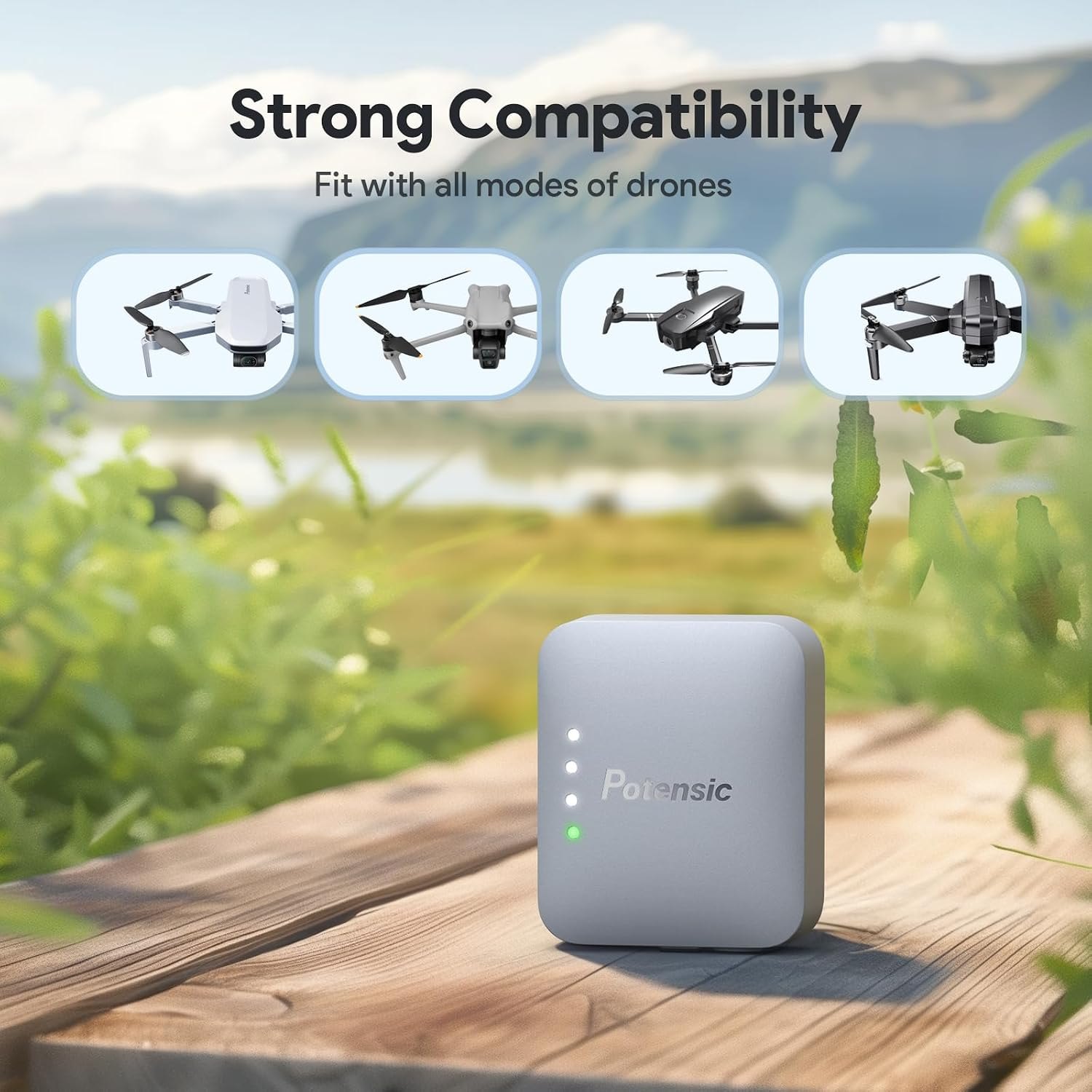
Potensic’s RID-916 is one of those modules. It is aimed first at Potensic owners, but Potensic says it works with any aircraft it can be attached to. If your drone already broadcasts Remote ID, or you only fly a sub-250 g drone for fun, you do not need it.
What’s in the box and how it fits
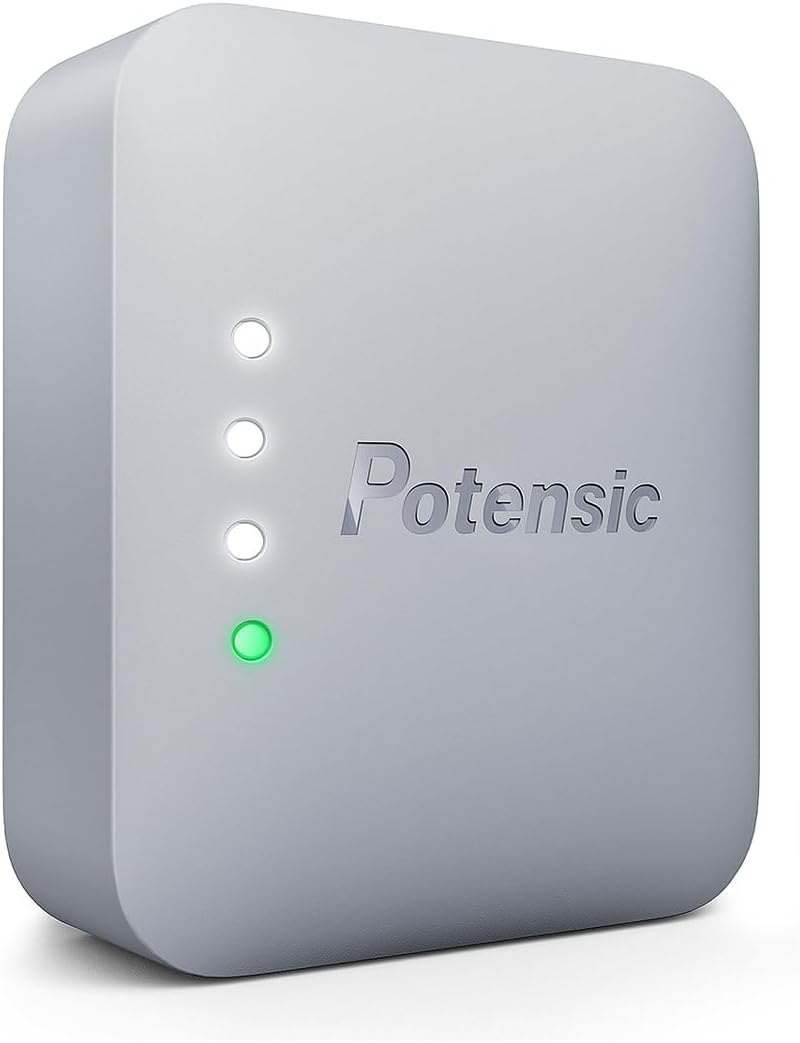
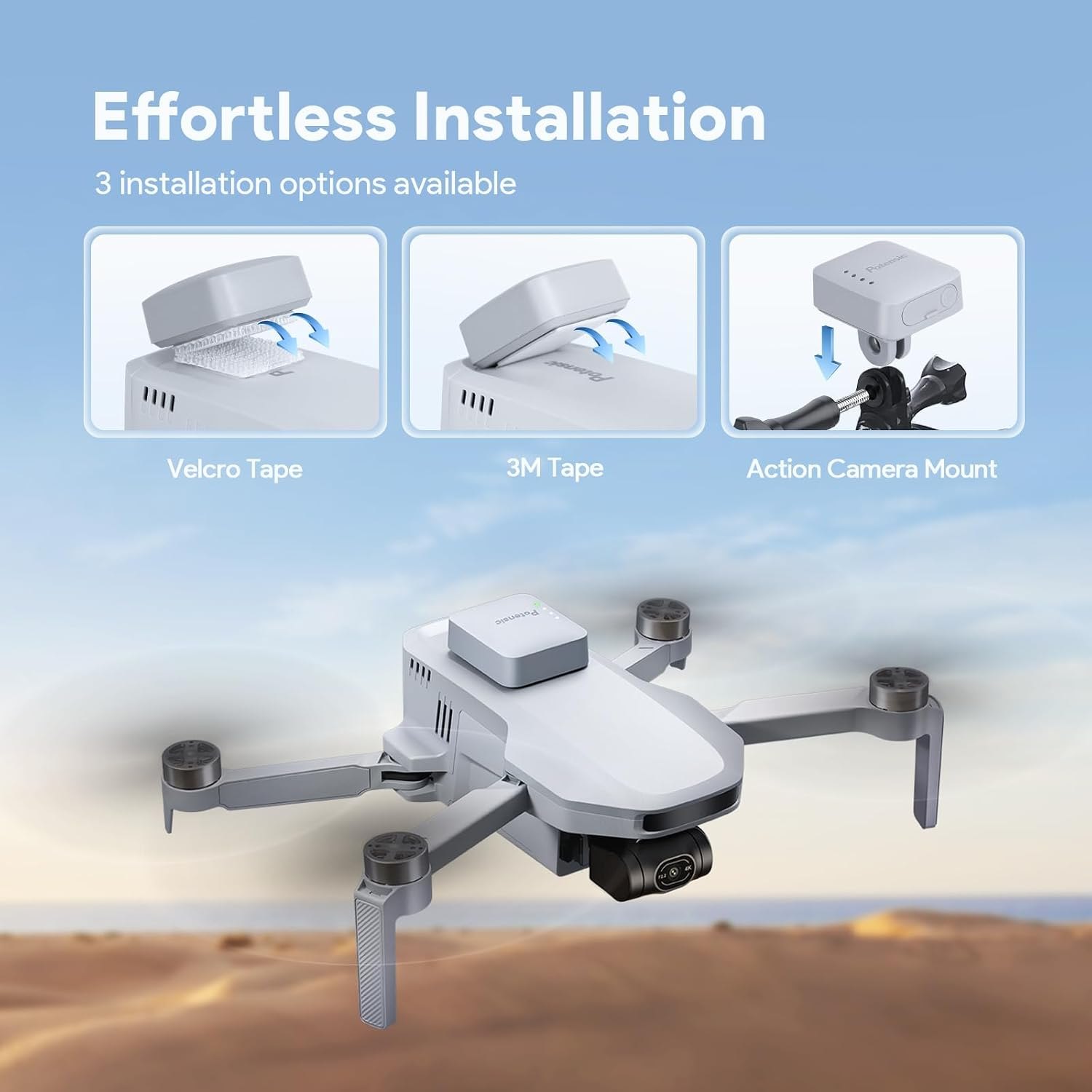
The module weighs about 19 g, measures 1.5 by 1.3 by 0.6 in, and is rated IP54 for splash and dust resistance. Potensic quotes up to 4 hours per charge, through a USB-C port with a dust plug. The box includes a USB cable, two strips of 3M tape, two 3M Dual-Lock fasteners, an action-camera mount and a manual, which covers most ways of attaching it: stick it on, use the reclosable fastener so you can remove it, or clip it onto a drone that has an action-camera mount.
Setup follows a specific order. You first register with the FAA through DroneZone to get your registration details. You then connect the module to a computer over USB and write your registration data through Potensic’s Remote ID management system. Finally, you mount it, power it on and press the button once to set the takeoff point. Potensic also documents setup for EU and Japanese users, but this listing is the US version, RID-916-US.
Broadcast and performance
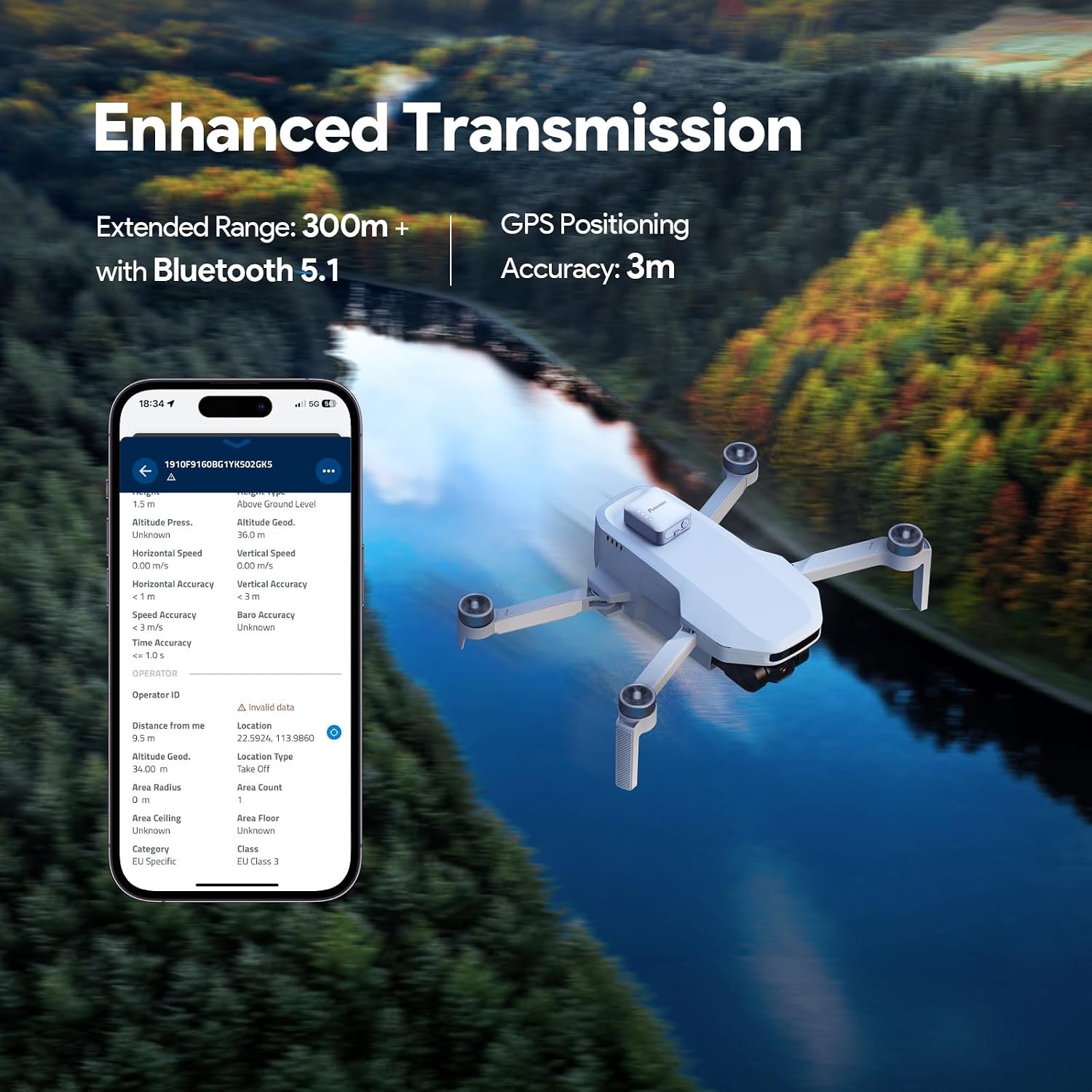
The module has its own GPS and broadcasts over Bluetooth 5.1 at up to 8 dBm. According to the listing it sends the serial number, takeoff position, live latitude and longitude, altitude and speed; Potensic claims positioning error of under 3 m. You can check what it sends with free receiver apps such as Drone Scanner or OpenDrone ID OSM before your first flight.
Owners rate it well, at 4.6 stars from about 150 Amazon ratings at the time of writing, though that is a modest number of ratings.
Two points need correcting in the listing. First, it suggests the module lets drones over 250 g fly free with no more worry about FAA rules. It does not. You still register, you must add the module’s serial number to your FAA registration, and drones using a broadcast module must stay within visual line of sight at all times. Second, a broadcast module is only legal if its maker has an FAA-accepted Declaration of Compliance. We could not find a public record confirming that for the RID-916, so check the FAA’s UAS Declaration of Compliance database for the model before relying on it.
Value for money
At about $40 on Amazon at the time of writing, it costs the same as Holy Stone’s module and far less than replacing a drone that otherwise flies well. The 4-hour battery means one charge covers a long day of flying, and the IP54 rating and the choice of mounts make it easy to live with. The main hidden cost is time: plan for the computer-based setup before your first flight, not in the field.
Alternatives
- Holy Stone Remote ID Broadcast Module costs the same and is aimed at older Holy Stone GPS drones; compliance questions have been raised about Holy Stone’s earlier module, so check the FAA database first.
- DJI Air 3S is the answer if you are replacing the drone anyway: like current DJI drones over 250 g, it has standard Remote ID built in, so no module is needed.
- Potensic Atom 2 avoids the question entirely for recreational flyers: at under 249 g it needs no Remote ID when flown for fun.
The bottom line
The RID-916 is a well-equipped module: light, splash resistant, with a long-lasting battery and a sensible set of mounts. The listing oversells what it does, and you should confirm its FAA compliance entry before you depend on it. For an older or homebuilt drone over 250 g, it is a reasonable way to fly legally.
.gap-review{margin:2.5rem 0 0}.gap-review h2{font-size:1.5rem;margin:0 0 1.25rem}.gap-verdict{background:#0E1A2B;color:#fff;border-radius:16px;padding:1.5rem 1.75rem}.gap-verdict__head{display:flex;gap:1.25rem;align-items:center}.gap-score{margin:0;width:84px;height:84px;border-radius:50%;background:#FF5A1F;color:#fff;display:flex;flex-direction:column;align-items:center;justify-content:center;font-weight:800;font-size:1.9rem;line-height:1}.gap-score small{font-size:.7rem;font-weight:600;opacity:.85}.gap-eyebrow{margin:0 0 .35rem;text-transform:uppercase;letter-spacing:.08em;font-size:.75rem;font-weight:700;color:#FF5A1F}.gap-verdict__line{margin:0;font-size:1.125rem;line-height:1.45}.gap-proscons{display:grid;grid-template-columns:1fr 1fr;gap:1.25rem 2rem;margin-top:1.5rem;padding-top:1.25rem;border-top:1px solid rgba(255,255,255,.15)}.gap-proscons h3{margin:0 0 .6rem;font-size:.9rem;text-transform:uppercase;letter-spacing:.05em;color:inherit}.gap-proscons ul{list-style:none;margin:0;padding:0}.gap-proscons li{position:relative;padding-left:1.6em;margin:0 0 .45em}.gap-proscons li::before{position:absolute;left:0;top:0;font-weight:800}.gap-pros li::before{content:’+’;color:#4ADE80}.gap-cons li::before{content:’2013′;color:#F87171}.gap-specs,.gap-faq{margin-top:2rem}.gap-specs h3,.gap-faq h3{font-size:1.2rem;margin:0 0 .75rem}.gap-specs table{width:100%;border-collapse:collapse;font-size:.95rem}.gap-specs th,.gap-specs td{text-align:left;padding:.65rem .9rem;border-bottom:1px solid #E2E8F0;vertical-align:top}.gap-specs th{width:38%;background:#F4F6F9}.gap-faq details{border:1px solid #E2E8F0;border-radius:10px;padding:0 1rem;margin:0 0 .6rem}.gap-faq summary{cursor:pointer;padding:.85rem 0;font-weight:600}.gap-cta{margin-top:2rem;padding:1.25rem 1.5rem;background:#F4F6F9;border-radius:16px;display:flex;flex-wrap:wrap;gap:.75rem;align-items:center}.gap-btn{display:inline-block;padding:.85em 1.5em;border-radius:10px;font-weight:600;text-decoration:none!important;background:#FF5A1F;color:#fff!important}.gap-btn–secondary{background:transparent;color:#0E1A2B!important;border:2px solid #E2E8F0}.gap-disclosure,.gap-note{font-size:.875rem;color:#4A5568;margin:.75rem 0 0}@media(max-width:640px){.gap-proscons{grid-template-columns:1fr}}
Potensic Remote ID Broadcast Module review
7.5/10
madagear.com verdict
Buy it if you fly a registered drone over 250 g, or fly commercially, and the drone has no built-in Remote ID; skip it if your drone already broadcasts Remote ID or you only fly a sub-250 g drone for fun.
What we like
- Weighs about 19 g and is splash and dust resistant to IP54
- Up to 4 hours per charge over USB-C, with a dust plug on the port
- Bluetooth 5.1 broadcast with its own GPS, so it works on non-Potensic aircraft
- Comes with 3M tape, Dual-Lock fasteners and an action-camera mount
- 4.6 stars from about 150 Amazon ratings at the time of writing
What we don’t
- Registration data is written on a computer over USB, not a phone app
- A broadcast module limits you to visual line of sight flying
- We could not confirm its FAA Declaration of Compliance entry; check before buying
Specs at a glance
| Model | RID-916 (US version RID-916-US) |
|---|---|
| Weight | About 19 g (Potensic: under 20 g) |
| Size | 1.5 x 1.3 x 0.6 in |
| Battery life | Up to 4 hours |
| Charging | USB-C |
| Broadcast | Bluetooth 5.1, up to 8 dBm |
| Positioning | Built-in GPS |
| Protection | IP54 |
| In the box | Module, USB cable, 2 x 3M tape, 2 x 3M Dual-Lock, action-camera mount, manual |
Frequently asked questions
Do I need a Remote ID module?
In the US you need Remote ID if your drone must be registered: any drone over 250 g, or any drone flown commercially under Part 107. If your drone has built-in standard Remote ID you do not need a module. Recreational flyers with sub-250 g drones need neither.
Does this module mean I no longer need to register my drone?
No. The listing’s suggestion that it lets drones over 250 g fly free is misleading. You still register with the FAA, add the module’s serial number to your registration, and keep the drone within visual line of sight.
Can I move it between drones?
Yes, it is a standalone unit with its own battery and GPS, and it mounts with tape, Dual-Lock or an action-camera mount. Make sure the module’s serial number is listed in your FAA registration for the drone you are flying.
How do I check what it is broadcasting?
Potensic points to free apps such as Drone Scanner and OpenDrone ID OSM, which show the serial number, position, altitude and speed received from the module.
Amazon price at the time of writing. Potensic’s own store has listed the module as backordered. Price and availability checked on 2026-11-10.
madagear.com is reader-supported. When you buy through links on our site we may earn an affiliate commission, at no extra cost to you. This never affects what we recommend.


Reviews
There are no reviews yet.