



Description
Who it’s for
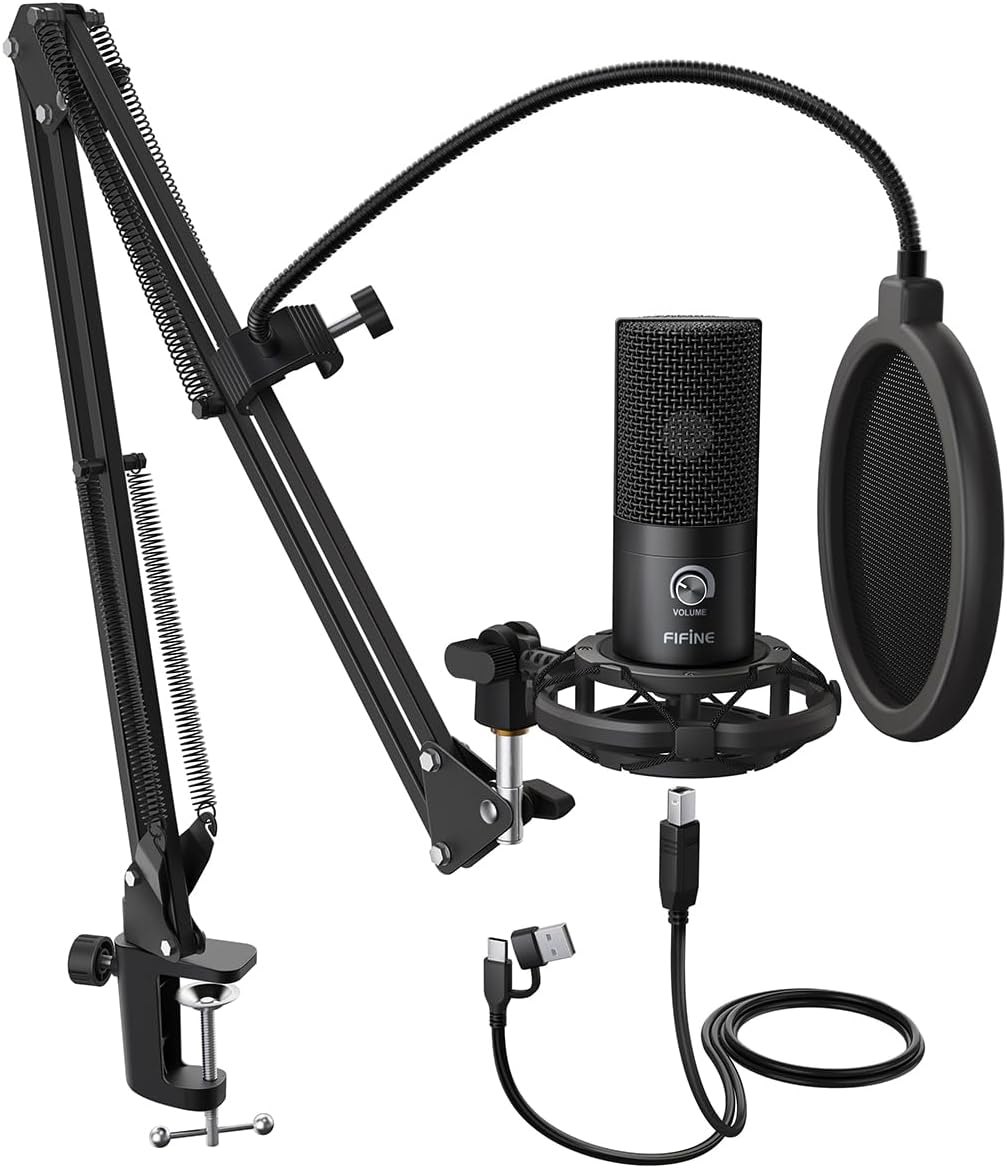
This is a starter kit for someone who has decided to take their voice seriously but has not decided to spend serious money. The FIFINE T669 is sold as a bundle rather than a bare microphone: you get the cardioid USB condenser, a steel scissor arm, a shock mount, a double pop filter and a detachable 8.2ft cable, all for $52.99 at the time of writing. That bundling is the whole argument. Buying a decent mic and then discovering you also need an arm, a mount and a filter is how a $50 purchase quietly becomes a $120 one.
The obvious audience is podcasters recording into a laptop, streamers who want their face unobstructed on camera, and anyone doing a lot of Discord, Zoom or Skype calls who is tired of sounding like a laptop. Voice-over hobbyists and people dubbing video are also squarely in range. The listing names PS4 and PS5 as supported platforms and explicitly rules out Xbox, so console buyers need to check which box is under the TV before ordering.
It is not for anyone with a path toward a studio setup. A USB mic is a closed system: there is no way to run it into a mixer or an XLR interface later, so when you outgrow it you replace it rather than upgrade around it. If you already know you want a preamp chain, start somewhere else.
Design and build
The physical package is more interesting than the microphone on its own. The scissor arm is described as all-steel with 180 degrees of up-and-down rotation and 135 degrees of forward-and-back extension, with a 13-inch fixed horizontal section and a 30-inch reach. The mount is a combo design: a C-clamp for desk edges plus a detachable desktop base. In practice, arms in this price class are usually fine mechanically but can sag once you hang a heavy mic on a fully extended boom. A condenser of this size is light enough that it should sit within the arm’s comfort zone.
The low-profile, table-hugging geometry the listing describes matters more than it sounds. An arm that comes in from the side and sits just below the chin keeps the mic out of the camera frame, which is the main reason streamers buy arms at all rather than using the desk stand that comes in most boxes.
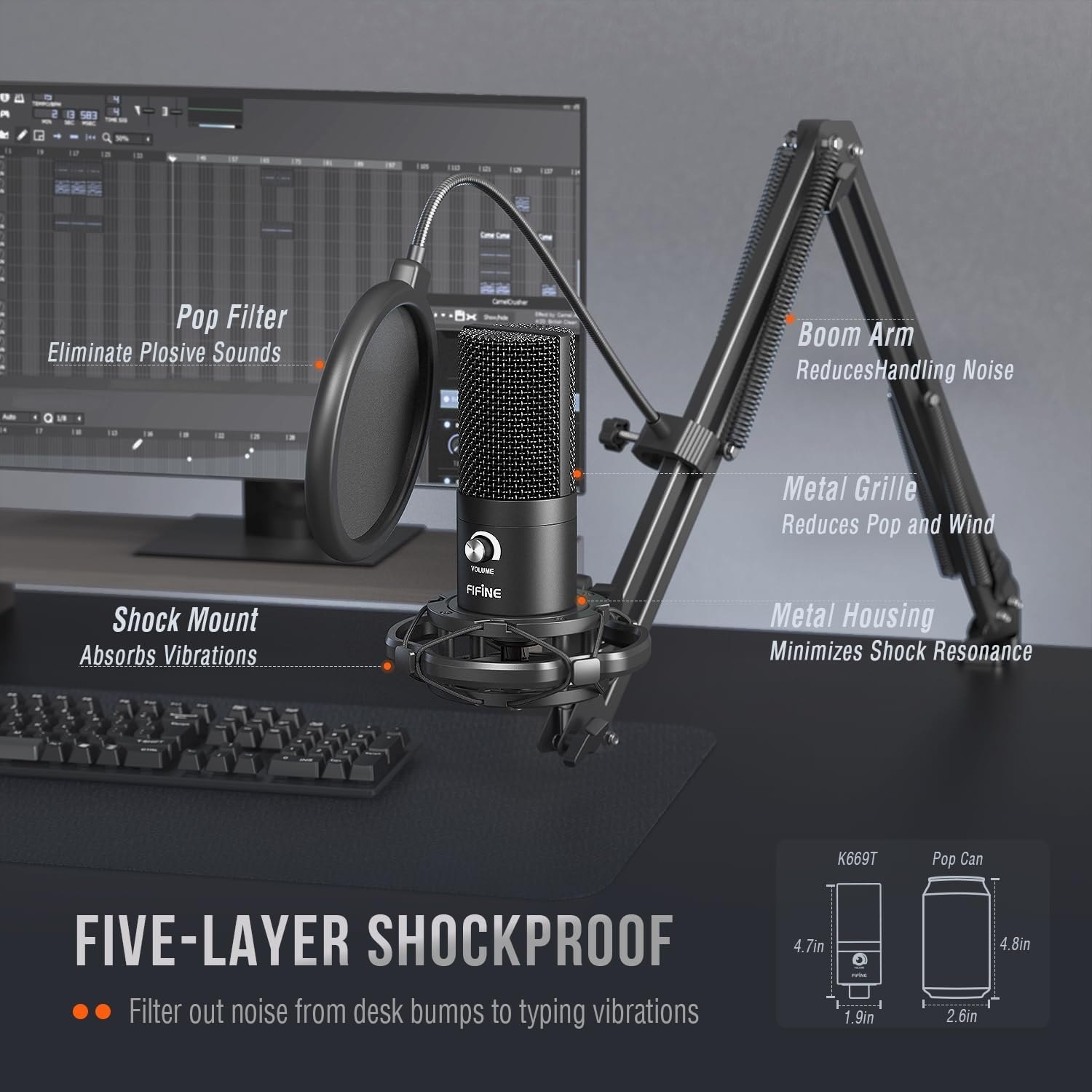
The mic itself is a side-address condenser in a shock mount, with a gain knob on the body. That gain knob is a genuinely useful inclusion at this price: being able to pull the level down with a thumb when you get loud is faster than hunting through operating system sound settings mid-recording. The double pop filter adds two layers of air dissipation in front of the capsule, which should take the edge off plosives without needing a separate foam windscreen.
What the specs tell us
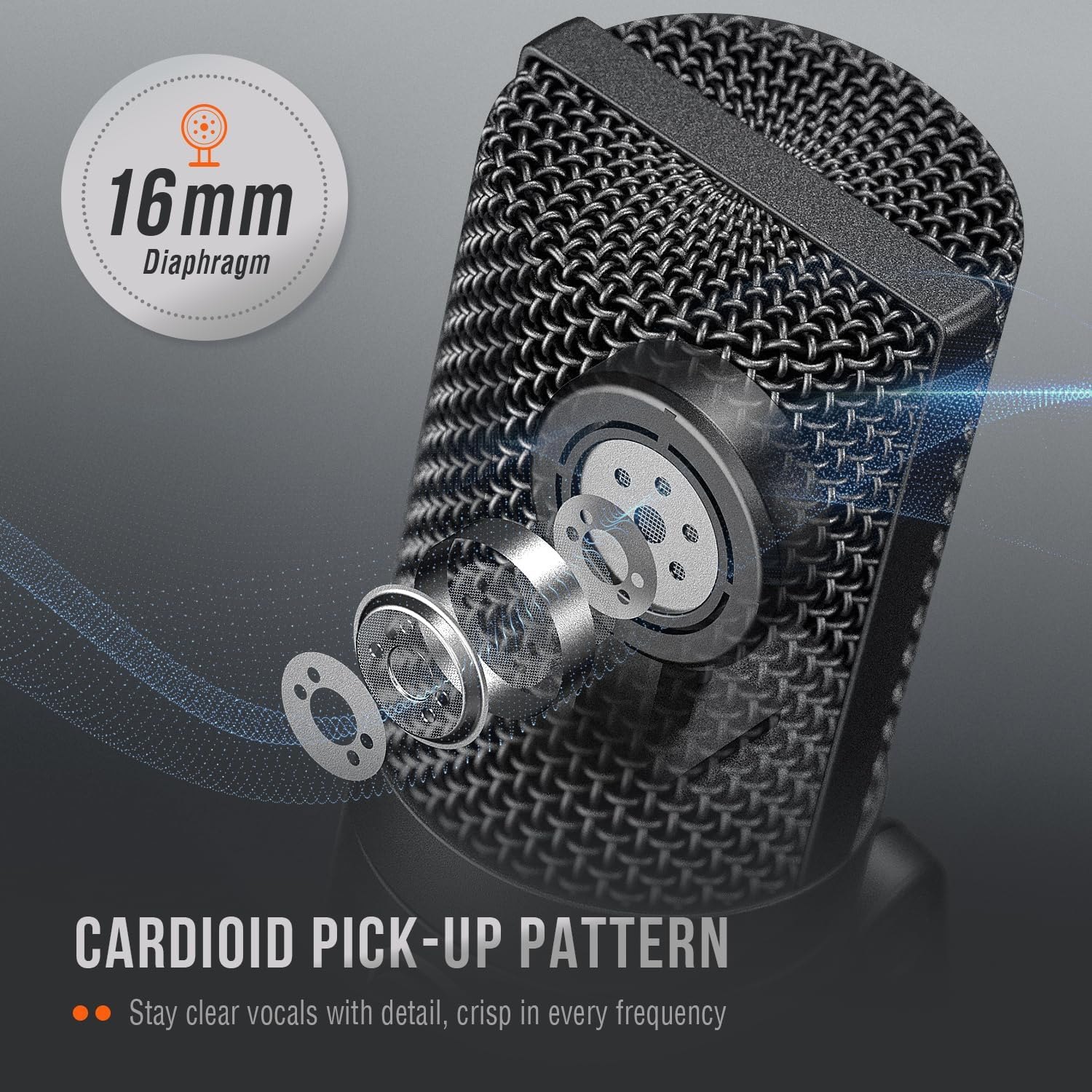
The headline figures are a 20Hz to 20KHz frequency range, a unidirectional cardioid pattern, one channel, and a 78 dB signal-to-noise ratio. The frequency range is the full audible band and is quoted by nearly every microphone sold, so treat it as a formality rather than a differentiator. The cardioid pattern is the number that actually affects your recordings: it picks up from the front and rejects what is behind it, which is why a mic like this sounds better in an untreated room than an omnidirectional one.
The 78 dB signal-to-noise ratio is the honest weak spot on paper. More expensive USB condensers typically quote the mid-80s or better, and a lower figure means a higher noise floor relative to your voice. For spoken-word podcasting at a normal distance it should be a non-issue, especially if you apply a light noise gate in your editor. For very quiet sources, whispered ASMR or anything where you push gain hard in post, that floor becomes audible.
The omission worth noting is a headphone jack. There is no monitoring output in the specification, so you cannot hear yourself with zero latency through the mic. You monitor through the computer instead, which usually means a small delay that some people find distracting while speaking.
Living with it
Setup should be the easiest part. USB plug-and-play with no drivers means the mic should show up as an input device within seconds on Windows or macOS, and the cable shipping with both USB-A and USB-C ends removes the dongle problem for modern laptops. Buyers rate the product 4.6 out of 5 across a very large number of ratings, which suggests the basics hold up over time for most people.
The day-to-day work is positioning. Condensers are sensitive, and a cardioid capsule only rejects what is directly behind it, so mechanical keyboards, desk thumps and a nearby fan will still get through if they are in front of the capsule. The shock mount handles vibration traveling up the arm; it does not handle airborne noise. Expect to spend your first session finding the distance and angle where your voice is full without the room creeping in.
The other recurring chore with kits like this is cable management. A 30-inch reach arm with 8.2ft of cable moving around a desk will tangle unless you route it along the arm with the supplied clips or your own ties.
Value for money
At $52.99 at the time of writing, the accessories alone roughly justify the price. A steel boom arm typically runs $20 to $30 on its own, and a shock mount and pop filter add more. Viewed that way, the microphone is close to free, which is a reasonable way to think about what you are getting: competent, not remarkable, audio wrapped in genuinely useful hardware.
Prices on bundles like this move downward during sale periods rather than upward, so if you are not in a hurry it is worth watching. What does not change is the ceiling. This is a mic you buy to sound clearly better than a headset, not to sound like a broadcast studio.
Alternatives
The Blue Yeti is the default comparison and usually costs noticeably more. Pick it if you want multiple polar patterns for interviews or room recording and onboard headphone monitoring, and if you do not mind buying an arm separately.
The Audio-Technica ATR2100x-USB is the one to choose if you want a path forward: it is a dynamic mic with both USB and XLR outputs, so it rejects room noise better and can move into an interface-based setup later.
The Samson Q2U occupies similar ground as a dual USB and XLR dynamic at a comparable budget, and it is the better pick if you are recording in a noisy or echoey room where a condenser would pick up too much.
The bottom line
The T669 succeeds because of what is in the box rather than what is on the spec sheet. For someone starting a podcast or stream this week, getting a working arm-mounted setup for one modest payment removes more friction than an extra few decibels of signal-to-noise would add. Just go in knowing that the lack of headphone monitoring and the USB-only connection are limits you grow into, not around.
.gap-review{margin:2.5rem 0 0}.gap-review h2{font-size:1.5rem;margin:0 0 1.25rem}.gap-verdict{background:#0E1A2B;color:#fff;border-radius:16px;padding:1.5rem 1.75rem}.gap-verdict__head{display:flex;gap:1.25rem;align-items:center}.gap-score{margin:0;width:84px;height:84px;border-radius:50%;background:#FF5A1F;color:#fff;display:flex;flex-direction:column;align-items:center;justify-content:center;font-weight:800;font-size:1.9rem;line-height:1}.gap-score small{font-size:.7rem;font-weight:600;opacity:.85}.gap-eyebrow{margin:0 0 .35rem;text-transform:uppercase;letter-spacing:.08em;font-size:.75rem;font-weight:700;color:#FF5A1F}.gap-verdict__line{margin:0;font-size:1.125rem;line-height:1.45}.gap-proscons{display:grid;grid-template-columns:1fr 1fr;gap:1.25rem 2rem;margin-top:1.5rem;padding-top:1.25rem;border-top:1px solid rgba(255,255,255,.15)}.gap-proscons h3{margin:0 0 .6rem;font-size:.9rem;text-transform:uppercase;letter-spacing:.05em;color:inherit}.gap-proscons ul{list-style:none;margin:0;padding:0}.gap-proscons li{position:relative;padding-left:1.6em;margin:0 0 .45em}.gap-proscons li::before{position:absolute;left:0;top:0;font-weight:800}.gap-pros li::before{content:’+’;color:#4ADE80}.gap-cons li::before{content:’2013′;color:#F87171}.gap-specs,.gap-faq{margin-top:2rem}.gap-specs h3,.gap-faq h3{font-size:1.2rem;margin:0 0 .75rem}.gap-specs table{width:100%;border-collapse:collapse;font-size:.95rem}.gap-specs th,.gap-specs td{text-align:left;padding:.65rem .9rem;border-bottom:1px solid #E2E8F0;vertical-align:top}.gap-specs th{width:38%;background:#F4F6F9}.gap-faq details{border:1px solid #E2E8F0;border-radius:10px;padding:0 1rem;margin:0 0 .6rem}.gap-faq summary{cursor:pointer;padding:.85rem 0;font-weight:600}.gap-cta{margin-top:2rem;padding:1.25rem 1.5rem;background:#F4F6F9;border-radius:16px;display:flex;flex-wrap:wrap;gap:.75rem;align-items:center}.gap-btn{display:inline-block;padding:.85em 1.5em;border-radius:10px;font-weight:600;text-decoration:none!important;background:#FF5A1F;color:#fff!important}.gap-btn–secondary{background:transparent;color:#0E1A2B!important;border:2px solid #E2E8F0}.gap-disclosure,.gap-note{font-size:.875rem;color:#4A5568;margin:.75rem 0 0}@media(max-width:640px){.gap-proscons{grid-template-columns:1fr}}
FIFINE T669 USB Condenser Microphone Kit review
7.6/10
madagear.com verdict
Buy it if you want a complete desk audio setup for one low price; skip it if you need XLR flexibility, onboard headphone monitoring or broadcast-grade noise rejection.
What we like
- Full kit: mic, steel boom arm, shock mount and double pop filter included
- Plug-and-play USB with no drivers or audio interface needed
- Cardioid pattern helps keep room noise out of voice recordings
- Onboard gain knob lets you set level without diving into software
- Detachable 8.2ft cable with both USB-A and USB-C ends
- C-clamp plus detachable desktop mount covers most desk types
What we don’t
- No headphone jack for zero-latency monitoring of your own voice
- 78 dB signal-to-noise ratio is modest for quiet recording rooms
- Not compatible with Xbox, so console coverage is PS4/PS5 only
- USB-only means no path to an XLR interface later
Specs at a glance
| Brand | FIFINE |
|---|---|
| Model | T669 Black |
| Acoustic principle | Condenser |
| Polar pattern | Unidirectional (cardioid) |
| Connectivity | USB Type-A, USB Type-C |
| Frequency range | 20Hz-20KHz |
| Signal-to-noise ratio | 78 dB |
| Channels | 1 |
| Form factor | Microphone with boom arm |
| Compatible devices | Laptop/Desktop, PC, PS4/PS5 |
| Cable | 8.2ft detachable USB-B to USB-A/C |
| Price at time of writing | $52.99 |
Frequently asked questions
Does it work with Xbox?
No. The listing specifically states the microphone is incompatible with Xbox. Listed hardware support covers laptops, desktop PCs and PS4/PS5.
Do I need an audio interface or phantom power?
No. It is a USB condenser, so the USB connection supplies power and handles conversion in one cable. You plug it into a computer and it appears as an input device without extra drivers.
Can I hear myself while recording?
Not through the microphone itself, since there is no headphone output listed. You would need to monitor through your computer’s output, which usually adds a small amount of latency depending on your software and drivers.
Will the boom arm clamp to my desk?
The arm uses a combo mount with a C-clamp plus a detachable desktop mount, and the listing quotes a 13-inch fixed horizontal section with a 30-inch reach. Thick desktops, very thin glass tops or desks with a lip can still be awkward for C-clamps, so measure before ordering.
At the time of writing it is $52.99 for the mic plus the steel scissor arm, shock mount, double pop filter and an 8.2ft detachable USB-B to USB-A/C cable, and kits like this tend to drift down during seasonal sales rather than up. Price and availability checked on 2026-11-14.
madagear.com is reader-supported. When you buy through links on our site we may earn an affiliate commission, at no extra cost to you. This never affects what we recommend.

Reviews
There are no reviews yet.